Wellbrock's Deliberate Narration Keeps Distinctions From Blurring
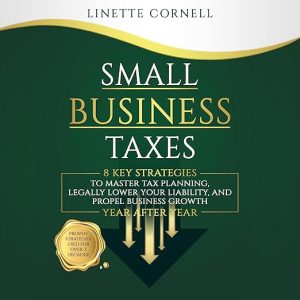
Small business tax confusion tends to concentrate around the same recurring uncertainties: what expenses qualify as deductions, whether the business structure is right for the owner's situation, and how to avoid the catastrophic surprise of a large tax bill that proper planning could have reduced. Linette Cornell's Small Business Taxes audiobook, narrated by Teri Wellbrock and running four hours and sixteen minutes, attacks all three of those concerns in sequence. The guide comes with an accompanying PDF available in the Audible library, which matters for a subject where tables, rates, and forms are part of the practical vocabulary. That combination of audio explanation and reference document makes this a more complete resource than audio-only tax guides that ask listeners to hold numerical details in working memory.
Small business owners who reviewed this guide were consistent on one point: the language is clear without being vague, which is a genuine achievement for tax content. The difference between self-employment taxes and corporate income taxes, between wages paid by the company and profit distributed as dividends, between year-round tax planning and year-end scrambling, are distinctions that require precise explanation to be useful. Cornell makes them clearly, and Wellbrock narrates with enough deliberateness that the differences register rather than blur together during the listening session.
Practical Questions Come Before Regulatory Answers
The structural approach distinguishes this guide from generic small business finance books. Cornell organizes the content around decision points rather than tax code sections, which is how small business owners actually encounter tax questions. When you are deciding how to classify an expense, or choosing between a sole proprietorship and an S corporation, or determining whether to pay yourself a salary or a distribution, the question is practical first and regulatory second. Cornell addresses the practical dimension, then explains the regulatory reason behind it, which inverts the structure most tax books use and makes the material considerably more applicable to real decisions.
The deduction maximization sections are the most immediately useful for most listeners. Cornell covers business expense classification with enough specificity to be actionable, including common misclassifications that trigger IRS scrutiny and strategies for documenting mixed-use expenses accurately. The material on estimated tax payments and cash flow management addresses the timing dimension that many small business owners underestimate: the IRS expects quarterly payments, and owners who think of taxes as an annual obligation rather than a quarterly one often face penalties that proper planning would have avoided entirely. Understanding that distinction alone can save a first-year business owner from an expensive surprise.
The audit preparedness section and the guidance on when to hire a tax professional round out the practical toolkit. One reviewer who owns two small businesses called this a resource they will return to for years, and that durability assessment reflects how the guide is structured: it is built for reference as well as initial listening, and the accompanying PDF supports that use case directly. The guide's rating of 4.9 from forty-six reviewers is among the higher averages in this category of business audiobooks, and it holds up to the expectation that rating creates.
Complex Structures Need More Than This Overview
At four hours and sixteen minutes, this audiobook covers its subject efficiently, which means some areas receive overview treatment rather than deep technical analysis. Business owners with complex structures, multiple revenue streams, or significant international income will find the guide addresses their situation at the level of principles and decision frameworks rather than specific compliance procedures. The material is most complete for sole proprietors, single-member LLCs, S corporations, and small partnerships; more complex entities will likely need specialized professional advice beyond what the audiobook covers.
Tax law changes regularly, and audiobooks by nature become dated faster than digital resources. Cornell's guide addresses the legal landscape as of its publication date, and while the foundational principles of expense classification, entity structure, and tax planning strategy remain stable, specific rates, thresholds, and form references should be verified against current IRS guidance. The accompanying PDF is useful for reference, but listeners should cross-check any specific figures they intend to act on with current IRS publications or a tax professional.
Moving Owners From Reactive to Strategic Habits
This audiobook is designed for small business owners who have been managing their taxes reactively and want to shift to a more strategic approach. The material is accessible to owners with no accounting background, and the language calibration that multiple reviewers praised means first-time listeners will not need a financial dictionary. Owners who are choosing between business structures, building their first deduction strategy, or trying to understand what triggers an audit will find specific, actionable answers organized in a way that makes the connections between decisions clear.
Experienced accountants or tax professionals will find the content too foundational for their needs. The guide is intentionally written for the business owner rather than the advisor, and that positioning is appropriate given that most people who listen to a book called Small Business Taxes are trying to understand their own situation, not prepare to advise someone else's. Wellbrock's narration keeps the four-hour experience genuinely listenable, which for a subject that can become dry very quickly is a contribution worth noting. Owners who listen once as an orientation and then return to specific chapters before quarterly estimated tax deadlines will get more out of this resource than those who treat it as a single-session consumption and move on.
In Brief
- Narrator: Teri Wellbrock brings a composed and clear delivery to Linette Cornell's tax guide; the narration stays conversational enough to keep dense regulatory content from becoming a slog across four hours.
- Subjects: Tax liability minimization, small business structures, year-round planning strategy
- Tone: Practical and empowering, with the calm confidence of someone who has sorted out the complexity ahead of you
- Bottom line: Cornell's Small Business Taxes audiobook is one of the more practically organized tax guides in audio, covering deductions, business structure, audit preparedness, and technology tools without drowning listeners in IRS jargon.
Questions Listeners Ask
Does the Small Business Taxes audiobook cover S corporation election and its tax implications?
Yes, the guide addresses how different business structures affect tax treatment, including the difference between paying yourself wages versus taking profit distributions, which is central to the S corporation decision. It provides enough framework to understand the strategic considerations, though specific election decisions should involve a tax professional.
Is there an audiobook companion document, and is it included with the purchase?
Yes, the product notes indicate that a PDF companion is available in your Audible library when you purchase this title. For a tax guide, that resource is meaningful: tables, forms, and rate schedules are easier to reference in a document than to absorb through audio alone.
How current is the tax information in this audiobook?
The guide reflects the tax code as of its publication date. Foundational principles around deductions, business structures, and quarterly estimated tax strategy remain stable, but specific rates, thresholds, and form numbers change with legislation. Cross-referencing current IRS guidance before acting on specific figures is always recommended.
Does narrator Teri Wellbrock make the tax content easier to follow over four hours?
Meaningfully yes. Wellbrock's delivery is conversational and clear rather than recitative, which keeps the denser regulatory sections from becoming monotonous. For a subject that could easily tip into dry recitation, the narration stays accessible throughout the four-hour runtime.