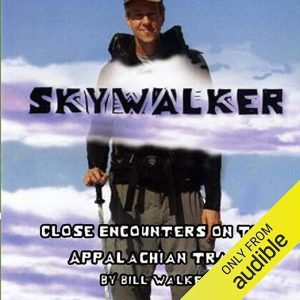
Bill Walker's Skywalker delivers something the Appalachian Trail memoir genre actually needs more of: a first-hand account by someone who was, by any reasonable measure, unprepared. Walker, a former commodities trader from Chicago and London, had never spent a night outdoors before he set off from Georgia in the spring of 2005, intent on completing all 2,175 miles to Mount Katahdin in Maine. This audiobook is not a story of a lifelong outdoorsman finding himself on a familiar landscape. It is the story of someone plunging into a world he did not understand and documenting the results with more honesty than flattery.
Walker self-narrates, which is the right call for a book this personal. His delivery is measured and occasionally clipped, consistent with a former trader who processes information efficiently but doesn't always linger on the emotional register. When the prose turns self-deprecating, which it does frequently, the narration matches the tone well. There are moments where a more experienced audiobook narrator might have drawn out the humor, but Walker's restraint actually suits the subject. The trail rewards people who keep moving, and his narration has that quality.
The Verdict, Briefly
The trail name "Skywalker," which Walker earned from his 6-foot-11 frame, gives the book its structure and its central irony. He was visually impossible to miss on a trail where invisibility to bears was not exactly optional. His height made him more susceptible to weight loss and cold, and his lack of wilderness experience meant that fears most seasoned hikers have long ago calibrated were, for him, live and constant. Snakes. Bears. Getting genuinely lost. Walker doesn't dismiss these fears to seem tough. He documents them because they were real, and that honesty is the book's most valuable quality.
The writing style, as one reviewer noted, can run brief at times, packing six months of experience into a book that has to move quickly to cover the ground. That compression is sometimes a strength and sometimes a limitation. Certain stretches of trail pass too quickly to leave a strong impression, while others, particularly the sections involving weather extremes and physical breakdown, are given the space they need. The result is a trail journal that reads more like a shaped narrative than a pure diary, with Walker exercising editorial judgment about what earns attention.
One of the stronger sections of this audiobook is its history of the Appalachian Trail itself. Walker weaves in the institutional story of how the trail became a public-private partnership drawing up to 4 million visitors a year, and that context enriches rather than interrupts the personal narrative. For listeners who want to understand the trail's culture, including the naming conventions, the shelter system, the social dynamics among thru-hikers, and the folklore of the trail, Walker covers it with genuine affection. He was clearly struck by the richness of what he had stepped into, and that sense of discovery carries through the writing.
The self-narration works especially well in these passages because Walker's enthusiasm for the subject comes through without needing to be performed. He found something on the trail that surprised him, and even with a delivery style that runs toward the understated, that surprise is audible. At 7 hours and 15 minutes, the runtime is substantial enough to follow the full arc of the journey without feeling padded, and the pacing reflects the actual rhythm of long-distance hiking, stretches of grinding effort broken by something unexpected and memorable.
Before You Commit to Skywalker
The humor in this audiobook rewards patient listening. Walker's self-deprecating observations tend to arrive a beat after the situation that prompted them, which mirrors the way absurdity actually registers when you are too exhausted to respond in real time. His descriptions of his interactions with other thru-hikers are particularly sharp, and the trail-name culture gives the book a cast of characters who feel distinct even when they appear only briefly. Some have joked, as one reviewer noted, that the book is as much about what not to do as what to do. Walker himself endorses that reading, and it makes the book genuinely useful for anyone considering a long-distance hike.
The sections involving Walker's elemental fears, particularly the bear encounters and the moments of navigational uncertainty, are rendered with enough specific detail to feel real rather than dramatized. He does not heroize himself in these moments, which is exactly the right approach for a book that trades on candor as its primary asset.
Who Will Get the Most From It
This audiobook will resonate most with listeners who are interested in the Appalachian Trail specifically, whether they are planning a hike, have completed one, or simply follow the genre with curiosity. It holds up alongside more polished AT memoirs precisely because it offers a perspective the others rarely provide: the genuinely uninitiated outsider. Readers of Bill Bryson's A Walk in the Woods will recognize the self-deprecating outdoor-incompetent narrator type, though Walker's account is less comic and more earnest.
Those looking for lyrical nature writing or deep philosophical reflection will find the book lean in those directions. Walker's strengths are observation and honesty rather than prose elegance. But for anyone who wants to understand what it actually feels like to attempt something wildly outside your experience and keep going anyway, Skywalker delivers that faithfully. It is a record of genuine effort, which matters more than polished prose when the subject is a 2,175-mile trail that doesn't care about either. Walker earned his trail name on terrain that didn't accommodate his frame, and that mismatch is what makes this account memorable.
A Few Questions About Skywalker
Does Bill Walker's self-narration add or detract from the Skywalker audiobook experience?
His self-narration adds an authenticity that suits the material. The delivery is measured rather than performative, which works for a book built on candor. Listeners who prefer more polished audiobook narrators may find it plain, but it fits Walker's voice on the page.
At over seven hours, does the Skywalker audiobook maintain momentum throughout or are there slow stretches?
There are stretches where the pace mirrors the grinding monotony of the trail itself, which some listeners will find authentic and others will find slow. The book picks up significantly during weather events, physical crisis points, and the history sections, all of which are well-paced.