Quick Take
- Narration: Matthew Spencer handles Remy’s sardonic narrator voice with consistent energy, sustaining the banter that reviewers identified as the book’s most reliable pleasure.
- Themes: loyalty and its costs, the politics of monstrosity, desire for people who should be enemies
- Mood: Dense with court intrigue and gore, occasionally confusing, shot through with banter that keeps the reading moving
- Verdict: A compelling queer vampire fantasy for readers who want court politics and a bisexual throuple with genuine stakes, though the pacing requires patience.
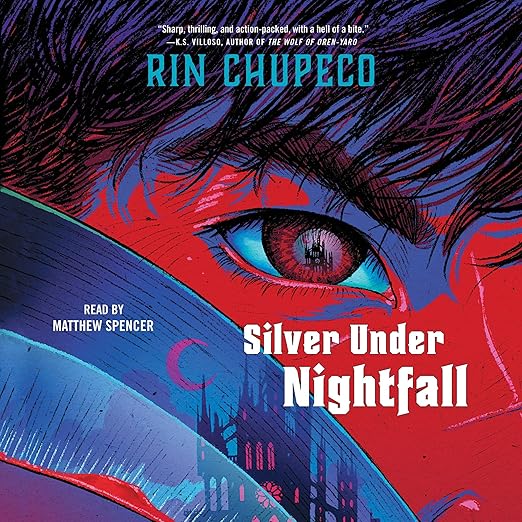
I have a complicated relationship with vampire fiction. I find the genre at its best when it uses the undead as a genuine lens for thinking about power, belonging, and desire rather than as aesthetic backdrop, and at its worst when the fangs are merely decorative. Rin Chupeco’s Silver Under Nightfall is firmly in the first category, though it is also, as one reviewer noted, genuinely confusing in places, and the marketing does not quite prepare you for what kind of book it actually is.
Remy Pendergast is the son of a duke, an elite vampire bounty hunter called a Reaper, and the subject of persistent rumors that he is himself part vampire, given that his mother eloped with one. He is barely tolerated by the kingdom he serves, which makes his usefulness to them all the more interesting as a power dynamic. When a terrifying new breed of vampire, carrying a mutating virus called the Rot, appears outside the city, Remy’s investigation brings him into contact with vampire heiress Xiaodan Song and her fiance, the vampire lord Zidan Malekh. They want to work together. Remy is certain this is a mistake. He is wrong, and then he develops complicated feelings about being wrong.
Our Take on Silver Under Nightfall
The comparison to Castlevania in the marketing is not casual. The aesthetic, the warring vampire courts, the gothic political machinery, the gore, and the genuinely dark mythology of the Rot all share DNA with that animated series. So does the banter, which one reviewer described as incredible and which is in fact the book’s most consistent pleasure. Remy is a sarcastic narrator in the best sense: his observations about his own situation are funnier for being accurate, and his developing affection for both Xiaodan and Zidan is traceable through the changes in how he talks about them.
The bisexual throuple at the center of the book is handled with more seriousness than the term throuple might suggest. Remy’s feelings for both Xiaodan and Zidan are complicated and genuine, and the book does not reduce the configuration to titillation. That said, one reviewer noted that the library catalog described this as a romance when it is more accurately a love-friendship with romantic elements, which is a meaningful distinction for readers who arrive with specific expectations about genre.
Why Listen to Silver Under Nightfall
Matthew Spencer narrates, and at nearly nineteen hours he has to sustain a lot of tonal ground. The Bridgerton-meets-Castlevania description that one reviewer offered is accurate in the sense that the book moves between political scheming, genuine horror, and romantic comedy sometimes within the same chapter. Spencer handles those shifts with competence, keeping Remy’s voice consistent even when the material around him is lurching between registers.
The world Chupeco builds is dense, and the density is not always fully resolved by the close of book one. Some threads are left deliberately open as series setup; others are confusing in ways that may or may not be intentional. Reviewers who found the book confusing were not wrong, and listeners who need their fantasy logic airtight at all times will find Silver Under Nightfall frustrating. Readers who can ride the ambiguity while the picture assembles will find a world that rewards continued attention.
What to Watch For in Silver Under Nightfall
The slow burn is slow across all dimensions, not just the romance. The plot moves deliberately, the vampire politics accumulate gradually, and the Rot mythology takes its time revealing its full shape. Reviewers who described this as not working in a good way were specifically responding to the undifferentiated slowness, where even the most potentially exciting sequences fail to accelerate. The banter prevents the pacing from becoming genuinely stalling, but listeners who need sustained momentum should know what they are walking into at nineteen hours.
The sex scenes are more prominent than the love story framing suggests, which surprised at least one reviewer who arrived through a library romance catalog. This is adult fantasy fiction with explicit content, not a YA adventure with vampires. The marketing sometimes blurs this, and it is worth being clear about before you start.
Who Should Listen to Silver Under Nightfall
This is for readers who loved the Castlevania animated series and want something with a similar aesthetic in prose form, for fans of The Priory of the Orange Tree who want their vampire fiction with queer romance and political depth, and for listeners who specifically want a bisexual male protagonist navigating a complex emotional entanglement with two people who should, by every political logic of their world, be his enemies. Skip it if pacing consistency is essential to your enjoyment, if you need your fantasy world logic to be fully coherent by book’s end, or if you want the romance to be the dominant structural element rather than one thread in a denser weave.
Frequently Asked Questions
Is Silver Under Nightfall actually a romance, or is the love story secondary to the political plot?
Primarily secondary. The marketing leans into the romantic elements, but the book is structured as a fantasy epic with court intrigue and horror at its center. The love story, specifically Remy’s developing feelings for both Xiaodan and Zidan, is a significant thread but not the primary organizing principle. Readers who arrive expecting genre romance pacing will be surprised.
How confusing does the world-building actually get? Is this something a careful listener can follow?
It depends on your tolerance for ambiguity during the reading experience. The world-building accumulates rather than being presented cleanly upfront, and some elements remain unresolved by book’s end. Careful listeners who are comfortable with information arriving slowly and not always resolving cleanly will manage. Those who need clean exposition will struggle at points.
Matthew Spencer narrates a substantial catalog of fantasy fiction. How does his performance handle the banter specifically?
Well. Remy’s sardonic internal voice is the book’s most consistent pleasure and Spencer sustains it effectively. The shift from combat and horror sequences to dry social observation is handled without jarring transitions, which matters for a book that moves between those registers frequently.
Does the bisexual throuple dynamic feel equal or does the story favor one pairing over the others?
The book gives genuine attention to both pairings, the Remy-Xiaodan dynamic and the Remy-Zidan dynamic, and the most interesting moments are those where all three are in the same room and the politics of the configuration become visible. Neither external pairing is treated as the real one while the other waits. This is one of the book’s genuine achievements.