Key Details
- Voice: Mark Boyett brings the military SF ensemble to life across 75+ hours with the consistency and command presence the Ixan saga demands.
- Big ideas: Species survival, prophecy versus agency, the evolution of warfare across generations
- Atmosphere: Fast-moving and expansive, with escalating stakes across three distinct arcs
- Worth it?: An enormous value proposition for military SF listeners who want a fully realized multi-arc saga in a single committed listen.
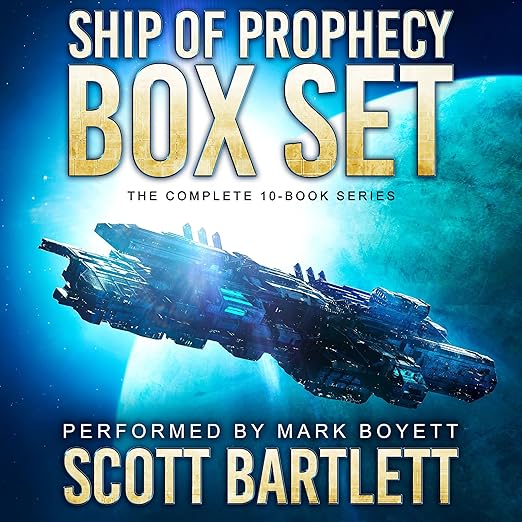
Scott Bartlett's Ship of Prophecy Box Set arrives as a single audiobook package spanning seventy-five hours and twenty-nine minutes: ten novels, three connected series arcs, and one continuously escalating story about humanity's place in a galaxy that has decided we might not deserve to stay. Mark Boyett narrates the complete Ixan saga, which accumulated tens of thousands of ratings across its individual volumes, and the box set format offers something the separate releases could not: the momentum of reading through three distinct narrative phases without the friction of acquisition between volumes.
The ten books divide across three interconnected series. The Ixan Prophecies covers Supercarrier, Juggernaut, and Reckoning. Mech Wars covers Powered, Dynamo, Meltdown, and Infliction. Ixan Legacy closes with Capital Starship, Pride of the Fleet, and Dogs of War. The entry point is Captain Keyes: a commander whose ship is on the verge of being decommissioned when the galaxy decides, with characteristic poor timing, that he is the only thing standing between humanity and an alien prophecy predicting our species' end. Bartlett's handling of that initial premise carries a dry comic register that distinguishes it from grimmer military SF, though the series does not stay light.
Where This One Lands
Reviewer T Turner's assessment that the Ixan Prophecies portion is thoroughly re-readable captures a quality that matters in a box set, because the early novels carry significant weight from accumulated context. The Mech Wars section represents a tonal shift: where the Prophecies arc operates at the starship command level, the Mech trilogy brings the scale down to individual combatants and the mechanical augmentation of warfare. Bartlett uses that shift deliberately, introducing new characters and conflicts that expand the universe's political and ethical complexity before the Ixan Legacy arc draws the threads together.
Reviewer anomdragon notes the progression and evolution of the various people, races, and governments involved as a consistent source of interest, and that is accurate. Bartlett is not satisfied with a static power structure. The political landscape of the Ixan universe changes across the ten books in ways that feel earned rather than arbitrary, and the consequences of earlier conflicts carry forward with fidelity. For listeners who find that military SF often sacrifices world coherence for pacing, this series functions as a corrective.
Mark Boyett is an experienced narrator in military SF and space opera, and across seventy-five hours he maintains the stamina and character distinction that a saga of this scope requires. The ensemble cast grows considerably across the three arcs, and Boyett's ability to keep secondary characters identifiable without letting them blur into the primary cast is one of the audiobook's consistent technical achievements. His pacing suits the material: fast enough for the action sequences, measured enough for the political and philosophical passages that Bartlett uses to give the saga its weight.
The value proposition of the box set format deserves direct acknowledgment. Ten novels at a single purchase point, narrated by a single narrator with consistent production quality, represents a significant listening commitment and a correspondingly significant return on that commitment. For listeners who have already read portions of the saga in print or as individual audio releases, the full arc listened to sequentially reveals connective tissue that is easy to miss when months or years separate individual volumes.
Weak Spots in Ship of Prophecy Box Set: The Complete 10-Book Series
Reviewer Ray S H's description of the protagonist's resilience as a recurring structural feature is accurate: Keyes and the central characters survive situations that would be fatal under more rigorous probability. Military SF readers accustomed to grimdark stakes may find this optimistic survivability a friction point; listeners who prefer heroes who demonstrably cannot be stopped will find it a feature. The tone shifts between the three arcs, with the Mech Wars section being the most kinetically focused and the Ixan Legacy arc returning to the broader political canvas of the opening trilogy.
At over three days of listening time, this is a significant audio commitment, and the early volumes are the most essential for establishing emotional investment. Listeners who find the first two Ixan Prophecies books compelling should proceed with confidence; those who feel neutral about the setup after the first novel may find the investment challenging to sustain across the full seventy-five hours. The series rewards patience and sequential commitment more than it rewards dipping in and out.
The alien prophecy at the center of the saga is handled with more sophistication than the premise initially suggests. Bartlett does not treat prophecy as a fixed rail along which the narrative has to travel; he uses the Ixan prediction as a lens through which different characters understand their own agency and responsibilities differently. Captain Keyes's relationship to the prophecy evolves considerably across the three arcs, from something he is reluctant to take seriously to something he cannot escape, and that evolution is one of the saga's quieter but more durable character arcs.
Recommended For
Military SF readers who have worked through Marko Kloos's Frontlines series or Craig Alanson's Expeditionary Force and want a comparable long-arc commitment will find Bartlett's saga a satisfying alternative. The box set format particularly suits listeners who dislike waiting between volumes and want the satisfaction of a complete story in a single library acquisition. Those new to military SF will find the accessible premise and dry humor of the opening arc a reasonable entry point into the genre. Readers who require high stakes for character survival and want grimdark probability in their fiction may find the tone lighter than they prefer, but those who want expansive universe-building with escalating multi-arc consequence will find exactly what they are looking for here.