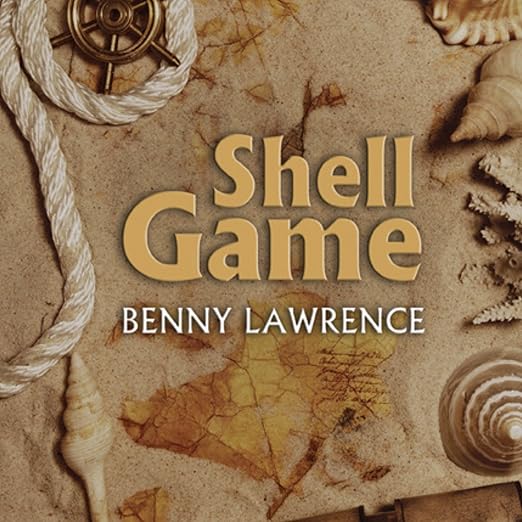
Quick Take
- Narration: Em Grosland delivers the comedy with expert timing, making the verbal sparring between Lynn and Darren the best reason to listen rather than read.
- Themes: Power and disguise, sapphic romance, survival and reinvention
- Mood: Rollicking and witty with genuine tension underneath
- Verdict: The sharpest, most enjoyable entry in the sapphic pirate canon, driven entirely by two characters who can barely stand to admit they need each other.
I finished Shell Game on a Sunday afternoon with a cup of tea that went cold because I kept not putting it down. Benny Lawrence writes comedy that is structurally sound rather than pasted on: the wit in Shell Game emerges from situation and character rather than from jokes inserted at intervals. By the time the marmalade became a plot point, I had fully accepted the book’s particular logic, and that is a harder thing to pull off than it sounds.
The premise is deceptive in its absurdity. Village girl Lynn is so desperate to escape her civil-war-ravaged fishing village that when pirate queen Darren arrives to kidnap someone, Lynn arranges to be that someone. Darren is not quite the ruthless terror her reputation suggests. Lynn is not quite the helpless victim her position implies. What follows is a ten-hour negotiation of who these two women actually are and whether either of them will admit what they want.
Our Take on Shell Game
The sparring between Lynn and Darren is the engine of everything. Readers have consistently described it as the book’s standout quality, and the narration is where this quality either lives or dies. Em Grosland has the comedic instincts to make the dialogue crackle: the rhythm, the pause before the comeback, the shift in register when the banter turns into something that actually costs a character something. Lawrence’s prose has a dry precision that rewards a skilled reader, and Grosland delivers it.
The supporting cast is built for contrast and function. The bounty hunters with no sense of humor are exactly that, played entirely straight. The old girlfriends arrive with specific weights of history. The crew of the Badger feel lived-in rather than assembled. Lawrence understands that a good ensemble doesn’t just provide plot obstacles; it reveals character by putting the leads in different relational contexts. We learn who Darren is partly from how her crew treats her.
Why Listen to Shell Game
One reviewer who came to this skeptical of the pirate-queen premise described reading it in two days. That pace is available in audio form too, because the book does not have slack. The mystery of who both women are beneath their assumed roles unfolds at a rate that keeps the listener invested without feeling rushed. The adventure is genuinely adventurous, not just a backdrop for romance, which means the stakes feel real when they arrive.
What to Watch For in Shell Game
One reader noted that the book took a while to get going, which is worth flagging. The opening chapters establish tone and character more than momentum, and listeners expecting immediate action may need to settle into the pace. By the midpoint, that patience is well rewarded. The mystery elements, including the question of Lynn’s true background, are less opaque than they might appear: several reviewers solved certain reveals early. The pleasure is not primarily in the surprise but in watching the characters navigate what has been in front of them all along.
The book’s treatment of power dynamics between Lynn and Darren deserves particular attention. What reads on the surface as a kidnapping-and-captivity premise is almost immediately revealed as something far more complicated, and the question of who actually holds the power in this arrangement shifts constantly throughout the narrative. Lawrence is not interested in simple dominant-submissive structures: both women are operating multiple layers of strategy simultaneously, and the reader gets the pleasure of watching those layers slowly become visible to the characters themselves.
Who Should Listen to Shell Game
Listeners drawn to sapphic fiction with actual stakes, not just romance orbiting around gender, will find Shell Game refreshingly committed to its world. Fans of witty banter as a primary vehicle for romantic tension should put this at the top of their queue. Readers who prefer their pirate stories to take themselves seriously may find the comedic register a mismatch, though Lawrence never sacrifices the genuine emotional weight that makes the ending land. Those unfamiliar with the sapphic pirate subgenre, yes, it exists and is more developed than you might expect, will find this an excellent entry point.
Frequently Asked Questions
Is Shell Game the first book in a series or a standalone?
Shell Game is a standalone novel. There are companion books set in the same world by Benny Lawrence, but this story resolves completely and does not require reading others in sequence.
How does Em Grosland handle the comedic and dramatic registers as they shift?
Very capably. Grosland’s timing on the banter is the production’s strongest asset. The emotional pivots in the latter half are handled with equal care, making the tonal shifts feel earned rather than abrupt.
Is the romance central to the plot or more of a subplot?
The romance is structurally inseparable from the plot. The entire story is about two women figuring out what they are to each other while external threats force the question. It is not a romance with adventure attached; they are fully integrated.
Does Shell Game have content that readers should know about going in?
The book deals with a setting shaped by civil war and involves themes of captivity, though the tone is more comedic adventure than dark. There are references to past relationships and some violence consistent with a pirate story, but nothing gratuitous.