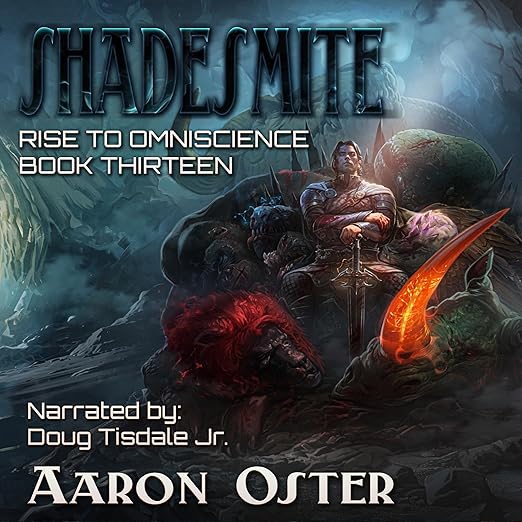
Quick Take
- Narration: Doug Tisdale Jr. has been the voice of the Rise to Omniscience series and brings the same energetic presence to the finale, he handles the GameLit stat-sheet elements with a naturalness that keeps them from feeling like interruptions.
- Themes: Surviving isolation while others depend on you, the finale problem of keeping multiple threats in play, what a series ending owes its characters
- Mood: Propulsive and action-heavy, with the bittersweet quality of a series finale that knows it is one
- Verdict: A satisfying series conclusion for Rise to Omniscience loyalists, with the pacing and battle sequences that define Aaron Oster at his best.
Series finales in GameLit and LitRPG are a specific craft challenge. By book thirteen, a readership knows the world’s rules intimately, the characters have leveled up to the point where ordinary threats cannot register as threats anymore, and the author has to find antagonists and situations that feel genuinely dangerous without breaking the internal logic of a progression system. Aaron Oster has been managing this balance across the Rise to Omniscience series for a long time, and Shadesmite is where all of it comes due.
The setup puts Morgan in the worst possible position: trapped in a Beast Zone where the environment itself is lethal, responsible for escorting survivors including Gwen and her friends to safety, while outside the Zone the invasion he should be stopping is entering its final phases. Nymon is moving on New Faeland with no one to counter him. Octagon the Eldritch, the Pinnacle King who does not forgive losses, is pursuing Morgan with personal intensity. And the clock is running in multiple directions at once. Oster is making the reader feel the impossibility of Morgan’s situation across twelve hours of audio, which is a sustainable tension only if the payoffs arrive at the right pace.
Our Take on Shadesmite
Reviewer dsm called this a nice wrap to the series, noting epic battles, true love reaffirmed, and the next generation growing up, which is a good shorthand for what a GameLit finale is supposed to deliver. Oster delivers those things. He also delivers the humor that reviewer Reader called just right: the series has always balanced its progression mechanics and combat sequences with a lightness that prevents the stat-sheet elements from becoming oppressive, and Shadesmite maintains that balance. Reviewer Zach, who cited this as a most favorite gamelit series, expressed sadness at seeing it end, which is the right feeling for a finale to produce.
Why Listen to Shadesmite
Doug Tisdale Jr.’s narration has been a consistency across this series that matters more than it might seem. GameLit audiobooks live or die on whether the narrator can read stat updates, skill acquisitions, and system notifications without breaking the narrative flow. Tisdale has developed a rhythm for the Rise to Omniscience series that treats those elements as natural parts of the story rather than interruptions, and at twelve hours, a narrator who has genuinely internalized the series voice makes a significant difference. For readers who have been following this series in audio, Shadesmite will feel like a proper goodbye.
What to Watch For in Shadesmite
The content warnings in the synopsis are worth noting: profanity and gore are present at levels that reflect the series having escalated over thirteen books. Reviewer Michel Bullard flagged some discomfort with a specific relationship dynamic involving Grace at the end, which is worth noting for listeners who have particular investment in how those characters conclude. The book is otherwise reviewed warmly, with the editing noted as strong with the exception of two specific character name errors that reviewer dsm caught, the kind of detail that only a highly attentive reader would notice but that points to the production quality being otherwise solid.
The series title, Rise to Omniscience, is worth considering as a frame for the finale. Omniscience is a high bar, and Morgan’s arc across thirteen books has been less about achieving unlimited power than about learning what power costs and who it costs it to. The finale’s emotional weight derives from that distinction: the battles are spectacular, but the question underneath them has always been whether Morgan can win without becoming something he would not recognize. How Oster resolves that question is what the thirteen-book investment has been leading toward, and the response from readers who finished it first suggests he found an answer worth the journey.
Who Should Listen to Shadesmite
This is exclusively for readers who have been following the Rise to Omniscience series. Entering at book thirteen is not a viable option in any functional sense, the world, the characters, the progression system, and the accumulated stakes all require the full context of the previous twelve volumes. For committed fans, this delivers a finale that respects the investment: Morgan’s arc concludes, the major threats are addressed, and the world of New Faeland is left in a place that honors what the series has been building toward. Reviewer Tricia L. hoped it was not truly the end, which is the best possible indicator of how the finale lands.
Frequently Asked Questions
Is Shadesmite a true series finale for Rise to Omniscience, or does it leave room for continuation?
Based on reviewer responses, Shadesmite functions as a series conclusion, multiple reviewers expressed sadness that the series is ending and hope that Oster continues in some form. The ending leaves open some possibilities, per reviewer Michel Bullard, but it wraps the central arcs.
How graphic is the content in Shadesmite compared to earlier volumes?
The publisher’s own synopsis flags profanity and gore as content considerations. Thirteen books in, the series has escalated significantly from its earlier volumes. Listeners who found earlier Rise to Omniscience entries acceptable should be prepared for the finale to push further.
Does Shadesmite work if you have only read some of the series rather than all thirteen books?
The series is tightly continuous, and the finale specifically resolves threads from multiple earlier volumes. Gaps in the reading history will create gaps in the emotional payoff. The recommendation is to read all thirteen in sequence.
Has Doug Tisdale Jr. narrated the entire Rise to Omniscience series?
Based on available metadata, Tisdale narrates Shadesmite and has been associated with the series. His performance in the finale reflects the familiarity of a narrator who has lived with these characters across a long run.