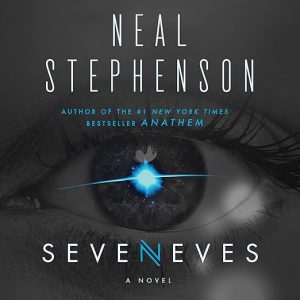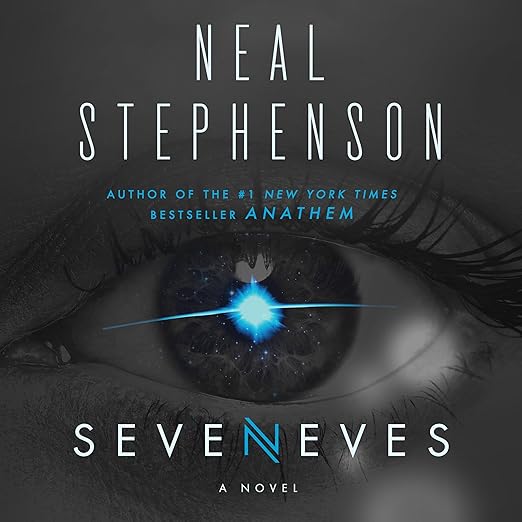
I have a friend who reads Neal Stephenson the way some people approach endurance sports: with preparation, with awareness that it will be hard, and with the knowledge that the difficulty is part of what makes it worthwhile. I thought of her often during my thirty-two hours with Seveneves, which is the most Stephensonian of Stephenson's novels in both the best and most challenging senses of that description. It is ambitious to the point of recklessness, dense beyond what most readers will tolerate, and, when it works, genuinely one of the most compelling works of speculative fiction I have encountered in years of reading the genre seriously.
I came to it knowing its reputation. Seveneves has the kind of divided critical response that accompanies books that are doing too much to be comfortably evaluated in a single frame. Some readers call it a near-classic; some find the second of its three structural sections a dealbreaker. Both responses are defensible. What I found was something that required me to recalibrate what I was asking a book to do, and that recalibration was ultimately worth the discomfort it caused.
The premise is blunt and devastating: the moon is shattered by an unknown agent, and within two years the resulting debris cloud will render Earth's surface uninhabitable for thousands of years. Humanity has that time to get as many people as possible into orbit. What follows is a sustained examination of what "as many as possible" actually means, what decisions look like when the stakes are the continuation of the species, and how human nature, political, tribal, irrational, and occasionally heroic, behaves at the edge of extinction.
Stephenson's method involves researching and then rendering orbital mechanics, genetic engineering, political negotiation, and materials science with the same granular attention he brings to characterization. This is either what makes the book extraordinary or what makes it unreadable, and the split between those responses is not about intelligence or patience in any simple way. It is about what you need fiction to do. If you need it to carry you along without demanding active engagement, Seveneves will exhaust you. If you want a book that models a possible future with enough rigor to make it feel real, it is almost without peer in contemporary science fiction.
Highlights
Mary Robinette Kowal is an excellent choice to navigate this material. She is a science fiction author herself, which gives her an intuitive understanding of what Stephenson is doing in the technical sections, she handles orbital mechanics and genetic terminology with the confidence of someone who reads this kind of writing for pleasure, not just for work. Her pacing is measured, which serves a book that rewards careful attention over forward momentum.
The caveat is the runtime: just under thirty-two hours. At that length, the density of Stephenson's prose and the book's structural peculiarities, particularly the sudden temporal leap that initiates the third section, will challenge even committed listeners. Several reviewers describe needing time to push through the middle of the book. That honest account of the listening experience is worth holding before you commit.
What to Watch For in Seveneves
The book's architecture is unusual and intentional. The first two-thirds follows the immediate crisis: the two years of preparation, the launch, the survival in orbit, and the catastrophic reduction of that community to its seven survivors, the Seveneves of the title. The third section jumps five thousand years forward to a civilization of three billion descended from those seven women, returning to a transformed Earth. The discontinuity is jarring in a way that some readers find artistically justified and others find structurally broken. One reviewer describes it as a "near classic marred by a flawed second act," which is a useful calibration device: if you find the middle section's demands too high, the third section arrives as something close to relief.
Stephenson fans who have made it through Cryptonomicon or Anathem will know what they are signing up for. Those new to his work should perhaps begin elsewhere, Snow Crash or The Diamond Age, before attempting this one.
Is This One for You?
Hard science fiction readers who want a book that takes orbital mechanics and genetic science seriously enough to have consulted specialists during the writing process will find Seveneves rewarding in ways that most genre fiction cannot replicate. Stephenson readers who have already established a tolerance for his particular mode of world-building will find this represents some of his most ambitious work. Readers with an interest in the political and social dimensions of civilizational-scale decision-making will find the first two-thirds particularly rich.
It is a genuinely poor match for listeners who want narrative propulsion over ideas, who find extended technical exposition a barrier to enjoyment, or who have not already established some patience for Stephenson's pacing. At thirty-two hours, the commitment required is real, and the reading experience is uneven enough that starting without knowing that would be unkind. Go in with eyes open, and it delivers something genuinely impressive.
At a Glance
- Voice: Mary Robinette Kowal brings rigorous intelligence to Stephenson's dense scientific prose, her pacing is deliberate enough to let the orbital mechanics breathe, though nearly 32 hours tests even the most committed listener.
- Big ideas: Survival and human adaptability under catastrophic constraint, the politics of extinction-level decision-making, genetic destiny and civilizational continuity
- Atmosphere: Dense, intellectually demanding, and periodically awe-inspiring, not background listening
- Worth it?: An extraordinary achievement in hard science fiction that requires a specific kind of patience, if you love Stephenson and embrace the world-building, it is among his finest work.
Common Questions
Does Mary Robinette Kowal's narration handle the scientific content, orbital mechanics, genetic engineering, materials science, clearly?
Yes. Kowal is a science fiction author herself, which gives her a fluency with the technical language that a general narrator might not bring. She handles complex scientific terminology with confidence and keeps the expository sections from collapsing into recitation, which is a non-trivial achievement given the density of the material.
How does the book's three-part structure affect the listening experience, particularly the five-thousand-year jump in the third section?
It is jarring and intentional. The first two-thirds follows the immediate survival crisis; the third section jumps forward five thousand years to a civilization descended from the seven survivors. Reviewers are split on whether the discontinuity works, some find it artistically justified, others find it structurally disruptive. Knowing the jump is coming, and why, makes it easier to absorb when it arrives.