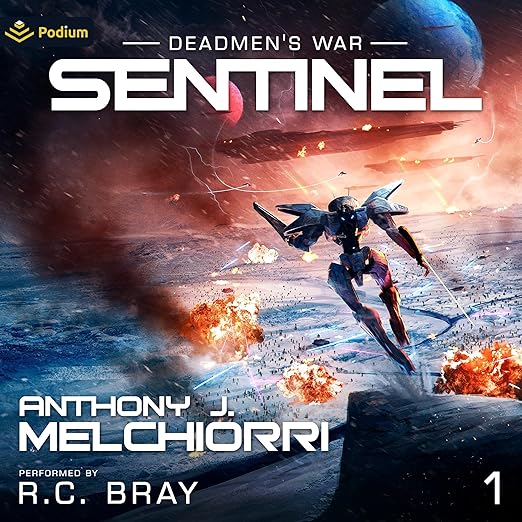
Before You Press Play
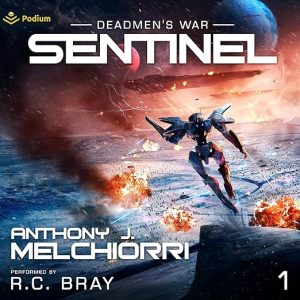
- Voice: R.C. Bray brings his full toolkit to Cole Shaw, grounding the mech combat sequences with physical immediacy and keeping the slower worldbuilding passages from losing momentum.
- Big ideas: Class and survival, ancient civilizations versus technological hubris, found loyalty under pressure
- Atmosphere: Cold, tense, and action-forward, with a mythological undertow beneath the military action
- Worth it?: A confident series opener from Melchiorri that delivers on its mech-and-ancient-ruins premise, with Bray elevating the material throughout.
I finished Sentinel on a Saturday afternoon when the weather had turned grey and I wanted something that matched the mood without requiring emotional labor. Anthony J. Melchiorri's military SF opener is exactly that kind of book: atmospheric, action-efficient, and built on a premise that is more original than its genre positioning might suggest. The frozen planet Ferrous, the dormant technologies of an extinct civilization, the team of mech operators caught between scientific ambition and ancient threat: these are not new elements in isolation, but Melchiorri combines them with enough specificity to make the world feel genuinely inhabited rather than generically realized.
The origin story for Cole Shaw is sharp in its efficiency. He is born on a desert planet called Xenia where starvation and disease are the default outcomes for those who cannot escape. His two options, die slowly or enlist, are presented without sentiment, and the military as a vehicle for social mobility rather than patriotic calling gives the series an edge that straightforward military SF often avoids. By the time he arrives on Ferrous operating an 11-ton mech called the Asher, you understand why he fights without needing a speech about it.
What We Made of It
The book's central discovery, the Sentinels themselves, functions as the novel's most interesting element. These are not simply alien monsters or malfunctioning machines. They are guardians of a Progenitor civilization that has been extinct long enough for its technology to have passed from dangerous into mythological. The race to understand and control that technology, with scientists pushing past safety thresholds and an enemy force willing to kill to prevent either side from getting there, creates a genuine three-way tension that is more sophisticated than the synopsis suggests.
Reviewer Julie Blaskie noted that Melchiorri's characters get hurt, and that women on the teams are written as strong without being tokenized. Both observations hold up. The ensemble around Shaw is drawn with enough individual detail to avoid generic-soldier syndrome, and the consequences of combat feel physical rather than cinematic. One reviewer noted occasional confusion, particularly in the middle sections where the Progenitor lore is being introduced. That is a fair observation: Melchiorri packs a lot of world into the first installment, and some of the exposition lands more smoothly than others.
What Makes Sentinel Worth Hearing
Bray is named in the book's own promotional text alongside his Audie, Earphones, and SOVAS Award wins, which tells you what the publisher knows about his value here. The match between Bray's delivery and Cole Shaw's working-class pragmatism is excellent. Where some narrators impose a layer of heroic gloss on military SF protagonists, Bray keeps Shaw rooted: the performance communicates someone doing a dangerous job rather than someone narrating their own legend. The technical language of mech operation and military procedure gets delivered with the precision of familiarity rather than rehearsal.
What Might Not Land
The Progenitor technology thread is clearly the series' long-term engine. Melchiorri plants multiple questions that this first book does not answer, and the specific nature of what the Sentinels are protecting, and why they were built to protect it rather than to use it, is the kind of mystery that rewards continued investment. Reviewer j-az noted being unable to predict the next twist, which is a meaningful signal in a genre where plot mechanics often become predictable fairly quickly. The worldbuilding investment in Ferrous, its ice and its buried secrets, pays off in ways that suggest Melchiorri had the larger arc planned from the beginning rather than improvising forward.
Should You Listen to Sentinel?
Military SF listeners who enjoy the ancient-civilization discovery subgenre will find this familiar in the best sense. The mech combat adds visceral texture that distinguishes it from pure political space opera. Skip it if you want leisurely literary pacing: Melchiorri moves fast and expects you to keep up. Start with this book; the Deadmen's War series is designed to be read in order, and the mysteries established here are built for long-term payoff.