Quick Take
- Narration: Kirsten Potter is an excellent match for Will Parker’s wry, first-person voice, and she handles the period dialogue and shifting tones of 1940s noir with consistent skill.
- Themes: Golden Age mystery as meta-commentary, queer identity in mid-century America, the ethics of obsession with crime
- Mood: Sharp and witty with a genuine undercurrent of menace, like a cocktail that is stronger than it tastes
- Verdict: A third entry that improves on its predecessors by adding a layer of literary self-awareness without losing the genre pleasures that built the series’ audience.
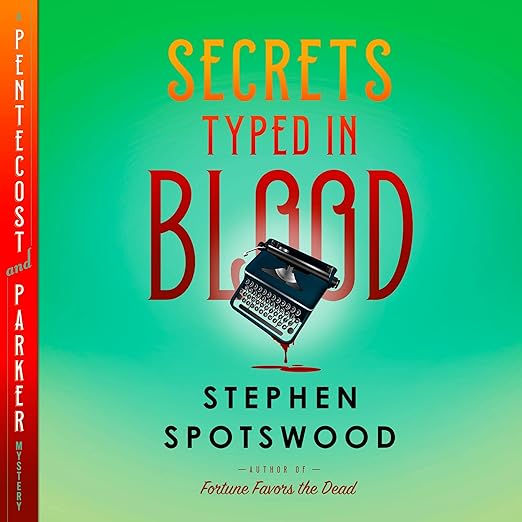
I came to Secrets Typed in Blood already two books deep into the Pentecost and Parker series, which means I arrived with established affection for the characters and a clear sense of what Spotswood is trying to do with the genre. He is writing 1940s noir with a modern sensibility about who gets to be the detective, and he is doing it with enough craft that the result does not feel like a corrective exercise but like the kind of mystery these characters were always going to write once someone figured out how to write them. The third entry is the best so far, and it earns that distinction by adding a layer of meta-awareness that the earlier volumes were building toward.
The premise here is more clever than most mystery novels give themselves credit for being. Holly Quick, a pulp fiction writer who makes her living inventing gruesome murder stories, comes to Pentecost and Parker because someone is re-enacting her stories in real life, leaving corpses that correspond to her published plots. The investigation that follows implicates an underground Black Museum Club, a pair of editors with their own secrets, and an old adversary whose thread runs from the prior books. Spotswood is juggling a lot, and he mostly keeps everything in the air.
The Pulp Meta-Layer That Elevates the Plot
The most interesting move in Secrets Typed in Blood is what it does with Holly Quick as a character. She is a successful commercial fiction writer who has spent years thinking about murder as entertainment. Placing her at the center of a real murder investigation forces both the character and the reader to examine what the enjoyment of fictional violence says about us, and what it costs when that violence stops being fictional. Spotswood does not push this into territory that becomes preachy or self-congratulatory, but the thematic current is real and it gives the book weight that the earlier installments did not quite reach.
The Black Museum Club, a group of people obsessed with murder memorabilia and the psychology of killers, is the book’s most effectively unsettling invention. The philanthropist who runs it, described as having a collection of grim murder memorabilia that may not be enough to satisfy his lust for the homicidal, is drawn with just enough ambiguity to keep the reader uncertain about his guilt until Spotswood wants the uncertainty resolved. That kind of sustained misdirection is harder to pull off than it looks, and it is managed here with competence.
Kirsten Potter and the Will Parker Voice
Will Parker narrates these books in first person, and Kirsten Potter has inhabited that voice across three volumes with consistent skill. The character is funny without being flippant, physically competent without self-consciousness about it, and emotionally guarded in ways that occasionally allow something real through. Potter handles all of that and adds the period-specific voice of 1940s New York with the ease of someone who has lived there for two prior books.
The undercover secretary subplot, where Will has to operate in pencil skirts and sensible shoes while simultaneously running her own investigative thread, gives Potter excellent material to work with. The comedy of Will performing competent helplessness while being fundamentally incapable of passivity is something Potter plays perfectly. The audiobook format rewards this particular kind of performance in ways that the print experience does not quite match.
The Duo at the Center of Everything
One reviewer described the Pentecost and Parker series as queer rep and 1940s noir with a modern edge. That is accurate but incomplete. What Spotswood has built is a partnership between two women that functions as a complete working relationship without requiring either character to be subordinate to the other. Lillian Pentecost’s disability, which complicates her physical capacity in increasingly significant ways across the series, is handled with genuine attention in this volume. She is not defined by it, but it is also not minimized. The case in this book is one that has the great Lillian Pentecost questioning her methods, which is the most interesting development in the series so far.
The Nero Wolfe comparison that reviewers reach for is apt and acknowledged by the series itself. Will functions as the Archie Goodwin equivalent, doing the legwork and narrating, while Lillian operates as the analytical intelligence who rarely leaves the office. What Spotswood adds to that template is a genuinely modern understanding of what it costs to be two women doing this work in 1947, and that cost is woven into the plotting rather than relegated to subtext.
Where the Book Has Seams
The reviewer who noted that the plot got a little creaky about two-thirds of the way through was not wrong. The simultaneous investigation of three connected murders, while managing Will’s undercover assignment and the ongoing Dr. Waterhouse subplot, creates a structural complexity that occasionally works against the pacing. Spotswood is ambitious in his plotting, and ambition sometimes means the mechanism shows. The mystery resolves satisfyingly, but the middle section requires a bit more patience than the opening and closing thirds.
The guest character of Holly Quick, described as tad broadly drawn with too many repetitious descriptions of her physical and emotional quirks, is the other seam. She is an essential narrative engine, but the character work does not quite match the plot function she has been assigned.
Who Should Listen and Who Should Skip
Listeners who have read the first two Pentecost and Parker mysteries should come to this one immediately. Those new to the series can technically begin here, but the emotional payoff of the ongoing subplots and character development will be diminished. Readers who enjoy Deanna Raybourn’s Veronica Speedwell series, the Nero Wolfe canon, or 1940s period mysteries with genuine character depth will find Spotswood’s work a natural fit. Those who prefer their mystery lighter on meta-commentary and heavier on pure puzzle-plot mechanics may find the literary self-awareness occasionally distracting.
Frequently Asked Questions
Does Secrets Typed in Blood work as an entry point to the Pentecost and Parker series, or is reading order important?
Reading order matters. This is the third entry in an ongoing series with subplots and character development that build across books. The mystery plot is self-contained, but the full emotional experience, including the significance of Dr. Waterhouse and the evolution of the Pentecost and Parker partnership, depends on the prior volumes. Start with Fortune Favors the Dead.
How explicit is the queer content, and how central is it to the plot?
The queer identities of the characters are present and acknowledged rather than centered as the plot’s primary concern. Will Parker’s attraction to women is part of who she is; the book does not make it the story. The 1940s setting gives the characters real reasons to be guarded about their identities, and the narrative handles that historical reality without either dramatizing it excessively or pretending it does not exist.
Is the Nero Wolfe comparison accurate enough to help me decide whether to try this series?
Reasonably accurate for the structure: a brilliant analytical detective who rarely leaves the house, a physically active narrator-partner who does the legwork, and a pattern of taking on unusual cases from the New York upper and criminal classes. The differences are significant: the gender dynamics, the disability representation, and Spotswood’s more explicit engagement with what it means to be women in 1940s New York. If you enjoy Wolfe, this series will feel familiar and fresh simultaneously.
How does Kirsten Potter’s narration compare to the experience of reading the print edition?
Potter’s handling of Will Parker’s first-person voice is strong enough that some reviewers specifically recommend the audiobook over the print edition. The period comedy, particularly the undercover secretary sections, benefits from the performance dimension that audio provides. The character differentiation across the ensemble cast is competent throughout the nearly ten-hour runtime.