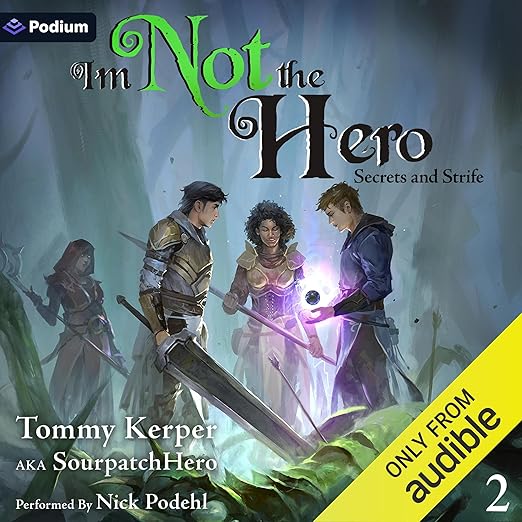
Quick Take
- Narration: The narrator handles the LitRPG genre conventions with the right energy, navigating status screens and system notifications without letting the technical overlay disrupt narrative momentum.
- Themes: isekai transportation and world adaptation, game mechanics as survival framework, hidden identity and political intrigue
- Mood: Fast-paced and mechanically intricate, with the addictive quality of a well-designed progression system
- Verdict: A LitRPG isekai that delivers on its genre promises while adding enough political complexity to keep the progression system interesting across the full run.
I am not the natural audience for LitRPG. My background in literary criticism tends to produce genuine impatience with the genre’s characteristic structural elements, the status screens, the leveling notifications, the numerical representations of character development that punctuate narrative momentum with what feels to me like a video game UI overlay dropped without apology into prose fiction. So I come to Secrets and Strife as a confirmed skeptic who found herself more engaged than expected and more willing to continue than my genre priors would have predicted, which I think is the more useful review position than enthusiasm from someone who was always going to enjoy it regardless of how well this particular entry executes on the genre’s potential.
The novel opens with a transportation to another world that establishes the isekai framework cleanly and without the excessive genre throat-clearing that less confident entries in this space use to signal their awareness of their own conventions. The protagonist arrives in a politically complex setting where the game mechanics are not simply a framework for personal power accumulation but are woven directly into the social and political fabric of the world in ways that have produced a stable hierarchical order with real beneficiaries and real victims. The nobility have their levels, their skills, their system privileges that reinforce existing power, and the protagonist’s status within that system is simultaneously a survival question and a political question from very early in the narrative. That structural integration of the game mechanics with the world’s political order is what primarily separates this from more purely mechanical LitRPG entries.
How the Isekai Setup Pays Off
The strongest element of the opening is the impressive speed with which the author moves from transportation shock to genuine engagement with the world’s political complexity and the specific dangers it creates. There is a persistent tendency in isekai fiction to spend excessive time in the confusion phase, as protagonists repeatedly fail to understand basic social and political structures before eventually adapting through accumulated painful experience. The protagonist here adapts quickly and with evident intelligence, using the meta-knowledge that comes from having read extensively in the isekai genre to navigate situations that would defeat a less genre-aware character. This self-aware trope is executed well here because the meta-knowledge is applied as genuine strategic intelligence rather than deployed primarily for comedic self-referential effect. The protagonist is consistently clever, and the narrative respects that cleverness by making the world genuinely difficult rather than conveniently simplified.
The System Mechanics and How They Serve the Story
The LitRPG system mechanics in Secrets and Strife are more deeply and convincingly integrated with the world’s political and social logic than in most genre entries, which gives the status screens and leveling sequences a narrative function that extends meaningfully beyond simple power progression tracking and reader satisfaction at accumulating numbers. The protagonist’s skill choices and statistical development have genuine political implications that ripple outward into the broader narrative, and the sections that engage with the game mechanics are better understood as political strategy sequences than as simple power fantasy delivery. That deeper integration requires a degree of mechanical complexity that may frustrate listeners who prefer clean, uncomplicated progression systems, but it rewards listeners who want the game mechanics to feel like they belong to a world rather than to a developer’s spreadsheet overlaid on a fantasy backdrop.
Narration in a Mechanically Dense Genre
LitRPG consistently presents narrators with a distinctive technical challenge: the status screens and system notifications need to be delivered with enough energy to feel like integrated elements of the narrative rather than interruptions of it, but without so much theatrical emphasis that the transitions between narrative prose and system text create jarring whiplash in the listener’s experience. The narrator here manages this specific balance with consistent skill throughout the audiobook. System notifications have a distinct vocal register that differentiates them clearly from the surrounding narrative prose without creating the disorienting friction that less skilled narration of this genre can produce. The political dialogue and the intrigue sections are handled with appropriate seriousness, and the action sequences are paced with the tightness and momentum that the genre’s audience expects and that the content requires.
What the Genre Enthusiast and the Skeptic Both Get
For LitRPG enthusiasts, Secrets and Strife delivers the genre conventions they are seeking with genuine competence while adding political complexity that makes the progression system feel embedded in a living, consequential world rather than an abstracted numerical game without stakes beyond the protagonist’s power level. For skeptics like me, the substantive integration of mechanics with world-building provides enough narrative substance to sustain genuine interest across the intervals between leveling sequences. The protagonist’s consistent intelligence and the real political stakes of the world prevent the audiobook from resolving entirely into power fantasy, and the secrets of the title generate narrative tension that does not depend on strong investment in the protagonist’s statistical development. This is a credible argument for what the genre can accomplish at its more sophisticated end of the spectrum. The audiobook is a strong argument for what the LitRPG genre can accomplish when its practitioners are willing to use the system mechanics as a genuine lens for examining social and political structure rather than as an end in themselves, and it justifies the investment of listening time from readers who come to it as skeptics as well as from those who already know they enjoy the form.
Frequently Asked Questions
Do you need familiarity with LitRPG conventions to follow Secrets and Strife?
No prior LitRPG experience is required. The game mechanics are introduced clearly and their role in the world is explained through the narrative rather than assumed. Genre newcomers can follow without a glossary.
Is the isekai premise self-aware or does it play the transportation trope straight?
The protagonist has prior knowledge of isekai fiction and uses that meta-awareness strategically. The novel is self-aware without being comedically self-referential, which makes the genre awareness feel clever rather than lazy.
How does the narrator handle the LitRPG-specific status screen and system notification content?
With clear differentiation between system text and narrative prose, using a distinct vocal register for each without creating jarring transitions. It is one of the better-handled aspects of the audio production.
Is this a standalone novel or the beginning of a series?
It functions as the opening of a series and ends with significant narrative threads open. The core arc of this volume reaches a satisfying point, but the political and personal storylines clearly continue in subsequent installments.