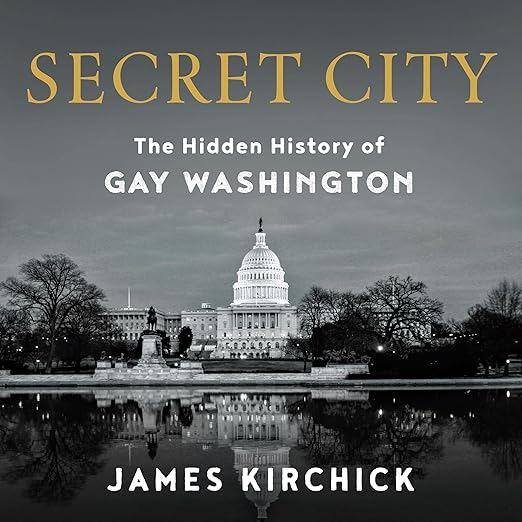
Quick Take
- Narration: Ron Butler navigates the book’s sweeping political cast and intimate personal stories with authority; his pacing suits both the archival sections and the more human-scale portraits.
- Themes: LGBTQ+ history and state persecution, Cold War paranoia, the hidden architecture of American power
- Mood: Revelatory and quietly outraged, the tone of meticulous historical reckoning
- Verdict: A landmark work of American political history that transforms how you understand both Washington and the twentieth century; its scope and research are genuinely formidable.
I started Secret City on a train to New York and found myself still listening when I arrived, sitting in Penn Station for forty minutes because I did not want to stop. James Kirchick has written the kind of book that makes you rethink things you thought you already knew. I knew the broad strokes of the Lavender Scare, the post-war purge of gay federal employees. I did not know how deep the entanglement went, how many of the pivotal figures in twentieth-century American politics carried this secret, and what it cost them and others to carry it.
The comparison to Robert Caro’s Years of Lyndon Johnson, made by George Stephanopoulos in the publicity, is not hyperbole as marketing language usually is. Secret City has Caro’s quality of immersive political history where the research is so dense and the characters so fully rendered that the institutional history becomes personal history. Kirchick has built something extraordinary here, and it deserved its place on the New York Times Book Review Notable Books list for 2022.
Our Take on Secret City
The book begins with the story of Sumner Welles, Franklin Roosevelt’s chief diplomatic advisor, and the scandal that ended his career in what the synopsis calls the greatest national scandal since the existence of the United States. Kirchick then traces how the specter of homosexuality shaped each successive presidential administration through the end of the twentieth century. The revelations accumulate: the WWII-era gay spymaster who pioneered seduction as a tool of American espionage; the devoted aide Lyndon Johnson treated as a son and then abandoned once his homosexuality was discovered; the allegations of a homosexual ring that nearly derailed Reagan’s 1980 election victory. Each story illuminates not just LGBTQ+ history but the internal workings of American political power at its highest levels.
One reviewer who came to it as a gay man in his seventies described recognizing so many names and making ready connections to figures whose secrets he was now learning. That quality of personal recognition meeting historical revelation is one of the book’s distinctive powers. Kirchick has accessed declassified documents, presidential archives, and over a hundred interviews. The research is not background; it is the primary experience of reading the book.
Why Listen to Secret City
Ron Butler’s narration handles the book’s unusual demands well. Secret City is simultaneously a work of archival political history and an intimate portrait of people whose lives were shaped by concealment. Butler navigates the register shifts without losing coherence: the documentary passages carry the appropriate gravity, and the more personal portraits breathe without sentimentality. At twenty-six hours, the book is long, but Kirchick’s narrative momentum prevents the length from feeling burdensome. The production from Macmillan Audio is polished.
One reviewer described the writing as alive and continually moving, and another noted it reads a little like a gossip novel, which is meant as praise: the archival research is leavened with narrative energy rather than buried under footnote density. That combination is what makes Secret City accessible to non-specialist listeners while still satisfying serious historians.
What to Watch For in Secret City
The book covers a large historical canvas: from FDR through Clinton. That breadth means some periods and figures receive less detailed treatment than others. Listeners who come hoping for extended deep dives into specific administrations may find Kirchick moves on before exhausting what each could yield. The structure serves the overarching thesis better than any single administration’s story.
Kirchick is also writing with a clear political point of view, arguing not only that this history has been suppressed but that the suppression itself shaped American political culture in lasting ways. That argument is well-supported, but listeners who approach the material from a more conservative political perspective may find the framing in certain chapters tendentious. The history is the history, but the interpretive frame is not neutral.
What lingers after Secret City is not any single revelation, though there are many, but the cumulative portrait of what enforced secrecy does to a political culture. The people whose homosexuality made them vulnerable were not exceptions or outliers. They were central figures in the architecture of American power, and the energy spent managing their exposure, either by themselves or by those who sought to use it against them, was energy taken from everything else. Kirchick’s implicit argument is that this was not merely a moral failure toward individuals. It was a systemic drain on the quality of American governance at its most consequential moments. That argument, built brick by brick through twenty-six hours of detailed historical evidence, is the book’s most enduring claim.
For listeners who come to Secret City knowing the broad outlines of modern LGBTQ+ history in America, the specificity of the archival detail will still surprise. Kirchick has assembled material that was either sealed, ignored, or deliberately obscured. The act of assembly is itself the argument: that this history existed, that it was consequential, and that its deliberate absence from mainstream accounts of American political history was not an accident.
Who Should Listen to Secret City
Anyone seriously interested in American political history will find this essential. LGBTQ+ listeners for whom this is personal history as much as national history will find it particularly resonant. Also suited for readers who came to this space through books like David K. Johnson’s The Lavender Scare and want a broader, more narrative treatment of the same territory. Those who want a focused, single-administration political history rather than a wide-angle century sweep may find the scope challenging to navigate.
Frequently Asked Questions
Is Secret City primarily LGBTQ+ history or American political history? How does Kirchick frame the book?
Kirchick explicitly frames it as American history that has been hidden, not as a separate category of LGBTQ+ history. George Stephanopoulos’s blurb makes this precise: it is not gay history, it is American history. The argument is that homosexuality shaped mainstream American political power, not that it existed separately from it.
Does the book cover only the Cold War era, or does it extend further?
It extends from FDR through the end of the twentieth century, including the Clinton administration. The Cold War is the period of peak intensity, when the Lavender Scare drove the federal purge of gay employees, but Kirchick traces the longer arc through subsequent decades.
Ron Butler is listed as narrator. Is he the right choice for material that covers both political archives and intimate personal stories?
Reviewers who have engaged with the audio describe the book as consistently engaging across its length, which suggests the narration works. Butler’s ability to shift register between documentary-historical and personal-intimate passages is the key requirement, and the twenty-six-hour running time without significant complaints about pacing is a reasonable indicator.
Is this a book primarily for LGBTQ+ readers, or will it resonate with general political history audiences?
Strongly both. The research into presidential administrations, Cold War intelligence politics, and the mechanics of political scandal is substantive enough to engage any serious political history reader. LGBTQ+ readers will find additional layers of personal recognition. The book was designed as a mainstream political history that happens to center hidden LGBTQ+ lives.