Quick Take
- Narration: Nick J. Russo brings Des’s first-person voice to life with warmth and precisely calibrated comedy. His handling of the emotional pivot from friendship to love feels genuine rather than performed.
- Themes: friends-to-lovers, chosen family, the comedy and tenderness of domesticity imposed on a confirmed bachelor
- Mood: Funny and tender in equal measure, with beer league hockey as warm background atmosphere
- Verdict: A well-executed MM romance that earns its emotional moments through character investment rather than manufactured drama. Book two in a series but fully functional as a standalone.
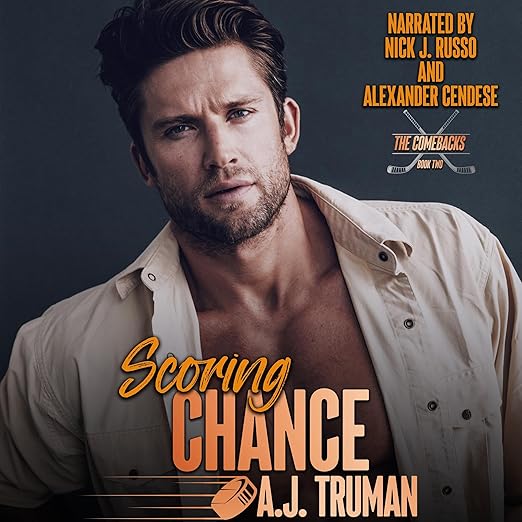
I listen to a lot of romance audiobooks, and the ones that stick with me are rarely the ones with the most dramatic plots. They are the ones where I believe the friendship before I believe the love story. Scoring Chance by A.J. Truman got its hooks in me precisely because the bond between Des and Tanner feels genuinely lived in before anything romantic develops. Nick J. Russo’s narration makes that friendship tactile and specific from the first chapter, which is most of the battle in a friends-to-lovers story.
The setup is absurd in the way good comedy romance setups usually are: Tanner Chance, recently widowed with four kids, loses his job and his family’s health insurance in the same fell swoop. His best friend Des, a man with a high-rise apartment and a fondness for bottomless mimosas, proposes a solution that any rational person would reject. They will get married on paper, Tanner’s family goes on Des’s insurance, and life continues as normal. Of course, a small town being what it is, the paper marriage immediately becomes a public marriage, and Des moves into the cramped split-level to keep up appearances.
Our Take on Scoring Chance
What Truman does particularly well is the domestic comedy of the transition. Des navigating four children, meatloaf, and sibling squabbles is the funniest material in the book, and it serves the emotional arc at the same time. Every moment of chaos in that house deepens Des’s understanding of what Tanner has been carrying alone since losing his wife, and it deepens the reader’s understanding of what Des has been missing in his solitary, stylish life. The comedy is doing structural work rather than just filling pages between romantic beats.
The friends-to-lovers tension is handled with genuine care. Both characters spend considerable time in denial, and Russo’s performance captures the specific quality of a man arguing with himself about feelings he already has. One reviewer notes that Tanner and Des have been through serious things together, Des’s cancer treatment among them, and that shared history gives the romance real weight. This is not a shallow infatuation dressed up as love. These are two men who have already proved what they mean to each other in genuinely hard circumstances, which makes the eventual acknowledgment of deeper feelings feel earned rather than convenient.
Multiple reviewers specifically praise the balance of humor and heart. One notes that the book is goofy and chaotic while also delivering a meaningful and loving relationship. Truman is working in a mode that is harder to execute than it looks: the comic chaos has to coexist with emotional sincerity without undercutting either, and this book manages that balance consistently.
Why Listen to Scoring Chance
Nick J. Russo is well-cast here. The single first-person perspective from Des’s point of view means Russo carries the whole novel, and he navigates the tonal range from broad domestic comedy to genuine vulnerability without the seams showing. The scenes where Des begins to understand what he actually wants land with real emotional force because Russo has built the performance steadily rather than reaching for emotion before it has been earned by the story.
The beer league hockey setting provides warm backdrop without demanding serious sports knowledge. You do not need to understand hockey strategy or terminology to enjoy the team dynamics or the community that forms around the local amateur league. Truman uses the sport as texture and atmosphere rather than as plot driver, keeping the romance at the center throughout.
What to Watch For in Scoring Chance
This is book two in The Comebacks series, but it functions as a complete standalone. The central romance has its own arc and full resolution, and while there are presumably characters from book one you will recognize if you read it, their presence does not disrupt the narrative for newcomers. The synopsis is explicit about standalone capability, and the reviews confirm that experience.
The heat level is moderate rather than explicit, which several reviewers flag approvingly. One reviewer rates the spice at 3 out of 5, noting a handful of explicit scenes that serve the emotional arc rather than dominating it. The emotional intimacy between the two leads is more developed than the physical. Listeners looking for high-heat MM romance should calibrate expectations accordingly.
Who Should Listen to Scoring Chance
MM romance readers who prioritize emotional investment and genuine friendship foundations before romantic development will be in good hands here. Fans of single-dad romance, fake-relationship setups, or hockey romance will tick multiple preference boxes simultaneously. Those seeking darker or more angsty romantic suspense should look elsewhere. And anyone who has been burned by friends-to-lovers stories where the friendship part feels perfunctory should give this one a fair chance, because Truman earns it deliberately and early.
Frequently Asked Questions
Do I need to read the first Comebacks book before listening to Scoring Chance?
No. Truman designed Scoring Chance to function as a complete standalone with its own central romance arc. Some characters from book one appear, but their presence does not require prior knowledge to follow or enjoy the story.
How does Nick J. Russo handle the single first-person POV throughout the entire book?
Very well. Russo carries the novel entirely from Des’s perspective and manages the full tonal range from broad domestic comedy to emotionally vulnerable moments without overplaying either. The performance builds steadily rather than reaching for emotional peaks before they are earned.
How explicit is the romance content in Scoring Chance?
Moderate. Multiple reviewers describe the spice level as present but not dominant, rating it around 3 out of 5. The emotional intimacy is more developed than the physical, making this accessible to readers who enjoy MM romance without wanting explicit content at the center of the story.
Is the hockey setting central enough to require sports knowledge, or is it background texture?
Background texture. Truman uses the amateur hockey league to build community and warmth around the characters, but the sport itself is not plot-critical. You do not need to understand hockey strategy or terminology to follow or enjoy the story.