At a Glance
- Voice: One credited reader, Daniel Wisniewski, against a description that advertises a two-voice production
- Big ideas: Academy progression and power systems, betrayal within a team, a human-only world under demonic siege
- Atmosphere: Propulsive, long-haul, character-forward
- Worth it?: A strong third installment for readers already inside the series, and completely unsuited to anyone starting here.
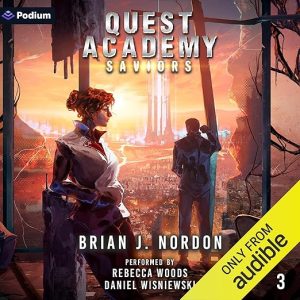
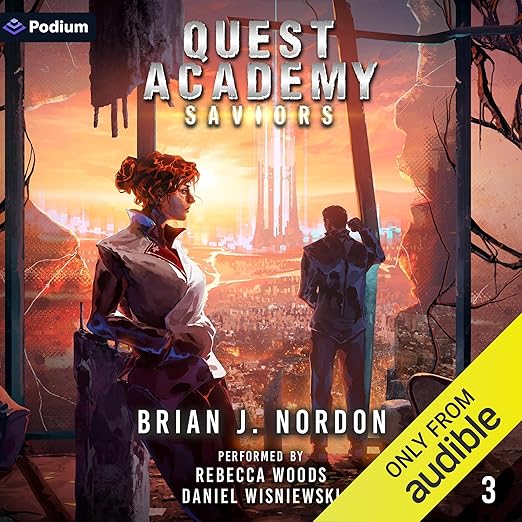
What does duet style mean when only one name appears in the credit field? That question sits at the center of this listing. The description for Brian J. Nordon's third Quest Academy book ends with a flat four-word sentence, "Narrated in duet style", while the narrator field gives a single reader, Daniel Wisniewski, for twenty hours and fifty-six minutes of audiobook from Podium Audio. Duet narration normally means two performers alternating, most often splitting perspectives. Either a second credit is missing from this page or the description was carried over from a different production plan, and neither possibility is something a buyer should discover after purchase.
The numbers on the page have their own problem. Four ratings produce the 4.8 average, and yet five written responses sit visible beneath it, which means the counter reports fewer grades than the number of people who took the trouble to write one. One of those five explains itself: it was filed in October 2024, three months before this recording was released, and it says "I am looking forward to Jack joining them in Saviors". That is somebody reviewing the previous book while anticipating this one. Your genuinely usable pool for this title is smaller than the five it appears to be.
The Review
Nordon's setup is unusually clean for the subgenre. The first semester is ending, Sal's trust in his team has hit rock bottom after another member's actions in the final fight of the excursion, and he now has to enter the Tower and fight demons alongside the person who betrayed him. He also suspects the former Super-Rookie on his team is a ticking time bomb. Accused of squandering his power, Sal is pushed to stop leaning on Mythcrafting and commit to the ability he was born with, Skill Master. Character conflict drives the progression rather than decorating it, which is rarer here than you might expect.
Worldbuilding is where the series distinguishes itself, and one five-star response puts it better than the description manages: "humanity is in a losing battle against demonic. Forces." The same response adds that "There ate no elves, orcs or trolls", typing errors and all, and the point underneath is sharp. Removing the standard fantasy species leaves a cast drawn entirely from humanity, facing something that comes from outside it, which changes what the power system exists to do. That response also notes that "the LitRPG stats are not as invasive as in some books", a distinction that matters enormously in a recording, where a stat block read aloud stops a scene dead.
The Tower is the structural device that makes this installment work, and it solves a problem the subgenre usually fumbles. Academy stories tend to stall between term-time politics and external threat, with neither able to carry a full volume. Putting the semester's climax inside a demon-filled tower forces both at once: Sal has to fight beside the person who betrayed him because the building does not care about his grievance. That is elegant plotting. It also gives Nordon a clean structure for escalation, since a tower supplies floors, and floors supply pacing without anyone having to invent a reason to travel.
Why Listen to Saviors
Twenty hours and fifty-six minutes is the argument, if you are the kind of listener who wants to disappear into something. Progression fantasy justifies its length differently from other genres: the pleasure is accumulation, and a long runtime means more accumulation. Jerry, at five stars, reports that "the character development is amazing" and that this entry has "a clear cut ending so they are great stand alone books", which is a useful thing to know about a series that could easily have ended on a cliff.
Consistency comes second, and it arrives with a caveat you can act on. A separate five-star response covering the series so far reports "I haven't had a bad book in this entire series" and credits all three with "great character moments, compelling plot and a good mix of stats, crafting, humor, adventure and action". Three books in, nobody visible reports a drop in quality. Set against that, Winterberry Farm's four-star assessment warns that "the first book was a bit of a slog" where Nordon was establishing his construct, and advises persistence: the construct is "extremely complicated but worth getting to know".
A Few Reservations
This is emphatically not an entry point, and one response says so in four words: "Read them in order". Book three opens mid-crisis, with a betrayal from the previous volume driving Sal's every decision and a team already split up, added to and subtracted from. Who the Super-Rookie is and why the Tower matters are treated as settled knowledge. Starting at twenty-one hours of book three would be an expensive way to learn that the series wanted you at book one.
Small inconsistencies elsewhere on the page are worth noticing. The description spells the class name at the center of the plot in the British form while the title uses the American one, so the same word appears two ways within a few lines of each other. Combined with the duet credit that has no second name attached and a ratings counter sitting below the number of written responses, the impression is of a listing assembled quickly. None of that touches the writing. All of it argues for sampling rather than trusting what the page tells you.
Should You Listen to Saviors?
Come here if you have finished the first two Quest Academy books and want twenty-one hours more, or if you like academy progression stories where the stat mechanics stay light enough not to interrupt the prose. Listeners who want a male lead without a tragic backstory are specifically served, since one response singles that out as a relief. Stay away if you need your fantasy populated with the usual species, if you dislike serialized structure, or if a duet credit with one name attached bothers you enough to want it resolved first. Go in having heard books one and two, or do not go in at all.
My own reservation is smaller than any of that and worth stating anyway. Twenty-one hours is a great deal of time to spend inside a single semester, and the middle stretch of any progression novel is where accumulation starts to feel procedural rather than dramatic. Nordon's answer is character friction, which is the right answer, though anyone indifferent to whether Sal forgives his teammate will find the hours long. Test that in the first two hours rather than the tenth.
Frequently Asked Questions
Is the Saviors audiobook really narrated in duet style?
The description says so, but only Daniel Wisniewski is credited on the listing. Duet narration usually means two performers alternating, often by perspective. Either a second name is missing from the page or the note was carried over from an earlier production plan. Anyone buying specifically for a two-voice reading should sample before committing to twenty-one hours.
How heavy are the LitRPG stats in this audiobook?
Lighter than the subgenre average. The description keeps its focus on the ability Sal was born with, Skill Master, and on what he chooses to develop, rather than on numerical progression. That emphasis matters more in a recording than on a page, since a listener cannot skim a block of numbers the way a reader instinctively does.