Quick Take
- Narration: Christian Leatherman handles the multiple POV structure deftly, giving each of the three primary characters a distinguishable voice without leaning on caricature. His pacing through the motel’s slow-burn dread sections is particularly well-judged.
- Themes: Southern Gothic atmosphere, obsession and retribution, isolation and belonging
- Mood: Creeping and atmospheric, with genuine unease underneath the humid Tennessee setting
- Verdict: Southern Gothic horror fans who want vampire fiction with emotional weight rather than action spectacle will find a lot to appreciate here.
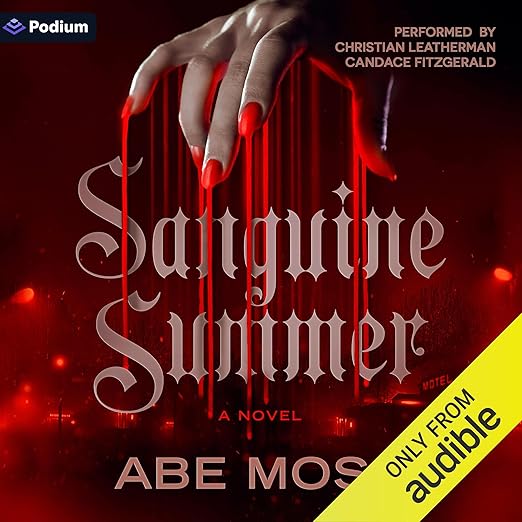
I finished Sanguine Summer on a Sunday evening with all the windows open, which turned out to be a reasonable choice given how warm and oppressive the atmosphere of this book gets. Abe Moss sets his story at the Silver Lining Motel deep in the backwoods of Brewster, Tennessee, and the setting is doing real work here, not just as backdrop but as mood, as trap, as a kind of moral gravity that pulls every character toward the worst version of themselves.
The guest in Room 10 is a vampire. That much the synopsis tells you. But Sanguine Summer is less interested in the mechanics of vampirism than in the three humans whose lives she disrupts: a male escort trying to buy his way to independence, a dollar store cashier with an fixation that has clearly crossed into something darker, and a married man whose double life is already unraveling before the supernatural element arrives. The vampire herself, Carissa, described by one reviewer as a classic heartless villain with family issues of her own, is less a predator than a catalyst.
Our Take on Sanguine Summer
What Moss is doing here aligns more closely with early Southern Gothic tradition than with contemporary vampire horror. The dread is slow-building and rooted in human psychology as much as supernatural threat. When one reviewer wrote that the heart of the story is about “someone who feels lost and is just trying to find a place to belong,” they were capturing something real about how Moss has written Carissa, a monster, certainly, but one whose hunger feels metaphorically resonant in a way that straightforward monster-of-the-week fiction usually doesn’t attempt.
The three converging storylines take some patience to invest in. The male escort Dario and his relationship with the controlling Carissa is the thread that reviewers mention most warmly, one called their dynamic “fun” and praised Dario’s rebellion, which suggests Moss builds toward some degree of agency in what might otherwise be a purely victimhood-based structure. The cashier’s storyline leans harder into psychological unease. The married man’s arc serves as the most conventional thriller thread of the three, which both grounds the novel and occasionally makes it feel like the most expendable piece.
Why Listen to Sanguine Summer
Christian Leatherman’s narration deserves significant credit for making the tonal shifts work across eleven-plus hours. Southern Gothic requires a specific register, unhurried, humid, attentive to silences, and Leatherman does not rush it. The motel setting allows for a kind of acoustic claustrophobia in the narration, and his rendering of the overnight scenes has real menace. Listeners who’ve found vampire audiobooks generally disappointing in terms of atmosphere should note that this one prioritizes tension over spectacle throughout.
The book is also notably character-focused in a genre that often neglects interiority. Reviews repeatedly mention being invested in Dario and Ruth specifically, which suggests Moss takes the time to make his human characters feel like people with real stakes rather than prey items waiting to be introduced to fangs. That investment is what separates horror that lingers from horror that evaporates the morning after.
What to Watch For in Sanguine Summer
The ending drew some criticism, at least one reviewer noted it was weaker than the build-up warranted, which is a common structural problem in horror that spends its energy accumulating dread. If the convergence at the Silver Lining Motel doesn’t land with the force the slow burn seems to promise, some listeners may feel the payoff is uneven. This is worth factoring in if you have low tolerance for atmospheric fiction that prioritizes mood over resolution.
The book also sits firmly in LGBTQ horror territory, with the male escort’s identity and the relationships around him central to the story. One reviewer complained about this element, which tells you something about the limits of that particular reader’s comfort zone rather than the book’s quality, but it’s useful context for understanding the audience this serves and the audience it may not.
Who Should Listen to Sanguine Summer
Listen if: You are drawn to Southern Gothic horror with psychological depth rather than gore-forward scares; you like vampire fiction that treats the supernatural as emotional metaphor as much as literal threat; or you appreciate character-driven horror with a strong sense of place.
Consider skipping if: You want fast-paced supernatural action, a resolution that ties all threads neatly, or vampire horror in the classic action-adventure tradition. This is a patient book for patient readers, and not everyone will find the eventual payoff worth the slow approach.
Frequently Asked Questions
Does Sanguine Summer work as a standalone, or is it part of a series that requires prior reading?
It is a standalone novel. There is no prior book in a connected series that you need to read first. The Silver Lining Motel setting is self-contained, and all three character threads are introduced and resolved within this single audiobook.
How graphic is the horror content, is this a gore-heavy audiobook or more psychological in its approach?
Sanguine Summer leans toward psychological dread and atmosphere rather than graphic violence. Reviewers describe it as ‘not too scary’ in terms of explicit content while emphasizing its emotional weight and creepiness. There is violence inherent to vampire fiction, but the book does not appear to dwell on gore for its own sake.
The synopsis mentions three separate characters whose lives converge, does the structure feel fragmented, or does the multi-POV approach work in audio?
Christian Leatherman’s narration handles the switching between the three perspectives effectively, giving each character a distinct enough voice that the transitions don’t disorient. The convergence at the Silver Lining Motel is the structural goal the whole book is working toward, and the audiobook format suits the slow reveal of how these separate stories connect.
Is Carissa, the vampire in Room 10, developed as a character, or does she function primarily as a threat?
Reviews suggest she is somewhat more developed than a pure monster archetype, described variously as having ‘family issues of her own’ and functioning as a catalyst for the human characters’ crises rather than simply hunting them. That said, she remains largely villainous throughout. The emotional center of the book is in the three human POV characters, not Carissa herself.