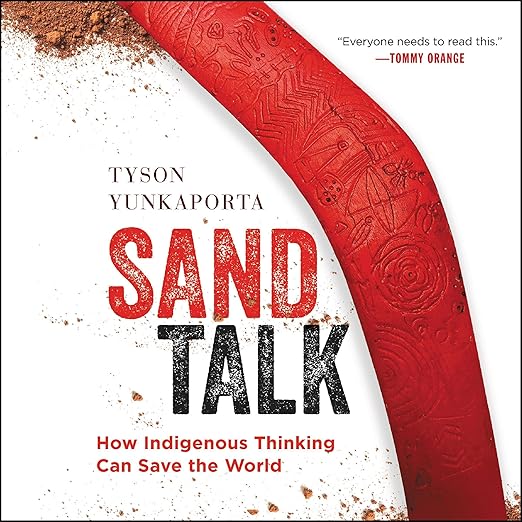
In Brief
- Read by: Yunkaporta reads his own work, and the self-narration is crucial - his voice carries the wry humor and the Aboriginal cadence of the text in ways that print alone cannot fully transmit.
- At its heart: Indigenous epistemology, custodianship versus ownership, alternatives to Western individualism
- Vibe: Dense, irreverent, and genuinely mind-expanding
- Short version: One of the most genuinely challenging and rewarding nonfiction audiobooks of recent years - difficult on first pass but worth returning to, and better in audio than in print.
I read Sand Talk in print first, which I now think was a mistake. Not because the writing is poor - Tyson Yunkaporta is a gifted, funny, sharply intelligent writer - but because the material works differently when you are hearing it rather than parsing it on a page. I went back to the audiobook after struggling with the density of the text, and something that had felt like an intellectual obstacle became something closer to a conversation. I finished it twice in audio before I felt I had actually understood what Yunkaporta was offering.
That is not a criticism. Books that require two passes are not failing. They are inviting something from the reader that most books do not bother to ask for.
Where This One Lands
Tyson Yunkaporta is an Aboriginal Australian academic who is also a woodcarver, and his writing process literally begins with images rather than words - he carves what he wants to say, then finds language for it. This is not a stylistic affectation. It is a description of how knowledge works differently when it is carried in objects and stories and relationships rather than in linear argument. The book moves through education, money, power, sustainability, and cultural memory, examining each through the lens of Aboriginal cosmology and modes of thinking.
Yunkaporta is a Western-trained academic who is also deeply embedded in his culture of origin, and that dual positioning gives him the ability to translate between systems without romanticizing either. He is not asking Western readers to abandon their ways of knowing. He is asking them to notice the assumptions those ways of knowing contain, and to consider what might be available outside them. The subtitle positioning this as a paradigm-shifting book in the vein of Sapiens is accurate in ambition if not in style - this is a denser, stranger, more challenging read than Harari, and more rewarding for it.
Why Sand Talk Works as an Audiobook
One reviewer who read both the print and audio versions specifically recommended buying the audiobook after finding the print difficult to get through. The self-narration by Yunkaporta is a significant part of why. His voice carries a humor that the text signals but does not fully deliver without the timing - he is genuinely funny, in the dry, self-aware way of someone who has spent decades translating between incompatible worldviews and learned to find the absurdity in the translation. A professional narrator would have delivered the words correctly. Yunkaporta delivers the world behind the words.
At seven hours and forty-nine minutes, the book is not long, but it is dense. The supplemental enhancement PDF that accompanies the audiobook is worth downloading for listeners who want visual access to Yunkaporta's diagrams and carvings - the audio is complete without them, but the visual material illuminates what he is describing when he talks about sand talk as a knowledge-transmission practice.
What Gives Us Pause
The book has been compared to Robin Wall Kimmerer's Braiding Sweetgrass, and the comparison is apt - both are Indigenous academics who are also Western-trained, both are trying to translate knowledge systems across a significant cultural gap, and both are doing so with genuine humor and self-awareness rather than with the solemnity that such projects sometimes assume. Sand Talk is denser and more theoretically ambitious than Braiding Sweetgrass, which makes it a harder listen but also a potentially more disorienting one in the productive sense.
One reviewer who identifies as from European Western modern culture noted that you will not relate easily to all this author says, and added that this requires pushing through. That is honest and accurate. The book is not asking for easy relation. It is asking for something closer to permeability - a willingness to hold your own assumptions loosely enough that alternative frameworks can do some work on you.
Who Should Pick Up Sand Talk
Listeners who found Braiding Sweetgrass rewarding and want something with more theoretical density and sharper political edges. Readers interested in alternative epistemologies, sustainability thinking, or Indigenous studies who want to engage with a primary source rather than a summary. Anyone willing to listen twice, which Yunkaporta's own readers consistently recommend. Not well-suited for listeners who need linear argument and clear takeaways - the book's form reflects its content, which means it does not resolve into easy conclusions. The audiobook is, by the report of readers who have experienced both, the superior format for this particular title.