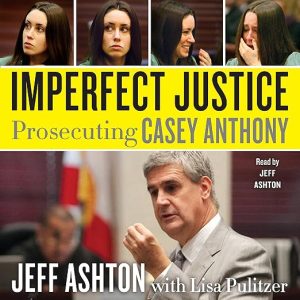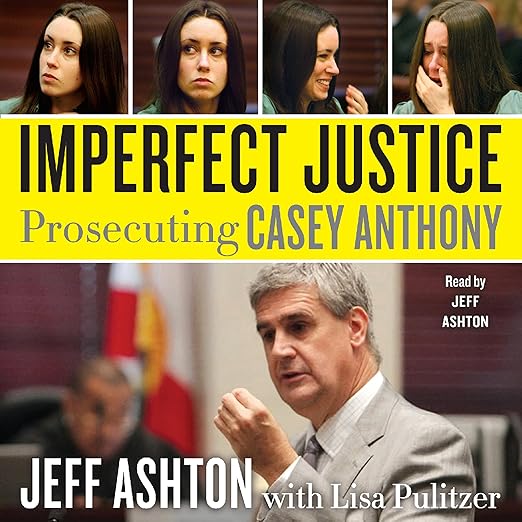
The Casey Anthony trial was one of those events that stopped people in the middle of ordinary days. I remember the verdict landing while I was at a coffee shop, and watching the reactions around me as the news spread. Jeff Ashton, one of the lead prosecutors in that case, narrates his own account of it in Imperfect Justice, and listening to him tell it is an experience unlike a conventional true crime audiobook. This is a participant's testimony, not a journalist's reconstruction, and the distinction matters in ways both productive and limiting.
Ashton spent years building the case against Casey Anthony for the murder of her daughter Caylee, only to watch the jury return a not guilty verdict in less time than it took to present the prosecution's case. That experience is still raw in the narration, and Ashton does not pretend otherwise. He believes Anthony was guilty. He believes the jury failed. He wrote this book partly to explain the evidence he thought was sufficient and partly to process a professional and moral wound that had not healed when the book went to press.
Is Imperfect Justice Worth Your Time?
What makes this genuinely valuable is the evidence walkthrough. Ashton is methodical about explaining the forensic science: the chloroform searches, the duct tape, the car trunk decomposition evidence, the behavioral timeline of Anthony's actions in the thirty-one days between Caylee's disappearance and the report to police. He does not dumb these down, and his explanations of why the prosecution found the evidence compelling are clear enough that listeners can form their own judgments. Reviewer Amazon Customer from the United Kingdom praised "very good explanations of the scientific evidence presented by the prosecution team," and that section of the book is its strongest.
The reviewer who was a fellow attorney raised the significant professional critique: it is not customary or particularly collegial to scrutinize opposing counsel's work product in a published book. That criticism has merit. Ashton is sharp about the defense team in ways that would raise eyebrows in a bar association. His frustration with the jury is also barely contained, and there are passages where the tone veers from analytical to accusatory in ways that undermine his credibility as a neutral witness to his own case. He is not a neutral witness, and the book is more interesting when it stops pretending to be one.
The Best Parts of Imperfect Justice
The self-narration is both the book's advantage and its limitation. Ashton reads with a prosecutor's cadence: measured, building, precise. When he is walking through evidence, that quality serves the material well. You understand both what was presented and why he believed it would be persuasive. When he is expressing his feelings about the verdict, the same cadence makes him sound more brittle than he probably intends. There is a controlled quality that suggests a man who has been giving press interviews about this case for years and has learned to modulate his emotions in public, while still not being quite able to modulate them fully.
At eleven and a half hours, the book does not waste time on material unrelated to the case. Reviewer Weezie From Dartmouth noted that "there were no boring sections," and that is accurate. Ashton moves efficiently through the investigation, the pre-trial proceedings, and the trial itself, with enough narrative momentum that the length does not drag.
Before You Commit to Imperfect Justice
This is advocacy, not reporting. Ashton makes that clear, but it is worth repeating for listeners accustomed to the more neutral posture of documentary true crime. The title itself signals the position: the justice was imperfect because the person he believed was guilty walked free. That framing shapes every chapter. The defense's theory of the case is presented and then methodically dismantled. The jury's reasoning is presented and then found wanting. You are reading a prosecution brief as memoir.
That said, the Anthony case is old enough now that most listeners will come to it with existing opinions rather than blank slates. For those who followed the trial and shared Ashton's frustration with the verdict, this account will function as thorough validation. For those who think the jury verdict was defensible given the burden of proof, this will be a useful if sometimes infuriating window into how the prosecution thought about its own case.
The Right Listener for Imperfect Justice
True crime listeners who followed the Anthony case will find this the most thorough and immediate account available from the prosecution's side. The evidence section alone justifies the listening time for anyone who has questions about what the prosecution actually presented and why. Listeners who prefer balanced, journalistic true crime accounts should be aware that this is explicitly not that kind of book. If prosecutorial perspective and its frustrations interest you as a subject in themselves, there is also a meta-level reading of this book as a document about how lawyers process defeat.
Good to Know
Does Imperfect Justice require prior knowledge of the Casey Anthony case, or does Ashton provide enough background?
Ashton provides sufficient background on the case to follow the narrative without prior knowledge. However, listeners who followed the trial live will get significantly more from the book, since Ashton often comments on how specific evidence played in real time versus how he hoped it would land.
How does the self-narration change the listening experience compared to a professional narrator?
Ashton reads with a lawyer's precision, which works well during the forensic and evidentiary sections. In the more emotionally charged passages about the verdict, the controlled delivery can feel slightly stiff. Overall it is a functional narration that gives the account an authenticity a hired narrator could not replicate.
Is this book critical of the defense team or the jury?
Yes to both, openly. Ashton examines the defense's tactics with prosecutorial critique, and his frustration with the jury's reasoning is explicit in the final chapters. A fellow attorney reviewer noted that publicly criticizing opposing counsel's work product is unusual professional conduct, so readers should know the book is not generous toward the defense.
When was this written relative to the trial, and does the time gap affect the account?
The book was published in late 2011, just months after the July 2011 verdict. Ashton was writing while the case was still raw, which gives the book an immediacy that would be harder to sustain from a greater distance. It also means the analysis has not had time to settle or reconsider.