In Brief
- Voice: The four-narrator production with Jorjeana Marie, Will Damron, Cassandra Morris, and Michael Crouch is a masterclass in ensemble audiobook casting.
- Big ideas: The forgotten casualties of World War II, survival as moral choice, secrets carried by refugees
- Atmosphere: Devastating and human, moving toward catastrophe with terrible inevitability
- Worth it?: Historical fiction that recovers an overlooked atrocity with genuine craft; the full-cast audiobook is the format this story was made for.
I was halfway through Salt to the Sea on a Wednesday morning commute when the full weight of what Ruta Sepetys was doing with structure hit me. The novel tells the story of four young people converging on the Wilhelm Gustloff in January 1945, each from a different occupied country, each carrying a different secret, each rendered in a different first-person narrative voice. And then you remember, knowing even a little of what Sepetys is building toward, that not everyone who boards a ship survives. The alternating POV structure is not just an aesthetic choice. It is the novel's central ethical act, insisting on the individuality of people who would otherwise be absorbed into a statistic.
The Wilhelm Gustloff disaster killed more than 9,000 people on January 30, 1945, making it the largest maritime loss of life in recorded history. It dwarfs the Titanic by a factor of six. Almost no one in the English-speaking world has heard of it, in part because the victims were predominantly German and Eastern European civilians and soldiers fleeing the Soviet advance, and their deaths were inconvenient to postwar narratives from multiple directions. Sepetys has made a career of these inconvenient histories, and Salt to the Sea is her fullest achievement in the form.
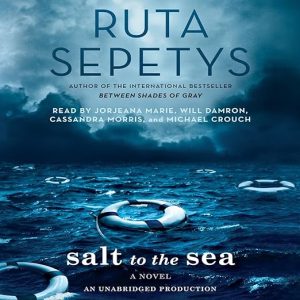
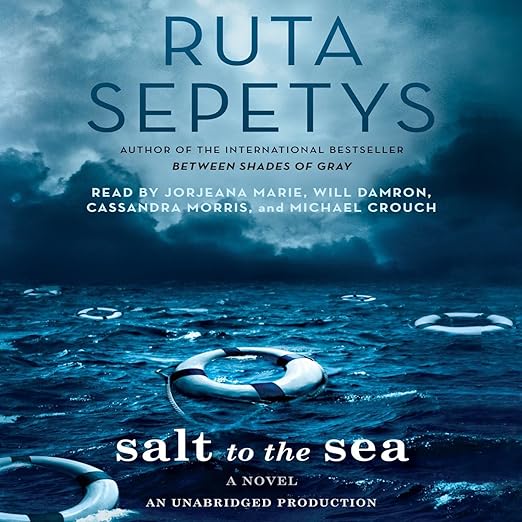
The four-narrator audiobook production, featuring Jorjeana Marie, Will Damron, Cassandra Morris, and Michael Crouch, is the way this novel should be experienced. Publishers Weekly gave the production a starred review, citing the narrators as superbly cast, and School Library Journal concurred, calling the narration mesmerizing. Jorjeana Marie leads as Joana, the Lithuanian nurse whose competence and guilt are the novel's moral spine. Will Damron's Florian carries a Prussian coldness that slowly reveals the vulnerability underneath. Cassandra Morris brings something heartbreaking to Emilia, the Polish girl whose secret is the most devastating. And Michael Crouch's Alfred, the delusional German sailor whose sections function as dark comedy and horror simultaneously, is arguably the most technically demanding part in the ensemble and Crouch handles it with complete control.
The decision to assign each POV character a distinct voice creates a listening experience where you always know whose consciousness you are inhabiting. One reviewer described the four narrators working together to create a vivid and well-rounded reading experience, and that collaborative quality is what elevates this production beyond the sum of its individual performances.
What Works
Sepetys writes historical fiction with a historian's conscience and a novelist's instinct for emotional specificity. The alternating POV structure, with short chapters that pass the baton rapidly between the four voices, creates a momentum that reviewers have described as impossible to set aside. The combination of propulsive structure and inevitable tragedy creates a reading experience that is genuinely unusual in its affective range.
The educational value is real and not at the expense of the narrative. A reviewer who described the novel as teaching them about the countries neighboring Germany during the war, Prussia, Poland, Lithuania, regions that standard history textbooks cover in a few sentences, was articulating what Sepetys achieves structurally. The four characters are chosen to maximize geographic and experiential breadth within the refugee population, so the reader emerges with a sense of the human scale of the displacement without ever losing the intimacy of the individual stories.
Things to Know Before Starting Salt to the Sea
This is not a comfortable listen. The novel is building toward a documented catastrophe, and Sepetys does not flinch from it. The final sections, covering the night of January 30 on the Gustloff, are harrowing in the way that earned tragedy is harrowing: felt rather than manufactured. Listeners who are currently working through grief or experiencing heightened emotional sensitivity should approach the ending with awareness of what is coming.
Alfred's chapters are written in a register that is deliberately disturbing: his delusion and complicity are rendered from the inside without authorial correction, which means some passages require the reader to do the work of moral judgment that the narrative withholds. Crouch handles this beautifully, but it is demanding material that requires active engagement.
Who It's For
This is essential listening for anyone interested in World War II from the perspective of occupied and displaced civilian populations rather than the familiar Allied vantage point. It works equally well for adults and mature teenagers, and multiple reviewers recommend it across that age range. Fans of Sepetys's other novels who have not yet reached this one should consider it her fullest achievement.
Listeners who find multi-POV historical fiction with a tragic outcome hard to sustain should be honest with themselves about the terms going in. This is not a novel that offers relief or rescue. It offers clarity, humanity, and the specific kind of dignity that comes from restoring forgotten people to the record.
A Few Questions About Salt to the Sea
Do I need to know about the Wilhelm Gustloff disaster before listening, or does the novel explain it?
Sepetys provides all necessary historical context within the narrative itself. The novel works as an introduction to the Gustloff disaster for listeners with no prior knowledge, and the historical note at the end of the book supplements the fiction with documentation. No prior research is required.
Is Salt to the Sea appropriate for young adult listeners, given its graphic content?
The novel is classified as YA and is widely used in high school curricula. The violence is present but not gratuitous, and Sepetys has been careful throughout her career to honor the historical material without sensationalizing it. Multiple reviewers recommend it for both teens and adults.
How does the four-narrator production affect the pacing of the novel?
The rapid POV alternation, with short chapters that switch between voices every few minutes, creates a propulsive effect that audio handles particularly well. The distinct voices mean there is no disorientation when the POV shifts, which is the primary risk in multi-narrator productions. The ensemble format is one of the reasons reviewers describe this as the definitive way to experience the novel.