
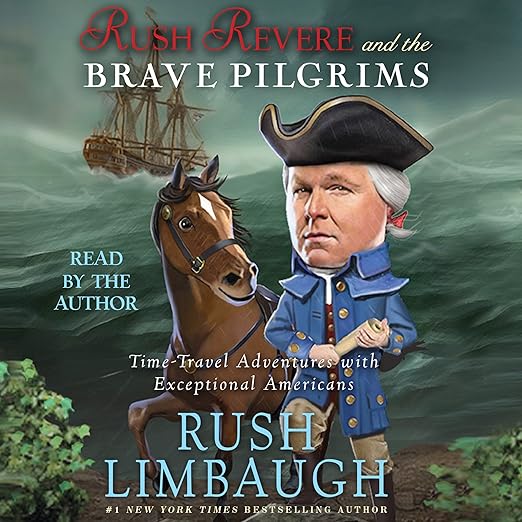
Pilgrims braving the Atlantic in a leaky wooden ship is one of those history lessons that kids tend to glaze over in textbooks. Rush Revere and the Brave Pilgrims turns that glazing into genuine curiosity, and this audiobook earns its reputation for landing that transformation consistently. The hook is simple but clever: Rush Revere, substitute history teacher, has a talking horse named Liberty who can open a time portal. Together with a couple of middle-school kids, they climb aboard the Mayflower in 1620. What follows is not a dry recitation of dates and treaties but an immersive visit, complete with seasickness, rationed biscuits, and the terrifying reality of landing in a new world with nothing but the clothes on your back and a covenant document no one is quite sure how to enforce.
Rush Limbaugh narrates his own story, and that is a decision worth discussing. He brings an obvious enthusiasm to the material, and the voice he adopts for Rush Revere is warm, slightly theatrical, and calibrated for a younger audience without ever sliding into condescension. Whether you agree with his politics or not, the man knows how to hold a room, and that skill translates to audiobook narration aimed at eight-to-twelve-year-olds. Parents who have been reading aloud with their children for years will recognize the particular energy he deploys, somewhere between a favorite uncle telling a campfire story and a teacher who genuinely loves his subject. He moves between voices for different characters with enough distinction that younger listeners can track who is speaking without visual cues.
What Works
The time-travel device exists entirely in service of the history, not the other way around. Limbaugh does not use the Mayflower voyage as set dressing for an adventure plot. The crossings, the brutal first winter at Plymouth, the cooperation that made the first Thanksgiving possible, the role of Squanto as interpreter and essential guide to survival, all of these get genuine and detailed treatment. Reviewers noted that their children were learning real history without realizing it, which is exactly the kind of praise that signals a book has done its job invisibly. The listener who finishes this audiobook will know why the Mayflower Compact mattered and what the phrase 'common store' meant for the early colonists in ways that stick precisely because they were experienced rather than memorized.
The talking horse Liberty functions as the comedic relief valve. Whenever the historical content risks becoming too heavy for its target audience, Liberty pipes up with something absurd. It is a reliable structural device, and it works particularly well in audio form because vocal timing matters enormously for comedy aimed at children. Limbaugh gives Liberty a distinct voice that kids will recognize immediately and find funny at exactly the moments the text needs them to laugh before returning to more serious material. The rhythm of that alternation, serious history followed by absurdist punctuation, is more carefully managed than it might appear on the page.
Before You Commit to Rush Revere and the Brave Pilgrims
This is a book with a point of view, and it does not try to hide one. The framing of early American history here is explicitly celebratory and patriotic, which is an artistic and editorial choice rather than a flaw, but parents who prefer their children's history presented with more ambiguity around conquest, displacement, and the treatment of Indigenous peoples will want to supplement this audiobook with other sources. The relationship between the Pilgrims and the Wampanoag is handled generously toward the colonists in ways that reflect a particular interpretive tradition. Knowing that going in allows parents to use the book as a conversation starter rather than a final word on the period.
The other thing to note is that this is the first book in a series that runs to five volumes, covering Paul Revere's midnight ride, the signing of the Declaration of Independence, the Constitutional Convention, and the Civil War. As a series opener, it establishes the characters and the mechanics of the time-travel conceit more than it delivers a tightly structured narrative arc. For younger listeners still building the habit of sustained attention, that low-stakes structure is actually an asset: each historical stop is self-contained enough to feel complete even if the listening session ends early. For older or more experienced readers in the target age range, the book can feel slightly thin in its fictional scaffolding even as the historical content is solid and specific.
Who It's For
This audiobook is well suited for children between the ages of seven and twelve, particularly those in the early stages of studying American colonial history. Road trips are an ideal setting, as one reviewer discovered with her own kids. The episodic nature of the storytelling and the short chapter runtime make it easy to pause and resume, and the humor gives adults in the car something to smile at alongside the kids. Homeschooling families and parents looking for supplementary material that makes early American history feel tactile and real will find genuine value here. Those expecting a neutral or multiple-perspective account of the colonial period should look elsewhere, but within its chosen patriotic framework, this is a competent and energetic introduction to a foundational chapter of American history that children tend to retain well past the listening session.
A Few Questions About Rush Revere and the Brave Pilgrims
Does this audiobook work for children who have no interest in history?
The time-travel setup and the talking horse Liberty are designed precisely for that listener. Several parents noted their children were absorbing real historical detail without feeling like they were studying.
Is Rush Revere and the Brave Pilgrims appropriate for the full elementary age range?
The content suits ages seven through twelve, though younger children in that range will get more from listening with an adult. Older listeners in the range may find the plot stakes low even as the historical content is substantive.
Do I need to start this audiobook series at book one?
Yes. The characters of Rush Revere, Liberty the horse, and the student companions are introduced here and carry through the subsequent volumes. Starting at book one is the right call.
Does the audiobook version add anything beyond what is in the print edition?
Limbaugh's narration is the primary reason to choose audio over print for younger listeners. He gives Liberty a distinct comedic voice and brings the historical set-pieces the kind of energy that reads as genuine enthusiasm rather than professional performance.







