
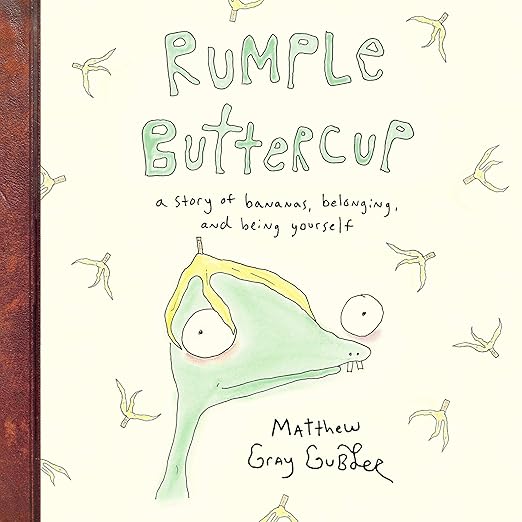
Twelve minutes is not much of a listening session. I put this one on while making tea one morning, fully expecting something pleasant but slight. By the time the kettle boiled, Matthew Gray Gubler had read his own book to me in its entirety, and I sat down at the kitchen table for a moment longer than I intended.
Rumple Buttercup has five crooked teeth, three strands of hair, and green skin. His imaginary friend is made of trash. His name is Candy Corn Carl. The book is exactly as described: a story about a small, weird creature learning that his weirdness is not a defect. What makes it work is that Gubler narrates it himself, and his performance is the thing that elevates this from charming picture book to something a little stickier.
Where This One Lands
Gubler is an actor with a very particular register: warm, slightly odd, earnestly sincere without tipping into saccharine. That register is exactly right for Rumple Buttercup. The book's message, that everyone is weird and different and that is what makes people wonderful, is not a new one. Gubler's delivery earns it anyway. Reviewers have compared the experience to the classic What-a-Mess by Frank Muir, which is apt: both books locate dignity in characters who are conspicuously out of step with the world around them, and both manage to be funny about it without mockery. A first-grade teacher noted that her students understood immediately why Rumple was hiding and felt his situation with emotional sophistication. That is the measure of a book that works on multiple levels despite its brevity.
The Best Parts of Rumple Buttercup
The author-narrated format is the right choice here. Gubler wrote and illustrated this book, and his performance carries that ownership. He does not perform the text as a professional narrator would: there is no theatrical range-shifting or character differentiation in the conventional sense. What there is instead is something warmer, a person reading their own story the way they heard it in their head when they wrote it. For a book this short, that intimacy is the whole experience. Parents who have read aloud to children will recognize how much a reader's genuine investment changes the way a text lands. At twelve minutes, this is a perfect read-aloud to do together after listening, because children will want to.
Points to Consider
The brevity is both the book's greatest strength and its primary limitation. At twelve minutes, there is no room for narrative development in any conventional sense. Rumple's journey is emotional rather than plot-driven: he moves from hiding to belonging, and the mechanism of that shift is understated. Listeners who approach this expecting story beats and character arcs will find it too short. The book operates instead like a sustained image: Rumple, his crooked teeth, his three strands of hair, his friend made of trash, and the slow opening outward to a world that turns out to be stranger and more welcoming than he feared. The humor is gentle and specific; Gubler does not telegraph jokes but trusts them. That restraint is part of what makes the book land differently than a typical picture book read-aloud.
Who Should Pick Up Rumple Buttercup
This is the rare children's audiobook that works for parents as much as for children. The age range is genuinely broad: the core audience of four to eight year olds will connect with Rumple immediately, but adults who pick it up alone, which some clearly do, will find something in it too. Reviewers over sixty reported reading the series with as much pleasure as their grandchildren did. Teachers looking for a short, emotionally rich discussion starter for younger grades will find it useful. Those who need more narrative substance in their children's audio will want to pair this with something longer, but as a twelve-minute mood reset or a pre-nap listen, it is exact.
Gubler has continued writing and illustrating children's books since Rumple Buttercup, and readers who find this one resonate will want to explore the others. But this first book stands as the clearest statement of his sensibility: that being unusual is not a problem to solve, that imaginary friends made of trash have dignity, and that belonging can be found in the most unexpected corners of the world. In audio, with Gubler's own voice carrying those ideas, the effect is more direct than it has any right to be. Some picture books work better as objects, as things held and looked at. This one works equally well as something heard.
Is Rumple Buttercup really only 12 minutes long?
Yes. The audiobook is the picture book read in full by the author. It is best understood as a complete, concentrated experience rather than a longer narrative, and at that length it works well for short listening windows or as a prelude to reading the physical book together.
Does Matthew Gray Gubler's narration work if children don't know him from Criminal Minds?
Completely. His performance has nothing to do with his television persona. He reads with warmth and genuine investment, and children who have never heard of him respond to it the same way.
Is this suitable for children who struggle with feeling different or left out?
Yes, thoughtfully so. The book does not pretend difference is painless, and Rumple's discomfort feels real before the resolution does. That honesty is part of why children seem to connect with it on a deeper level than simple reassurance books.
Does this work as an audiobook without the illustrations?
Mostly, though the illustrations add a layer of visual comedy that audio cannot replicate. Gubler's vocal performance compensates significantly, but if possible, pairing the audiobook with a look at the physical book enhances the experience.







