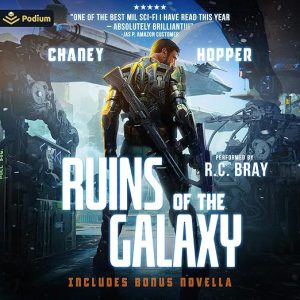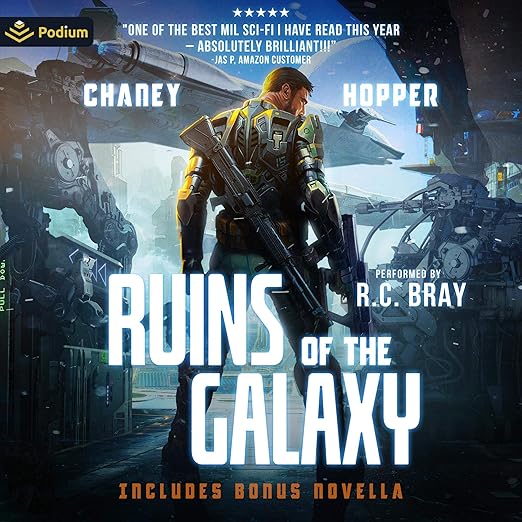
I came to Ruins of the Galaxy during a period when I had burned through most of my usual queue and wanted something that would move. Not literary ambiguity. Not narrative complexity for its own sake. Pure forward momentum with characters worth following. J.N. Chaney and Scott Moon's first series entry delivers that with enough character texture to justify the investment in what is clearly a very long ride.
The setup is efficient and deliberately cinematic: Lieutenant Magnus and his 79th Recon Team escort a peace summit emissary, an explosion scrambles everything, a dying alien chieftain presses a crucial intelligence drive into the wrong hands, and suddenly a simple escort mission threatens the entire galaxy. You have seen this architecture before if you have spent any time in military SF, but the execution is clean and the character work saves it from feeling like a checklist of genre requirements.
What We Made of It
The book's two structural pillars are Magnus and Awen, and the deliberate contrast between them carries more weight than the plot mechanics. Magnus is the Republic Marine: pragmatic, physically capable, professionally excellent. Awen is a Luma, gifted with something that functions like Force sensitivity, idealistic and navigating her first real-world assignment after being blindsided by a mentor. Reviewer Catherine Mackay called her brilliantly drawn, and the description is apt. Awen's arc in this first book, from institutional idealism to hard-won competence, is the more interesting of the two trajectories, though Magnus anchors the action sequences effectively and gives the military SF audience a reliable entry point.
The comparison to Star Wars is unavoidable and intentional. The galaxy-spanning politics, the Force-adjacent abilities, the military culture: all of it sits in that tradition. Reviewer K. Page, who discovered this during COVID isolation, noted having to turn it off when making too much noise, which is a genuine signal about the book's claim on attention. The difference from derivative genre fiction is that Chaney and Moon give their characters actual stakes and consequences rather than relying entirely on familiar trappings to do the narrative work.
The Best Parts of Ruins of the Galaxy
R.C. Bray is an Audie Award winner for a reason. His voice carries the weight and cadence of military authority without tipping into parody, and his range across the ensemble cast keeps distinct characters identifiable across a 14-hour runtime. In a multi-POV military SF audiobook, the narrator functions almost as a director: Bray makes choices that clarify whose perspective we are in and what emotional register the scene demands. He is particularly strong in the action sequences, where pacing decisions matter enormously. This is one of the better matchups of narrator to material in the genre, and it is a significant reason to choose the audio version over the text.
What Might Not Land
This first book does the work that all series openers must do: it establishes the world's rules, populates it with a cast worth caring about, and ends at a point that demands continuation without being dishonestly incomplete. The bonus stories included, The Night of Fire and Demons at War, extend the world's edges without disrupting the main narrative's momentum. They work best as an epilogue after the main text rather than as interruption.
One reviewer noted finding the series after studying covers and synopses across Amazon for a while, then discovering this was the right place to start. That speaks to the book's structural clarity: it is genuinely accessible as a first entry into this corner of the genre, even for listeners new to military SF as a category.
Who Should Listen to Ruins of the Galaxy
Listeners who enjoy military SF in the Galaxy's Edge or Expeditionary Force tradition will find this comfortable territory that offers a bit more character complexity than average. If you need slow-burn literary depth, this is not where to look. But if you want a cinematic, well-voiced space opera with two protagonists worth following across a long series, this is a very competent starting point. Begin here, not mid-series.
Frequently Asked Questions
Do I need to have read J.N. Chaney's other series before starting Ruins of the Galaxy?
No. Ruins of the Galaxy is a standalone series opener with its own world and cast. No prior familiarity with Chaney's other work is required, and the book is built to be accessible to new readers of military SF.
How does R.C. Bray handle the dual POV structure between Magnus and Awen?
Bray distinguishes the two protagonists effectively, giving Magnus a grounded command-weight delivery while keeping Awen's perspective warmer and more uncertain. In a 14-hour listen, that distinction prevents the POV shifts from becoming confusing.
How closely does Ruins of the Galaxy resemble Star Wars in tone and content?
The comparison is real and intentional. Galaxy-spanning politics, a Force-adjacent ability system, military culture, and an ensemble of heroes against a vast enemy all echo Star Wars structurally. The authors credit Galaxy's Edge and Battlestar Galactica as touchstones. It is inspired rather than imitative.
Are the bonus stories included in the audiobook worth listening to?
Yes. The Night of Fire and Demons at War extend the world's lore and deepen character context without being essential to the main plot. They work best as an epilogue after finishing the primary narrative.