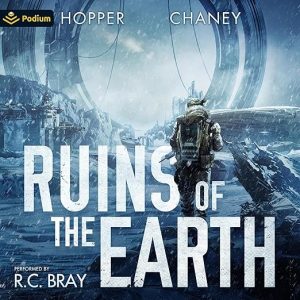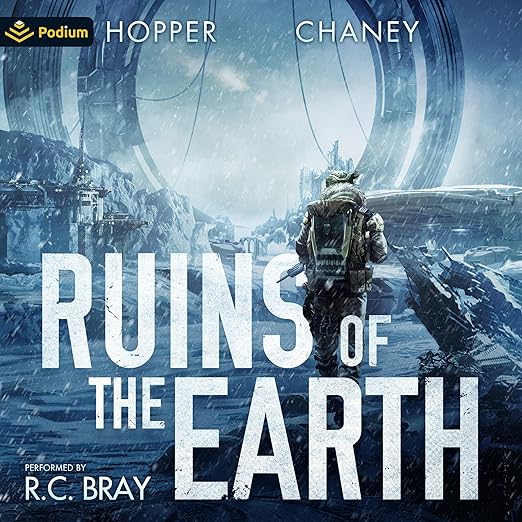
Patrick 'Wic' Finnegan doesn't want to be in Antarctica. That's the first thing Ruins of the Earth establishes about its protagonist, and it's the right first thing. A Brooklyn-born master gunnery sergeant on his last op before retirement, grudgingly accompanying a research team to the Ellsworth Subglacial Highlands as a favor he wishes he hadn't agreed to, Wic narrates his own inconvenience with professional fatalism. Christopher Hopper and J.N. Chaney designed him as a character before they designed him as an action vehicle, and that ordering of priorities shapes everything that follows. The audiobook's opening hours are essentially a character study in military attitude and competence before they're an alien invasion story, and the distinction matters for why it works as well as it does.
The Verdict, Briefly
The premise takes its time getting to the science fiction element. The early chapters establish who Wic is, what he values, how he processes his environment, and why he's worth spending sixteen hours with before asking him to face the impossible. When the research team's discovery shifts from archaeological curiosity to existential emergency, the transition is earned because you've had time to understand exactly who Wic is before asking him to process the unprocessable. The portal that opens in the Antarctic subglacial highlands and unleashes what the synopsis calls a storm of unbridled fury upon humanity is not a surprising plot beat in military sci-fi terms, but Hopper and Chaney use it as a character crucible rather than just an action generator.
One reviewer described the action as starting in familiar genre territory and escalating to something that genuinely surprised them, and that arc is real. The early chapters establish conventions in order to have room to subvert them. Another reviewer was charmed despite initial skepticism, noting the book follows a familiar pattern before introducing something that shifted their investment entirely. The co-writing partnership between Hopper and Chaney, who have collaborated on multiple successful military sci-fi series, is smooth enough that no seams are visible in the narrative voice.
Why Ruins of the Earth Works as an Audiobook
R.C. Bray's performance is the primary reason to choose the audiobook over print for this series opener. His track record with military sci-fi, most notably the Expeditionary Force series where his Joe Bishop performance became definitional for that character, means he understands the register completely: wry, physically capable, able to convey tactical thinking and human exhaustion simultaneously, and genuinely funny when the material calls for it. The Brooklyn Marine voice for Wic requires that kind of specificity, and Bray delivers it without slipping into caricature.
At nearly sixteen hours, Ruins of the Earth is a substantial audiobook, and Bray's pacing across the full runtime maintains energy without becoming monotonous. The from-Antarctic-tundra-to-Manhattan escalation that the synopsis promises is handled with proper cinematic scale, and Bray's delivery keeps the action sequences spatially legible even when multiple simultaneous threats complicate the geometry. One reviewer mentioned laughing so hard in a workplace setting that they were grateful to be alone, which is a specific response that Bray's comedic timing with Wic's internal monologue will plausibly generate across the audio experience.
Points to Consider
A skeptical reviewer flagged the character assembly as implausibly convenient: a Marine Raider, a Navy SEAL, and an Air Force pararescue specialist all crossing paths and instantly bonding feels engineered. That criticism is fair, and it's a structural feature of military sci-fi in this tradition that requires some suspension of disbelief regarding coincidence. The competent-Americans-hold-back-the-planetary-threat framing will also either read as genre convention or as ideological furniture depending on the listener. The authors pitch this as being for fans of District 9, Expeditionary Force, and Galaxy's Edge, and that's accurate: if those titles have worked for you, this will too. If they've not worked, the same issues will be present here.
The series continues beyond this volume, and the ending establishes rather than resolves the larger conflict. Wic's situation at the end of the audiobook is clearly a setup for what follows in the Ruins of the Galaxy sequence. The immediate narrative arc has enough resolution to feel satisfying, but listeners who need complete closure should know that the world-threatening situation is far from concluded when the credits roll.
Who Should Listen to Ruins of the Earth
Military sci-fi readers who have enjoyed R.C. Bray's narration on other series will find this a natural next listen. The character voice he constructs for Wic Finnegan is among his best, and spending sixteen hours with it is a genuine pleasure for listeners who value narration as part of the experience. Fans of Chaney and Hopper's other collaborative projects will recognize the co-writing dynamic and the character-first approach to genre storytelling that distinguishes their work from plot-delivery vehicles.
Listeners who want sustained action with a protagonist whose voice they can spend extended time with should find Ruins of the Earth satisfying. Those who require fresh structural invention in their science fiction premises, or who find the competent-operators-save-the-world template narratively limiting regardless of execution, will find the craft good but the architecture familiar. This is book one of a running series, and it functions accordingly: the world is established, the relationships are forged, the larger threat is defined, and the ground is laid for everything that follows. For listeners who invest the sixteen hours, the world Hopper and Chaney build justifies the investment. R.C. Bray's performance is the reason to prioritize audio over print.
- Read by: R.C. Bray is one of the most reliable military sci-fi narrators working, and Ruins of the Earth is squarely in his wheelhouse. Wic Finnegan's Brooklyn-born Marine voice lands with authority and comedy in equal measure.
- At its heart: First contact and planetary crisis, military brotherhood forged under impossible odds, the cost of competence
- Vibe: Kinetic and wryly funny in the early chapters, increasingly apocalyptic as the Antarctic discovery goes catastrophically wrong
- Short version: A strong opening to the Ruins of the Galaxy series that earns its Expeditionary Force comparisons through genuine character work rather than just marketing adjacency.
Do I need to read other books before listening to the Ruins of the Earth audiobook?
No. Ruins of the Earth is book one of the Ruins of the Galaxy series and serves as the complete entry point. No prior knowledge of Hopper or Chaney's other work is required, and the world is built from the ground up in this first volume.
Is the Ruins of the Earth audiobook suitable for listeners who don't normally read science fiction?
The strong character focus in the early chapters makes it more accessible than harder SF. If you enjoy military action stories and can accept a portal to another dimension opening in Antarctic ice, the sci-fi elements don't require genre fluency to follow. The humor also makes the premise easier to sit with.
Does the Ruins of the Earth audiobook have a satisfying ending or does it cut off mid-story?
The immediate narrative has enough resolution to feel complete, but the series arc is established rather than finished. Wic's situation at the end sets up what follows in the Ruins of the Galaxy sequence. It's a satisfying enough stopping point that you won't feel stranded, though the larger threat remains very much unresolved.