In Brief
- Voice: Kevin R. Free has fully inhabited Murderbot at this point in the series, his flat affect for the SecUnit's internal commentary lands the comedy without overselling it.
- Big ideas: Identity under surveillance, the ethics of corporate power, antisocial heroism
- Atmosphere: Wry and propulsive, with genuine emotional undercurrents
- Worth it?: The third Murderbot novella is the series finding its full stride, sharp, funny, and quietly affecting in ways the runtime should not allow.
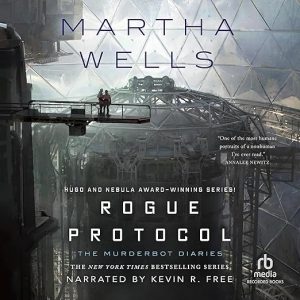
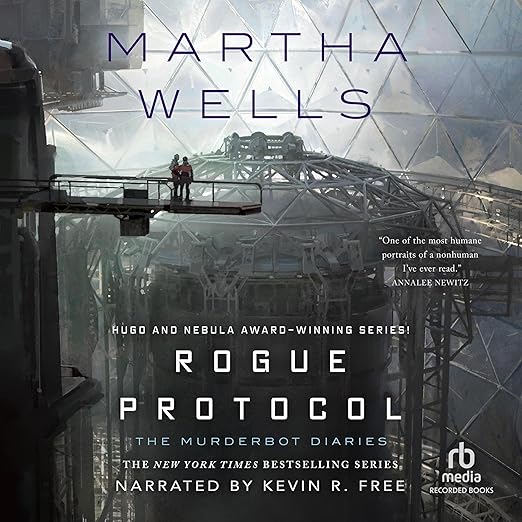
Martha Wells has done something genuinely difficult with the Murderbot Diaries: she has made a character whose primary desire is to be left alone into one of the most compelling presences in recent science fiction. Rogue Protocol, the third audiobook in the series, demonstrates exactly how that trick works, and Kevin R. Free's narration is a significant part of the mechanism.
By the time Murderbot reaches this installment, Wells has established enough of the character's interior logic that the book can afford to let the comedy breathe. Our SecUnit, now traveling under the assumed name Rin, is not on a heroic mission. It is trying to gather information that might help Dr. Mensah's case against GrayCris Corporation while simultaneously avoiding the kind of attention that would lead anyone to ask inconvenient questions about where exactly Dr. Mensah's SecUnit actually is. The gap between those modest ambitions and what actually happens is where the series lives.
What Martha Wells Delivers
At 3 hours and 46 minutes, Rogue Protocol is a novella in the fullest sense, tight, purposeful, with nothing wasted. Wells does not use the short form as an excuse for thinness. The GrayCris storyline that runs through the entire Murderbot Diaries arc advances here in ways that matter, and the new characters Murderbot encounters aboard a transport unit are sketched quickly but with enough specificity that their fates carry weight. There is a robot companion in this installment whose interactions with Murderbot produce some of the series' most unexpectedly affecting moments, the relationship between them says more about Murderbot's emotional development than several pages of interior monologue would.
One reviewer covering the full series described the writing as wry, witty, and effective, and that is accurate without being sufficient. Wells manages tonal range that most full-length novels fumble. The horror is real when it arrives. The comedy does not undercut the stakes. The action is spatially coherent in a way that matters enormously in audio format, where you cannot flip back to a map or a diagram to reorient yourself.
What Martha Wells Gets Right
Kevin R. Free has been narrating this series from the beginning, and by the third installment the performance has a settled confidence. Free's interpretation of Murderbot's internal voice, the running commentary on human behavior, the dry observations about social scripts the SecUnit cannot quite replicate, the specific register of someone who has watched thousands of hours of serialized television and now filters every situation through narrative structure, is the audiobook's central achievement. The flat affect that Free deploys is not emotionless; it is the voice of a character who has learned to protect its actual feelings behind procedural competence.
The supporting human characters are also well-differentiated. Wells writes people who are competent without being infallible, and Free finds distinct registers for each. The audio format suits the Murderbot Diaries well because so much of the series' appeal is rhythmic, the comic timing of Murderbot's interior interruptions of external action depends on pacing that Free handles with the precision of a practiced reader of this material.
Where Martha Wells Loses Some Ground
Newcomers should not start here. The series is best read from All Systems Red, the first installment. The character development that makes Murderbot's emotional beats in Rogue Protocol land depends on what happened in books one and two. A reviewer noting this is the third in the series confirmed that the books are best enjoyed in order. The GrayCris corporate antagonist also requires prior context, arriving at this book without having encountered the setup would leave significant amounts of the tension without grounding.
It is worth pausing on what Wells is doing structurally with GrayCris. The corporation is not merely a convenient antagonist but a specific portrait of the kind of institutional power that evades accountability because it operates through complexity rather than malice. The SecUnit's problem with GrayCris is not that the corporation is evil in any simple sense but that it is large and profitable enough that the mechanisms designed to hold it accountable are insufficient. That political dimension runs under the surface of the novella without ever reducing it to polemic, it remains adventure fiction, but adventure fiction with a coherent argument about corporate accountability underneath.
The price-to-length ratio of the Murderbot novellas is a point some listeners raise, and it is worth acknowledging directly. At under four hours, this is a short audiobook, and the per-hour cost is higher than most full-length productions. Whether that calculus works for a given listener depends on how much they value the specific quality of what Wells delivers. Those who find the series compelling will not begrudge the runtime. Those approaching it as comparison shoppers looking for maximum duration may want to wait for a bundle.
Who Should Pick Up Rogue Protocol
Series readers who have completed the first two novellas should move directly to this one, the momentum building through the GrayCris arc and the emotional arc of Murderbot's growing relationships with various humans and robots rewards continued investment. Fans of science fiction that treats corporate malfeasance as a serious structural problem rather than a backdrop will find Wells is doing something more considered than the genre conventions might suggest.
Anyone who has never encountered the Murderbot Diaries should start with All Systems Red. The series has won the Hugo Award for Best Series and the individual novellas have accumulated major genre awards, that recognition reflects genuine quality, not marketing. Rogue Protocol is the book where the formula, if there is one, has become completely confident in itself. Hugo Award winner Ann Leckie's praise for Murderbot is cited in the marketing for good reason: this is the kind of character-driven science fiction that earns its audience through sustained craft across multiple installments rather than a single impressive opening.