Quick Take
- Narration: Michael David Axtell sustains Isaac’s internal conflict with a controlled intensity that keeps the moral stakes audible beneath the action.
- Themes: Loyalty and betrayal, identity beyond training, queer belonging in unlikely places
- Mood: Fast and kinetic with an emotional undertow
- Verdict: A sharp magical school story that works because its protagonist’s mission puts him at genuine odds with everything he starts to want.
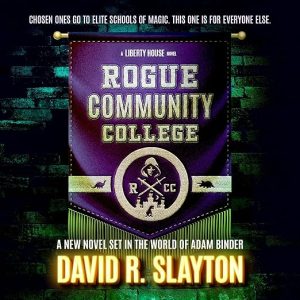
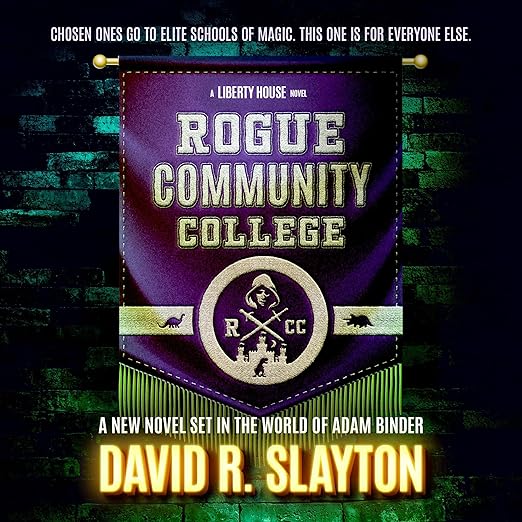
The magical school setup is one of fantasy fiction’s most reliable structures, and also one of its most scrutinized. David R. Slayton knows this. Rogue Community College earns its premise not by subverting the tropes but by placing an assassin at the center who is there to burn the place down. Isaac Frost is not hiding his past; he is hiding his present. That distinction does a lot of work.
I came to this book familiar with Slayton’s Adam Binder series, and while Rogue Community College is listed as the start of a new series set in that world, it functions well as an entry point for readers who do not carry that prior history. Isaac is new enough to Liberty House to require the same orientation the reader needs. The world is strange, the teachers are stranger, and the school’s indifference to student safety is a specific and welcome departure from the cozy magical institution template.
Our Take on Rogue Community College
Isaac’s special ability, absorbing the knowledge and power of others through a single drop of blood, is more interesting than standard assassin skill sets because it creates genuine moral weight. Using the ability on friends and enemies alike raises questions the book does not sidestep. His attraction to Vran, the Sea Elf who is himself carrying concealed knowledge about the school’s situation, develops in parallel with Isaac’s crisis of mission. These threads do not resolve neatly or easily, and that is the book’s primary strength.
Michael David Axtell’s narration keeps Isaac’s interior life present even in the sequences where the plot accelerates to its breakneck pace. Reviewers have called the pacing a highlight, and it is: Slayton moves quickly without losing the character work. The school’s chaotic faculty and eclectic student body are handled with enough specificity that Liberty House feels like a place rather than a set piece.
Why Listen to Rogue Community College
The moral engine is what separates this from comparable fantasy school narratives. Isaac is not lost and looking for belonging in the traditional sense: he is an agent of destruction who finds himself inconveniently developing reasons not to complete his mission. The question of whether he will follow through generates tension in a way that a conventional chosen-one arc cannot, because the reader is genuinely uncertain which outcome to root for as the loyalties complicate.
What to Watch For in Rogue Community College
Readers coming in without Adam Binder series background have noted wishing for more backstory on the wider world. Slayton writes with the efficiency of someone who has already established this universe, which occasionally means context is assumed rather than provided. This is not fatal but it does mean first-time visitors to Valdemar will spend some listening time assembling the geopolitical picture from context clues rather than exposition. The redemption arc structure, noted by one reviewer, is somewhat predictable in outline even if the specifics surprise.
What the book understands about magical school fiction that less considered entries in the genre miss is that the institution itself needs a relationship to harm. Liberty House is not the safe haven that school-fantasy protagonists typically require. Students get hurt. The teachers’ indifference to that harm is treated as a feature of the institution’s chaos rather than an oversight. Isaac, who has been raised in a far more explicitly violent environment, finds this familiar enough to be comfortable and specific enough to be disturbing, which is precisely the position that generates his most interesting choices.
Who Should Listen to Rogue Community College
Listeners who loved the Adam Binder series and want more time in that world will find this a generous expansion, particularly given Vran’s prominent role. Fantasy readers who find magical school premises appealing but want the protagonist’s relationship to the institution to carry genuine stakes should find Isaac’s position compelling. Those looking for cozy found-family academy fiction may be surprised by how dark the premise runs. This is a school story for readers who find safety boring.
Frequently Asked Questions
Do I need to have read the Adam Binder series before starting Rogue Community College?
No, though readers of that series will recognize Vran and the wider world. Slayton wrote this as a new series entry point, but context clues do most of the heavy lifting for newcomers.
How does Michael David Axtell handle the range of fantasy creature characters?
Axtell differentiates the student body and faculty with enough vocal distinction to keep the ensemble readable. Isaac’s internal monologue, which does a lot of narrative work, is delivered with consistent interiority.
Is the romance between Isaac and Vran a central plot element or secondary to the action?
It is woven through rather than separate. Their attraction develops against the backdrop of Isaac’s mission conflict, and Vran’s own concealed knowledge about the school makes the romance structurally load-bearing rather than ornamental.
Does Rogue Community College end on a cliffhanger or does it resolve?
Reviewers describe it as having a bittersweet but complete arc for the central storyline. It is the first book in a series, so threads continue, but the primary tension of Isaac’s mission and the school’s fate reaches a resolution.