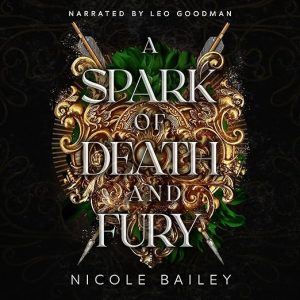
A Spark of Death and Fury audiobook opens in the ruins of divine order. The high gods have fallen, Zeus's place is empty, and what fills that vacancy is chaos: gods stepping into the power vacuum, treachery reshaping alliances, and a group of characters whose moral limits are being tested by the question of what they are willing to do to survive. Nicole Bailey has spent three books building toward this moment, and the fourth installment of the Apollo Ascending series carries the weight of everything that came before. Readers who arrive here without that context will be immediately disoriented. Bailey does not pause to explain the world to newcomers. She trusts, correctly, that everyone who reaches book four has already done the reading.
What Bailey does in this finale is collapse the series' central tensions into a single extended crisis. The scrabble to survive that the synopsis describes is not hyperbole. The plot forces its ensemble into corners where every choice has a cost and no outcome is guaranteed. One reviewer described it as a roller coaster of emotions with an ending that left them smiling all day. Another called it a beautiful and gut-wrenching end to an amazing series. A third emphasized the plotting, the worldbuilding, and the absence of loose ends in the conclusion. These responses converge on the same qualities: emotional impact delivered without cheap tricks, and a resolution that feels earned rather than manufactured after four volumes of setup.
What We Made of It
The LGBTQ+ representation in the Apollo Ascending series has been one of its defining features, and the finale does not treat that representation as a side note. The relationships, identities, and emotional stakes developed across four books are central to this volume's stakes rather than incidental to them. Temi, mentioned specifically by one reviewer as their favorite character, receives a resolution that satisfied even readers who feared a lesser outcome. That specificity of care, knowing which characters readers are most invested in and giving those characters endings that honor that investment, reflects Bailey's command of her ensemble. This is the kind of series conclusion that makes readers immediately want to re-read from the beginning, and multiple reviewers described exactly that impulse.
What Makes A Spark of Death and Fury Worth Hearing
Leo Goodman's narration carries significant responsibility in a series finale. The emotional extremes this story puts its characters through require a narrator who can move between intensity and intimacy without losing either, and who can give the larger battle sequences the same attention as the quieter character moments that carry as much weight as the action. The reports from readers who found the ending emotionally satisfying rather than hollow are partly a tribute to Bailey's writing and partly a testament to a performance that made the emotional stakes feel real through 11 hours and 25 minutes of increasingly high-pressure storytelling. Series audiobook narrators who maintain consistent characterization across four volumes provide a continuity that individual-book narrators cannot, and Goodman has done that work through the Apollo Ascending run.
The mythology Bailey draws on, Greek gods in a contemporary or near-contemporary setting, gives the series its structural framework, but the world she has built is specific to the Apollo Ascending universe rather than a straightforward adaptation of familiar myth. Listeners who know their Greek mythology will recognize the source material, but the divergences are substantial enough that the series functions as its own created world. That independence from the original myths means the finale can make choices that the source material would not allow, including resolutions for characters whose mythological counterparts have fixed fates. Bailey uses that freedom well.
What Might Not Land
The series prerequisite cannot be overstated. This is book four of four, and the emotional impact of this finale depends entirely on the investment built across the previous three installments. Readers who have not followed the Apollo Ascending series from the beginning should start with book one and work forward. The ensemble cast, the relationship histories, and the worldbuilding stakes are all load-bearing context for what happens here. The tone is significantly darker than the series' early volumes. The chaos that follows the fall of the high gods is handled with real weight, and the moral pressures placed on the characters push into territory that some readers may find intense. The ending has been widely described as satisfying rather than devastating, but the path to that ending is not easy or comfortable.
Bailey's handling of the moral complexity in this finale is worth noting separately from the plot outcomes. When the high gods fall and chaos fills the resulting vacuum, the story does not default to a simple opposition between good and evil characters. The beings who step up to claim Zeus's place are not straightforwardly villains. They are opportunists operating in a moral environment that the narrative has complicated over four books, and the characters at the center of the story are forced to make decisions that cannot be fully justified within a tidy ethical framework. That refusal to simplify is what makes the finale feel like literature rather than genre mechanics, and Goodman's narration sustains the ambiguity without losing the emotional core of each scene.
Should You Listen to A Spark of Death and Fury?
Listeners who have followed the Apollo Ascending series through its first three installments and are ready for the conclusion will find this exactly what a series finale should be: a full-commitment endpoint that honors the journey rather than rushing through it. LGBTQ+ readers who value explicit, centered representation in fantasy will find the series as a whole, and this volume in particular, worth the time investment. New listeners to the Apollo Ascending world should begin with book one, not because this book is inaccessible, but because its emotional power depends on context that only the earlier volumes can provide. Readers who prefer standalone fantasy or who are not interested in serial storytelling with a cumulative emotional arc should note that this series is specifically designed to be read in sequence.
A Few Questions About A Spark of Death and Fury
Does the A Spark of Death and Fury audiobook provide a satisfying series conclusion, or does it end on a cliffhanger?
The series concludes here. Multiple reviewers have specifically noted the lack of loose ends and the satisfaction of the resolution, with one describing it as a fine conclusion with no gaps. The path to the ending is intense and emotionally demanding, but the landing has been widely described as earned rather than abrupt.
How does this audiobook handle LGBTQ+ representation in the series finale?
The LGBTQ+ representation central to the Apollo Ascending series throughout remains central in this finale. Character relationships and identities are not sidelined in the crisis plot but are integral to its stakes and resolution. Reviewers have specifically highlighted character outcomes as satisfying rather than punishing.