Quick Take
- Narration: Janina Edwards brings authority and presence to Monica Miller’s scholarly prose, the right match for a cultural history that moves between academic analysis and vivid historical portraiture.
- Themes: Black dandyism, sartorial identity formation, Atlantic diaspora and cultural resistance
- Mood: Intellectually rich and historically sweeping, deeply rewarding
- Verdict: One of the more substantial cultural histories available in audio, essential listening for anyone interested in Black identity, fashion history, or the cultural politics of style.
I came across Slaves to Fashion in the week following the Met Gala, when the internet was full of commentary about Black dandyism and the Costume Institute exhibit that used Monica Miller’s research as its intellectual foundation. I had meant to read the book for years and never quite gotten around to it, so I queued up the audiobook and spent the better part of a week with it. It is a serious academic work, Miller is a professor of Africana Studies at Barnard College, but it is also one of those rare pieces of scholarship that earns its readership beyond the academy through the quality of its prose and the genuine significance of its argument.
The book’s central claim is that Black dandyism, far from being a frivolous affectation, has functioned historically as a site of identity formation, resistance, and political imagination. It begins with its imposition, the practice of dressing enslaved Black men in elaborate European livery as a form of conspicuous display by wealthy slave owners in eighteenth-century England, and traces how Black men took that imposed costume, transformed it, and made it something entirely their own. The dandy becomes, in Miller’s reading, a figure who uses the master’s tools to dismantle the master’s categories.
Our Take on Slaves to Fashion
The historical arc spans from Enlightenment England through Du Bois’s writings on Black masculinity, the Harlem Renaissance, and into contemporary art world figures. That is an enormous amount of ground, and Miller covers it with the kind of sustained analytical focus that lesser cultural histories diffuse into a collection of interesting anecdotes. Each chapter builds the argument, the dandy as a figure who breaks down limiting identity markers and proposes new ways of fashioning political and social possibility, rather than simply accumulating examples. Reviewer Vonda Lawrence found it essential enough to use in her AP African American Studies classroom, and the student response she describes, going to see the exhibit and making connections to the text, is exactly what good cultural history produces.
Why Listen to Slaves to Fashion
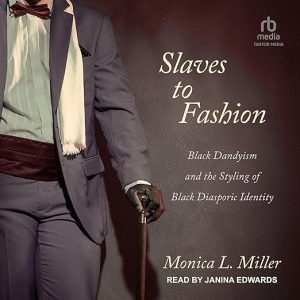
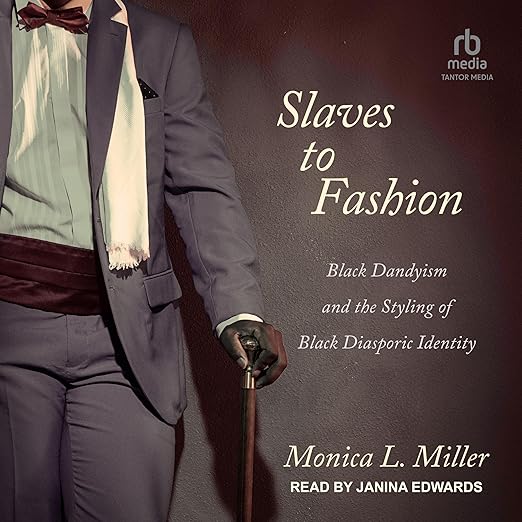
Janina Edwards’s narration is particularly well-suited to this material. Academic prose read aloud can easily become a monotone, but Edwards brings rhythm and emphasis that help Miller’s more complex sentences land without requiring the listener to re-read. For a 12-hour cultural history moving between eighteenth-century England, nineteenth-century American literature, and contemporary art criticism, that narration quality matters enormously. The reviewer who called it a scholarly tome and regretted the absence of photos was engaging honestly with the book’s nature, this is not a picture book, and the Met exhibit that accompanied it provided the visual component that the written text necessarily lacks. As an audiobook, the absence of images is not a problem the format can solve, but Edwards’s descriptive reading of Miller’s prose goes some way toward compensating.
What to Watch For in Slaves to Fashion
This is dense scholarly writing. Miller is operating at the intersection of literary criticism, cultural history, and art criticism, and the book demands some prior acquaintance with the fields it moves through, Du Bois, the Harlem Renaissance, the specific cultural politics of the Atlantic diaspora. Complete beginners to African American Studies may find some of the theoretical scaffolding challenging without additional context. The book also contains mature themes, as the listing notes, given that it engages directly with the history of slavery and its cultural consequences. This is not a warning about content suitability so much as a note that the material is substantive and historically serious.
Who Should Listen to Slaves to Fashion
Listeners with an interest in Black cultural history, fashion as a site of political meaning, or the cultural politics of the African diaspora will find this among the richest available treatments in audio form. Students of American literature and the Harlem Renaissance will encounter new frameworks for material they may know well. The audiobook works especially well for listeners who have some familiarity with the academic context and want to absorb Miller’s argument at the pace of a long walk or commute. Those looking for light cultural history or fashion biography may find the scholarly density a challenge.
Frequently Asked Questions
Is this book connected to the Met Gala Costume Institute exhibit on Black dandyism?
Yes. Monica Miller’s research was foundational to the exhibit, and the timing of the audiobook’s July 2025 release aligns with the renewed public interest generated by that cultural moment. Reviewer muffin specifically mentioned the Met Gala as the prompt for picking it up.
How accessible is this book for readers without an academic background?
It is written as scholarly work and engages with Du Bois, literary theory, and art criticism at a level that assumes some familiarity. Reviewer Vonda Lawrence used it in an AP high school classroom successfully, suggesting it is accessible to engaged general readers, but complete beginners to African American Studies may need additional context.
What time period does the cultural history cover?
The book spans from eighteenth-century Enlightenment England, where the figure of the dandified Black servant first emerges in the context of the slave trade, through Du Bois, the Harlem Renaissance, and into contemporary cosmopolitan art world figures.
Does Janina Edwards’s narration suit the scholarly prose style?
Based on the material and genre, Edwards is a strong match. Academic prose is among the more challenging to narrate well, the sentences are long, the argument is dense, and the risk of monotone is real. Edwards brings enough emphasis and rhythm that the 12 hours remain listenable without sacrificing the precision of Miller’s language.