Before You Press Play
- Read by: Tim Wheeler matches Kiyosaki's conversational register cleanly, delivering the mentor-voice storytelling with appropriate warmth across eight-plus hours.
- At its heart: Financial intelligence as a skill, asset accumulation versus expense cutting, the post-gold-standard economy
- Vibe: Conversational and provocative, more expansive than prescriptive
- Short version: A worthwhile extension of the Rich Dad framework for listeners who have the foundation and want a more granular look at how financial intelligence translates into specific categories of decision-making.
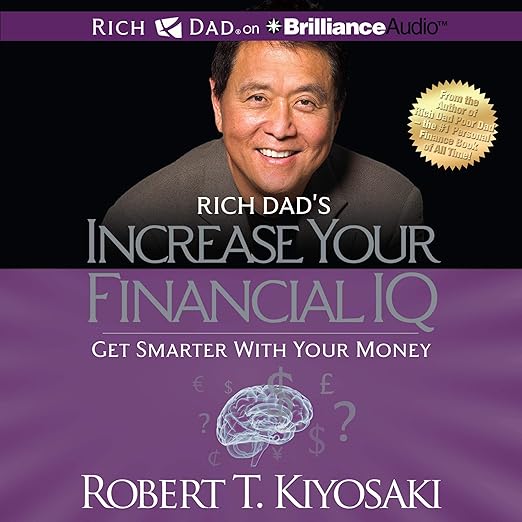
Robert Kiyosaki has been making the same core argument since 1997, and in this audiobook he has never pretended otherwise. Financial education matters more than financial information. The systems most people trust, savings accounts, home ownership, defined benefit pensions, have been made fragile by policy decisions that ordinary workers had no say in. Rich Dad’s Increase Your Financial IQ, narrated by Tim Wheeler, extends that argument into what Kiyosaki sees as the post-gold-standard era: a world where the rules changed fundamentally in 1971, when Nixon untethered the dollar from gold, and most people still have not updated their mental models to account for that change.
I came to this audiobook having read Rich Dad Poor Dad years ago, which meant I had the conceptual foundation Kiyosaki builds on here. Listeners who arrive cold may find the early chapters denser than expected, since this is less an introduction to the Rich Dad philosophy than an extension of it into more specific territory around asset accumulation, inflation protection, and the expansion of financial intelligence as a practical skill. Wheeler's narration is steady and clear, a reasonable match for Kiyosaki's conversational style.
The audiobook's central contribution is its taxonomy of financial intelligence. Kiyosaki distinguishes between five specific financial IQs: making more money, protecting money, budgeting money, leveraging money, and improving financial information. This framework is more granular than the broad asset-versus-liability distinction that drives Rich Dad Poor Dad, and for listeners who found the earlier book too conceptual, the added specificity here is useful. The expanding-your-means argument, specifically the idea that cutting expenses is a losing long-term strategy compared to expanding what you earn, is developed with more nuance than most personal finance books allow themselves.
One reviewer called this the best Kiyosaki book yet, praising how it gets you to see things a different way in contrast to the cost-cutting orthodoxy of most mainstream financial advice. Another credited the book with totally changing their understanding of the financial world. Tim Wheeler reads Kiyosaki's conversational first-person with appropriate warmth, avoiding the flatness that can creep into financial narration when the material becomes repetitive.
Why Rich Dad's Increase Your Financial IQ Works as an Audiobook
The historical argument grounding the book is more developed here than in earlier Kiyosaki titles. His contention that 1971 represents a hinge point in financial history, because severing the dollar from gold made purchasing power subject to political and monetary decisions rather than fixed supply, is not his original argument; economists have made it for decades. But Kiyosaki's ability to translate that structural reality into individual financial decision-making language, into what it means for how you save, invest, and think about your own balance sheet, is the distinctive value of his work.
The real estate sections build naturally from Kiyosaki's existing framework but add new texture around how property can function as leverage when financed intelligently, how rental income differs from capital gains, and why the your-house-is-an-asset assumption that Rich Dad Poor Dad challenged in 1997 became painfully obvious to millions of homeowners after 2007. The audiobook reads as vindication of an argument his listeners were already familiar with, but the context makes that vindication feel earned rather than self-congratulatory.
Weak Spots in Rich Dad's Increase Your Financial IQ
Kiyosaki's writing relies heavily on personal anecdote and mentor-voice storytelling rather than data, which is both a strength and a limitation. The rich dad figure is a narrative device as much as a real person, and listeners who want peer-reviewed economic research rather than experiential wisdom will find this audiobook unsatisfying. A critic could argue, and some reviewers have, that Kiyosaki tells you what to think more than he tells you specifically how to implement his ideas. That critique has merit for listeners at the beginner stage.
The investment landscape Kiyosaki describes has continued to evolve since the book's original publication, with cryptocurrency, index fund dominance, and shifting interest-rate environments all reshaping the context. The framework still holds structurally, but some specific illustrations may feel dated. Listeners should treat the mental models as durable and the specific examples as illustrative rather than actionable without current-conditions research. A financial advisor familiar with today's environment can help bridge that gap.
Kiyosaki's discussion of financial leverage is where this audiobook most clearly extends beyond what Rich Dad Poor Dad covered. He distinguishes between good debt and bad debt with the specificity that the earlier book's simplicity could not afford, explaining how the same mortgage can function as an asset in one set of circumstances and a liability in another depending on whether the property generates net income above its carrying costs. This level of granularity is what the five-financial-IQ framework makes possible. A reader who internalized the broad asset-liability distinction from Rich Dad Poor Dad can use this audiobook to move from that conceptual foundation into the messier, more conditional territory where most real financial decisions actually live. Wheeler's narration keeps this section accessible, which matters because leveraged investing is exactly the kind of topic where jargon can quickly become a barrier to practical understanding.
Who Should Listen to Rich Dad's Increase Your Financial IQ
This audiobook suits listeners who have already read or listened to Rich Dad Poor Dad and want the next layer of the argument rather than a repeat of the introduction. Adult listeners who have moved past basic budgeting and are actively thinking about how to build income from assets rather than labor will find the most traction here. Beginners who want step-by-step financial advice should start with the original Rich Dad title or a more prescriptive personal finance audiobook. For listeners already inside the Rich Dad framework, Wheeler's narration and Kiyosaki's expanded argument make this a worthwhile eight-hour addition to the series.
Do I need to have read Rich Dad Poor Dad before listening to this audiobook?
Not strictly required, but strongly recommended. This audiobook extends the Rich Dad framework rather than introducing it, and the conceptual foundation from the original book significantly deepens the usefulness of what Kiyosaki covers here.
Does this audiobook provide concrete investment steps or mainly conceptual frameworks?
Mostly conceptual. Kiyosaki's five financial IQs and the expanding-your-means argument provide useful frameworks, but specific implementation steps are not the book's primary offering. Listeners who want actionable plans should pair this with more prescriptive financial audiobooks.
Is the financial advice in this audiobook still relevant given how much markets have changed?
The structural mental models, assets versus liabilities, how leverage works, and why inflation erodes savings, remain useful. Specific investment illustrations may feel dated given changes in the economy since publication, and listeners should research current conditions before applying any specific strategies.