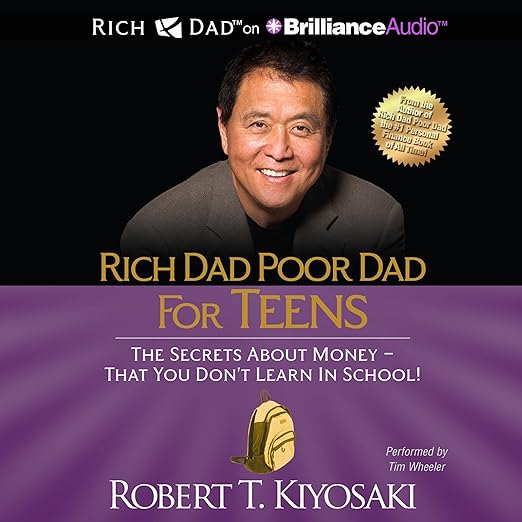
Personal finance education tends to reach young people either too late or in forms too abstract to stick. Robert Kiyosaki's original Rich Dad Poor Dad became a cultural touchstone precisely because it spoke in concrete terms about how money actually works: assets versus liabilities, passive income versus earned income, the difference between working hard and working smart. This audiobook adaptation, narrated by Tim Wheeler, takes that core framework and reconfigures it for younger listeners, with quizzes, sidebars, and a register calibrated for teenagers rather than adults entering the workforce. At 2 hours and 31 minutes, it does not waste a moment of its brief runtime.
Our Take on Rich Dad Poor Dad
The central argument of the original book, that the wealthy do not work for money but rather make money work for them, is simplified here without being falsified. Kiyosaki's 'language of money' framework, which teaches readers to identify and categorize financial instruments before attempting to use them, is preserved intact. What changes in this adaptation is the entry point: rather than the adult professional trying to escape the rat race, the target listener is a teenager who has not yet entered it, which means the lessons are genuinely preventative rather than corrective. A thirteen-year-old who internalizes the difference between an asset and a liability before they take their first job is at a structural advantage that most adults never recover.
The quizzes embedded in the audiobook deserve mention. They are not merely decorative; they are designed to force active engagement with the concepts rather than passive absorption. In audio form, Wheeler pauses appropriately before delivering answers, creating a beat that prompts real reflection. Whether you listen alone or with a young person, those pauses do real work. The sidebars, which expand on individual concepts with additional examples, are handled as natural interruptions to the narrative rather than appendixes, which helps the audiobook maintain its momentum throughout.
One young reviewer noted she was thirteen and had come to the book to learn about real estate; she found instead that the material was 'about how to take care of money and have money work for you, overall a good book.' That response captures exactly what the adaptation achieves: it redirects the reader from the surface-level appeal of specific wealth-building vehicles toward the underlying framework that makes those vehicles comprehensible. That is a pedagogically sound sequence, and the audiobook executes it with clarity.
Tim Wheeler's narration is well-matched to the material. His voice has the warmth of an older mentor without condescension; he reads to a teenager the way a smart adult should talk to a teenager, with respect, clarity, and enough energy to suggest that this material actually matters. The 2.5-hour runtime means Wheeler never has time to flag, and he does not. The pacing is brisk throughout, which suits the condensed format and the shorter attention windows of the intended audience.
The audiobook format is particularly well-suited to the pedagogical structure here. Financial concepts that can feel dry on the page, the specific mechanism by which assets generate income, the cascade of decisions that leads from earned income to passive income, become more tractable in audio, where the pacing is controlled and the listener is forced to receive each concept before moving to the next. Kiyosaki's instructional rhythm is conversational, and that conversationality is amplified in Wheeler's performance.
For parents who want to introduce financial literacy to a teenager without turning it into a lecture, this audiobook offers an external authority to do the work. Kiyosaki's reputation and the cultural weight of the original book give the adaptation credibility with young listeners that a parental recommendation alone might not carry. It functions as a conversation-starter as much as an educational resource, and that dual function is part of what makes it worth the short time investment.
What to Watch For in Rich Dad Poor Dad
At 2 hours and 31 minutes, this is a very compressed treatment of material that the full original book covers in considerably more depth. Listeners who want the complete Kiyosaki framework, including the real estate emphasis and the detailed asset-building strategies, will need to move on to the full-length original after completing this adaptation. Think of this audiobook as an introduction and orientation, not a comprehensive financial education in its own right.
The adaptation also reflects the Kiyosaki philosophy, which some financial educators have critiqued for oversimplifying complex markets and for the specific emphasis on real estate as the preferred vehicle for wealth building. For young listeners encountering these ideas for the first time, the framework is useful; for adults revisiting it, the limitations of that framework are worth keeping in mind as supplemental context. The audiobook works best as a gateway, not a destination.
Who Should Listen to Rich Dad Poor Dad
Teenagers who are beginning to think about money, employment, and financial independence will find this audiobook an accessible and genuinely motivating entry point. Parents who want to give their children a framework for thinking about wealth before they enter the workforce will find the 2.5-hour investment highly efficient. Adults who have never read the original Kiyosaki material may also find this compressed version a useful primer before moving to the full text.
Adult listeners already familiar with the original Rich Dad Poor Dad will find little new here; this is an adaptation, not an expansion. And listeners who prefer rigorous economic analysis over motivational financial storytelling will find Kiyosaki's approach, in any format, too narrative-driven for their purposes.
- Performance: Tim Wheeler reads with warmth and appropriate energy, mentor-ish without being preachy, well-matched to a teenage audience.
- What it covers: Financial literacy for young adults, assets versus liabilities, making money work for you
- Feel: Motivational and accessible, compressed and practical
- Our call: A tight, well-narrated introduction to Kiyosaki's financial framework for teenagers, ideal as a family listening experience or a teenager's first financial audiobook.
Common Questions
How does this audiobook adaptation differ from the original Rich Dad Poor Dad?
This adaptation is specifically calibrated for younger listeners, with quizzes, sidebars, and a compressed format at under 2 hours and 31 minutes. The core financial framework is preserved, but the depth and real estate emphasis of the full original are simplified for a teenage audience.
Is this audiobook appropriate for a 12-year-old or is it more suited to older teenagers?
The book is aimed at readers who are beginning to think about money and employment, roughly 12 to 16 is the intended range. A motivated 12-year-old will find the concepts accessible; older teenagers will find they can engage with more of the strategic implications.
Does Tim Wheeler's narration make the financial concepts easier to follow in this audiobook?
Wheeler narrates with the warmth of an approachable mentor, and the quiz pauses embedded in his performance create genuine moments of active engagement. The conversational tone makes financial concepts that can feel abstract on the page more immediate in audio.
Should young listeners graduate to the full Rich Dad Poor Dad after this audiobook?
Yes. This adaptation is an orientation, not a complete education. The full original covers asset building, real estate strategy, and the distinction between earned and passive income in considerably more depth. This audiobook is the right starting point, not the ending one.