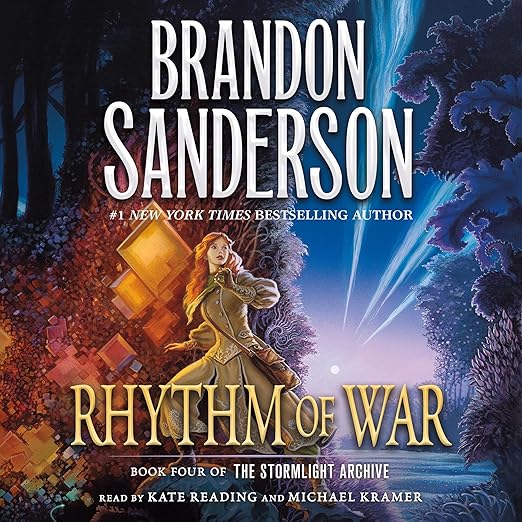
AudioFile Magazine's Earphones citation sits at the very top of this description, and it does something the credits do not: it names two people. The powerhouse narrating duo, it says, is Michael Kramer and Kate Reading, and it calls the audiobook a masterpiece of story and performance. The narrator field on this record lists Kate Reading alone. Somewhere between the award notice the publisher chose to lead with and the credits the page actually prints, one of the two readers has gone missing.
What Brandon Sanderson Delivers
Credits matter more than usual on a fifty-seven-hour production. Anyone committing that much time to a fourth volume is entitled to know whose voice they will be inside for it. The description asserts a duo and names both members. The record credits one reader. Both statements cannot describe the same recording, and nothing on the page lets a buyer work out which is accurate before paying. On a book of this length that is not a clerical detail.
Nobody who wrote on this page has said a word about the performance. Five signed responses, every one of them at five stars, and each discusses Sanderson's plotting, the world of Roshar, the magic system or the series' standing in modern fantasy. That leaves the publisher's own promotional citation as the page's sole word on the reading itself, which is an odd position for a listing selling a recording. For a commitment of this size, the gap is worth naming out loud.
Unfettered praise is how the December 2020 five-star describes itself, in exactly those words, before it begins. That response opens by asking whether it is even possible to give these books fewer than five stars and whether doing so would be permitted, then declares its own bias openly. Self-aware enthusiasm is more useful than the unmarked kind, and it also tells you what the whole column is: five people already committed to a series, three volumes deep, writing about the fourth.
What Brandon Sanderson Gets Right
Scale is what Sanderson is selling and this volume supplies more of it than any description can convey. A coalition holding together through a year of grinding war. An ally in Taravangian whose betrayal is treated as a question of timing rather than of possibility. Navani Kholin's scholars turning research into weapons and changing what the war actually is. Kaladin renegotiating his place among the Windrunners while the honorspren refuse to bond with any more humans. Four major threads, run concurrently, none of them dropped.
Sanderson's productivity is what the September 2023 response from the United Kingdom leads with, and it means that as praise: by default, it argues, you should read anything this author writes. That post calls the book a solid addition to the flagship series and singles out how much more it reveals about the way the magic operates. Mechanism is one of the real pleasures of this sequence, and volume four is where a great deal of the machinery gets opened up.
Fifty-seven hours and twenty-six minutes is the number that should govern every decision about this purchase. That is longer than many people's entire listening year, and the book expects sustained attention rather than background company: dense chapters, a large named cast, interleaved viewpoints. The description also notes that a PDF arrives alongside the recording, which usually means maps, charts or illustrated pages the audio cannot carry, and it is worth locating that file before you begin rather than an hour in.
Where Brandon Sanderson Loses Some Ground
Commitment is the first thing to be honest about. This is a fourth volume in an unfinished sequence, it assumes three previous books in full detail, and it recaps nothing. The copy points back to Oathbringer and then proceeds as though you have it memorized: Dalinar, Navani, Kaladin, Adolin, Shallan, Taravangian, the honorspren, the Fused and Odium all arrive without introduction. Coming to this one cold is less difficult than it is pointless.
Contradiction inside a single response is worth flagging, because a browser will read only its headline. The German-language five-star from November 2025 is titled as an epic final volume of breathtaking depth, and its own opening sentence then calls this the fourth volume of the series. Those are different claims, the sequence is not finished, and the headline is the part that shows in a preview. The same post praises the density and warns that the book repays intense attention, which is both accurate and useful.
Relevance is the argument the February 2022 five-star builds, and it is the most ambitious claim on the page. That response sets the book alongside works it considers genre-defining, reaches for film comparisons to carry the point, and asserts that the Stormlight Archive is a landmark in modern fantasy everyone should read. Accept that verdict or reject it, the reasoning is worth your time: it is the only entry here making a case rather than registering approval.
Should You Listen to Rhythm of War?
Commit to it if you finished Oathbringer and are ready for the installment where the war turns into a technological problem rather than only a moral one. The arms-race structure gives Sanderson a reason to explain how his systems function, the Lasting Integrity thread gives Adolin and Shallan something to do that is not fighting, and Kaladin's chapters travel somewhere the earlier books were visibly building toward. The five-star filed from Japan calls it an excellent addition and wants the next one immediately, which is close to the correct reaction.
Casual listening is not on the table. Fifty-seven hours of dense interleaved viewpoints will punish anyone treating it as background, and the payoffs depend on remembering material introduced dozens of hours earlier. Anybody new to the series should start with the first book, and anybody who found the earlier volumes slow should know this one is longer than all of them. The page also gives no indication of how many volumes remain, which matters when you are four books into something unfinished.
Macmillan Audio produced this from Tor Books, stated at the bottom of the description, and that is the sort of detail that signals the audio was taken seriously. What has not been taken seriously is the credit line. A page leading with an award citation that names two readers, and then printing one of them, is a page worth checking twice before spending fifty-seven hours inside it.
In Brief
- Read by: Kate Reading is the only name in the credit field, on a production long enough that the choice of reader is the single largest variable in the purchase.
- At its heart: An arms race inside a holy war, betrayal treated as a matter of scheduling, a magic system taken apart, bonds refused
- Vibe: Enormous, dense, and demanding of unbroken attention
- Short version: Essential for anyone three volumes deep, and completely impassable for everybody else.
Before You Listen
Who actually narrates this audiobook?
The credit field names Kate Reading and nobody else. That conflicts with the publisher's own promotional text at the top of the page, and the conflict goes unresolved. Sample the opening chapters before buying, because a fifty-seven-hour commitment is a poor place to discover that the casting is not what you were expecting.
What is the PDF that comes with this audiobook?
A companion document delivered alongside the download. The description mentions it in a closing note and never says what it holds, though supplementary files on books like this usually carry the diagrams and illustrated pages a recording cannot reproduce. Find it before you start, because it is very easy to miss.
Is a fifty-seven-hour audiobook really justified here?
That depends on your appetite for mechanism. Four major storylines run at once, the magic system gets taken apart in detail, and a diplomatic thread travels to a stronghold on the far side of the setting. If watching a system explained through consequences appeals to you, the length is the point rather than the cost.