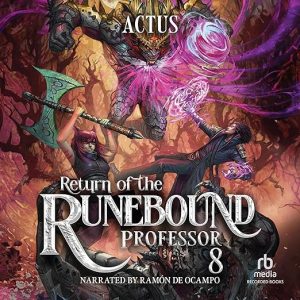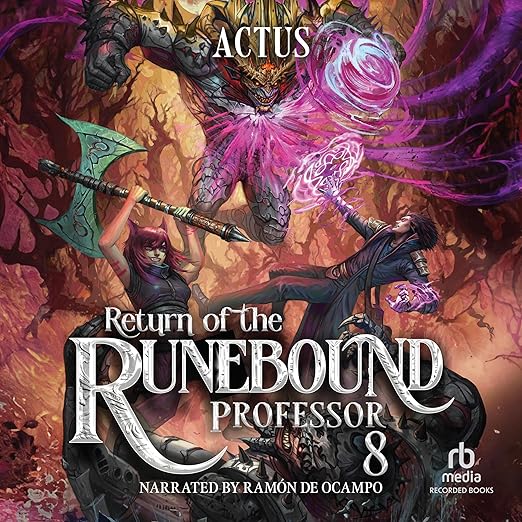
Key Details
- Performance: Recorded Books keeps Ramón de Ocampo in the chair for a single-voice reading, with no supporting cast anywhere across thirteen hours.
- What it covers: Power progression past the point of risk, institutional corruption, teaching as a form of loyalty
- Feel: Kinetic and escalating, with the school-story warmth still intact underneath
- Our call: Volume eight pays off years of foreshadowing and does nothing about the overpowered hero, which is the trade this series has been making for a while.
Eight volumes into a progression fantasy series, the question stops being whether the magic system holds up and becomes whether the author still remembers what the story was about. Actus opens book eight with three words, Wizen is dead, and then spends the rest of the audiobook making good on debts the series has been running since Noah first walked into Arbitage. Recorded Books put thirteen hours and twenty minutes of it into the hands of Ramón de Ocampo. What arrives is a war story wearing a school story's uniform.
First, the Big Picture
Five stars in December 2025, from Eric Sweeney, land on exactly the thing this installment fixes: the side plot is over. That response is blunt about it, praising the demon realm characters while insisting the series was always about Noah's adventures inside the human kingdom, and pointing at multiple books of foreshadowing that put him on a collision course with the corrupt noble houses circling the teenagers he teaches. Book eight is where that collision finally starts, and the relief in that reading is earned rather than manufactured.
Wizen's death is the hinge, and Actus refuses to make it simple. The ancient mage is not beaten. He chooses to trade his life for a young demon called Sticky, whose existence is the key to an ages-old problem and to righting Decras' greatest failure. That single decision reframes seven volumes of antagonism in about a paragraph. Everything after it, the return to Arbitage with Lee, Moxie and a fresh host of demonic students, the professors torn apart, Rank 5, the rune repairs, is aftermath rather than plot.
Numbers on this listing do not agree with each other. The rating counter reports a single vote, yet five graded responses sit underneath it, and one vote can only ever be a whole star, never the 4.8 on display. Average those five written grades, four top marks and one four, and the result is exactly 4.8. The average was computed over the prose the counter refuses to acknowledge. Trust the text, and treat the counter as the stale number on the page.
Why Listen to Return of the Runebound Professor 8
Characters carry it, says the January 2026 five-star from j4contact, along with a story that entry calls well written and inventive. That is the least surprising praise this series attracts and also the most durable. The runic magic is a genuine system rather than a set of colors: runes get drawn, repaired, combined and broken, and Noah teaches them, which obliges Actus to explain the mechanics in classroom dialogue instead of narration. Progression fantasy rarely gets that structural gift handed to it so cleanly.
Sticky is the reason to keep going. A young demon whose mere existence solves something ancient is a heavy load for a new character, and the description puts her at the center of Decras' greatest failure without ever explaining what that failure was. Eight volumes of accumulated mythology finally start paying out here, and the payout is structural: Father moves at last, ancient schemes surface too late to stop, and a war begins for Arbalest, a name the copy uses without clarifying how it relates to Arbitage.
Thirteen hours and twenty minutes is a long stretch for one reader to hold a cast this crowded, and the classroom scenes ask de Ocampo to keep demonic students distinct from human ones inside the same room. That work cannot be assessed from this page. Every graded response here was filed in the months before the recording existed, so not one of those grades could have taken this performance into account, whatever it turns out to be worth.
A Few Reservations
Four stars on January 6, in a column otherwise made of fives, produced the sharpest observation on the whole page. That reader finds the series filling pages at this length, admits to skimming passages that added nothing, and objects that Noah, who once had to fight for every increment of power, now simply overwhelms. The complaint is specific and it is structural. A protagonist who cannot plausibly lose has to generate tension from somewhere other than himself.
Slack behaves differently in audio. An eye can skip a thin chapter and rejoin the story further down the page, while an ear that skims loses the thread, so filler gets paid for in real time rather than a flick of the wrist. A book this long leaves plenty of room for a stretch that goes nowhere, and a listener who hits one either sits through it or surrenders the continuity that the whole series runs on.
Entry point matters more here than in most eighth volumes. Book eight opens on the immediate aftermath of a death that happened in book seven, name-checks Rank 5, the Apostles and a rune repair job without recapping any of them, and assumes you already know who Lee and Moxie are. Actus also wrote My Best Friend Is an Eldritch Horror, and listeners arriving from that book should still begin this series at volume one rather than here.
Who Should Pick Up Return of the Runebound Professor 8
Progression fantasy regulars who have stayed with Noah through seven volumes are the whole audience here, and they are well served. The side arc is closed, the school is back, the noble houses are finally within reach, and Father has stopped waiting. Anyone who drifted off during the Damned Plains stretch can rejoin without much pain, since the demon realm is left behind almost immediately and the human kingdom carries everything that follows it.
Give it a miss if you want a hero who can plausibly lose. Noah's power curve is this series' central pleasure and its central problem, and volume eight does not correct it. The same goes for anyone allergic to open-ended serials, because the story closes on escalation rather than resolution, and the February 2026 five-star on this page already reports dreading the wait for volume nine.
Eight books in, that is the honest shape of it: a series that stopped pretending its hero is in danger and started making the world around him dangerous instead. Whether all of that is worth your evening depends entirely on how much the first seven earned from you. Anyone still undecided at volume eight has probably answered the question already.
Good to Know
Can I start the audiobook at volume eight, or do I need the earlier books?
Start at volume one. Book eight opens on the aftermath of a death from the previous installment and uses Rank 5, the Apostles, Lee, Moxie and the rune work as shared knowledge with no recap. Nothing here is designed to orient a newcomer, and the emotional weight depends on seven volumes of setup.
Why does the audiobook show 4.8 stars from a single rating?
Because the counter is wrong. One vote can only be a whole number of stars, so 4.8 is unreachable from it. Five written grades sit on the page, four at the top mark and one at four stars, and they average out to precisely the number on display. That figure describes the prose rather than the counter.