Quick Take
- Narration: Hollie Jackson brings genuine energy to a fast-moving sapphic fantasy, the action sequences land well and the chemistry between leads feels earned.
- Themes: Mythological reimagining, found loyalty, forbidden love under existential stakes
- Mood: Propulsive and romantic, with Norse mythology worn lightly
- Verdict: A lean, entertaining sapphic fantasy-action listen, best for readers who want mythology-flavored romance without dense worldbuilding.
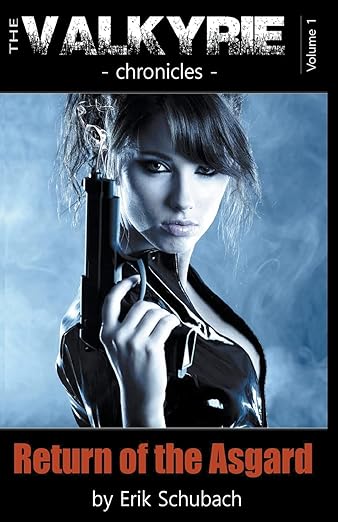
I have a weakness for mythology-adjacent fantasy that does something genuinely unexpected with its source material. Return of the Asgard caught my attention because the premise is so specific: a Valkyrie, fighting alone on Earth for five thousand years, waiting for her people to return after sacrificing herself at Ragnarok. That is a lot of emotional and historical weight to carry before the story even starts, and Erik Schubach does something interesting with it, he makes the weight visible without letting it crush the momentum.
Kara has been evading and fighting the Ragnarok race on Earth for millennia. She is essentially a one-woman rearguard action, holding out until the Asgard can return. When a human woman named Kate enters the story and chooses to stand with her, their connection becomes the emotional center of the book, and what begins as an alliance built on shared danger moves, without surprise but with genuine warmth, into something more.
Our Take on Return of the Asgard
Schubach writes genre fiction with a light touch. He is not trying to reconstruct Norse mythology faithfully, he is using it as atmosphere and scaffold for a sapphic romance with action stakes. Kara’s five-thousand-year backstory gives the central relationship an interesting asymmetry: she has watched everything she knew disappear, fought alone for longer than recorded human history, and now she has to figure out what to do with someone who actually matters to her. Kate, for her part, shows the kind of valor the synopsis describes as matching a Valkyrie’s, and the story is careful not to make her simply a human woman in over her head. She chooses this fight. That choice is what makes the relationship work.
The runtime of just under seven hours is appropriate for the ambition of the book. This is not a sprawling epic, it is a focused story with a clear emotional arc, and Schubach knows when to stop. The world is sketched rather than fully rendered, which some readers will find insufficient and others will find liberating. If you are coming looking for deep lore and intricate mythology, you may want to adjust expectations. If you are coming for the relationship between two women who are both, in their different ways, extraordinary, the book delivers.
Why Listen to Return of the Asgard
Hollie Jackson’s narration is a significant asset. She finds the right register for Kara, worn but not broken, ancient in knowledge but not distant. The distinction between Kara’s voice and Kate’s matters for the emotional clarity of the story, and Jackson maintains it throughout. The action sequences, which arrive regularly given the premise, are handled with the kind of pacing that keeps them from feeling static in audio form, she accelerates without losing articulation, which is exactly the right instinct.
The romance between Kara and Kate is built gradually rather than rushed, and Jackson’s performance honors that pacing. The moments of connection between them are given room to breathe, which means they land with actual weight when they arrive. For sapphic fantasy romance as a genre, narration choices like this make a substantial difference to whether the central relationship convinces the listener or simply exists on the page.
What to Watch For in Return of the Asgard
The Norse mythology here is loosely applied. Valhalla, the Asgard race, the Ragnarok horde, these are used as story elements rather than carefully reconstructed from the Eddas. Readers who are deeply invested in mythological accuracy may find this frustrating. Schubach’s approach is essentially to take the names and the general shape of the mythology and build a contemporary-feeling fantasy world around them, which has its own pleasures but is a different thing from serious mythological fiction.
The book also has no reviews in the data to draw from, which means I am reading it more from its genre positioning and its metadata than from a broad response. The 4.2 rating across 478 listeners suggests a solidly appreciated but not universally beloved entry in the sapphic fantasy space, which tracks with a book that is doing genre work competently rather than transforming it.
Who Should Listen to Return of the Asgard
Listeners who enjoy sapphic fantasy with action elements and a central romance that is given proper weight will find this a satisfying listen. It is particularly well-suited to readers who do not require dense worldbuilding and are comfortable with mythology used atmospherically rather than rigorously. The short-to-medium runtime makes it a good commute or weekend listen rather than a project.
Readers looking for a high-stakes epic with intricate Norse mythology or deep lore will want to look elsewhere. This is a focused, warm, action-forward romance with mythological flavoring, and it works best understood on those terms.
Frequently Asked Questions
Does Return of the Asgard accurately follow Norse mythology, or is it a loose reimagining?
It is a loose reimagining. The names and broad concepts, Valkyries, Valhalla, the Ragnarok horde, are drawn from Norse mythology, but Schubach uses them as story elements rather than attempting mythological accuracy. Readers who want faithful Norse mythology will need to look elsewhere.
How central is the romance between Kara and Kate to the story?
It is the emotional core. The action premise and mythology give the story its setting and stakes, but the development of the relationship between the immortal Valkyrie and the human woman who chooses to fight alongside her is what the book is fundamentally about.
Is Return of the Asgard a standalone or does it require reading other books in the series?
The metadata lists it as a standalone, no series number is attached. The synopsis presents a complete story arc, and at just under seven hours it functions as a self-contained narrative rather than an entry point into a longer series.
How does Hollie Jackson handle the contrast between Kara’s ancient Valkyrie perspective and Kate’s human viewpoint?
Jackson maintains distinct voices for the two characters, giving Kara a quality of weight and endurance that distinguishes her from Kate’s more immediate, human register. The contrast supports the asymmetry at the heart of the relationship, one woman who has lost everything and rebuilt herself over millennia, and one who enters this war by choice.