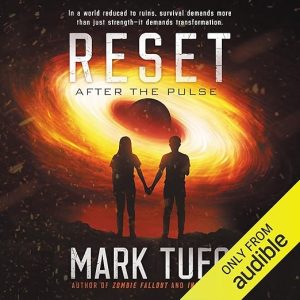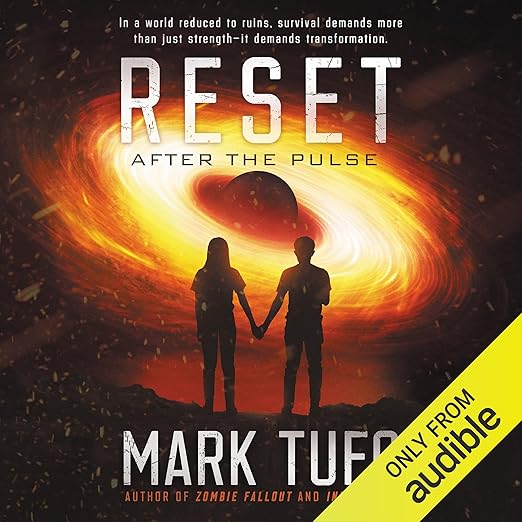
Marty's redemption arc anchors Reset far more than its opening electromagnetic pulse ever could, and that's the smartest choice Mark Tufo makes across this eleven-hour audiobook. Plenty of post-collapse fiction leans entirely on the disaster itself for momentum; this one spends its early chapters establishing four separate people (a recovering addict finding purpose in a crumbling military unit, two suddenly orphaned preteens, and a dying man escorting a stranger toward her scattered family) before the worldbuilding takes over completely.
Our Take on Reset
Benny and Becky carry some of the book's hardest material: inseparable preteens who lose their parents and have to learn, fast, that 'trust is scarce and innocence is a liability' in a world where the power grid, communication, and transportation have all failed within hours. Running parallel to them, Al's terminal diagnosis and his partnership with Sophie, a young woman trying to reunite with her scattered family, gives the book a quieter, more elegiac thread alongside Marty's harder-edged military survival story.
This is a series opener for After The Pulse, but it comes from an author with real staying power in the apocalypse genre; the synopsis itself credits Tufo as the author of Zombie Fallout and Indian Hill. One reviewer, Piper's mama, notes directly that this book is 'quite a bit slower than zombie fallout or Indian hill,' which reads less like a flaw and more like a deliberate shift toward character-first pacing for this new premise.
The synopsis frames the core conflict plainly: 'technology is useless, morality is tested, and the fight to stay human may be the hardest challenge of all,' and Marty's arc is where that framing lands hardest. A man already fighting one kind of battle, addiction, before the pulse ever hits gets handed a second, external collapse layered directly on top of the first, and the book treats his slow rebuilding of purpose inside a crumbling military unit as a genuine parallel to recovery itself, not just a convenient backstory detail.
The title itself works as a thesis statement once all four storylines sit next to each other. Marty is resetting from addiction, Benny and Becky are having childhood itself reset by loss, Al is resetting his remaining priorities around someone else's need rather than his own mortality, and Sophie is resetting her definition of family entirely. The pulse is the mechanism, but the actual reset the title promises is happening inside every major character independently of the blackout itself.
Why Listen to Reset
Vikas Adam has an established track record on this exact series: an existing entry notes his 'strong military SF delivery' and his particular skill at 'conveying urgency and soldier exhaustion,' along with a specific strength that maps directly onto this book, handling 'teenage-soldier POVs without making them sound too young or too old.' That last point matters enormously here given how much weight Benny and Becky's chapters carry.
Across eleven hours and four distinct point-of-view threads, a narrator has to differentiate a burnt-out addict rebuilding purpose in a military remnant, two frightened preteens, a dying man's quiet resolve, and a young woman's search for family, all without losing the reader's sense of who's speaking. That's a real vocal range test, and it's exactly the kind of ensemble work Adam's existing reputation suggests he's built for.
A four-person ensemble structure like this one actually suits audio better than it might suit the page. Vocal differentiation lets a listener track which thread they're in almost instantly (Marty's hardened urgency, Benny and Becky's frightened youth, Al's quiet resolve) without needing a chapter heading to announce the shift, which matters more in a book moving between four separate storylines than it would in a single-POV novel.
What to Watch For in Reset
As a series opener, the four-person ensemble takes real setup time to interlock, and listeners hoping for immediate, unified momentum from minute one may find the early chapters feel more like four separate short stories running in parallel than one unified plot, at least until the back half pulls them together.
Existing Tufo readers coming from the Zombie Fallout series specifically should recalibrate their expectations on pace going in. This book spends real time on character establishment across all four threads before they converge, rather than opening at a full sprint the way his zombie catalog often does, a deliberate structural trade-off rather than a slow start that simply fixes itself later in the runtime.
The synopsis leans hard on its own framing language, describing a 'brutal, desperate landscape' where survival demands hard choices, and that intensity is mostly earned rather than overstated. Where the book pulls back is in showing genuine tenderness alongside the harshness: Al's decision to spend his remaining time helping a stranger rather than settling his own affairs privately gives the collapse narrative an emotional counterweight that pure survival fiction often skips entirely.
As with most series openers, expect real threads to stay open rather than resolved by the final chapter; the point of a book like this one is setting four separate people in motion toward each other, not closing out their stories in a single eleven-hour installment. Listeners who prefer a fully self-contained story should know upfront that this is built as the first piece of a longer arc.
Choosing an electromagnetic pulse as the triggering event, rather than a virus or the undead, keeps the catastrophe grounded in something closer to plausible real-world vulnerability: modern life actually does depend entirely on a power grid and a communications network that could, in theory, fail together. That grounding gives the early chapters a different, quieter kind of dread than a more fantastical apocalypse trigger typically produces.
Who Should Listen to Reset
Fans of ensemble post-collapse fiction, existing Tufo readers willing to try a premise built around an EMP rather than zombies, and anyone who prefers character-driven apocalypse stories over pure relentless action will find a lot to like here.
Fans of other found-family apocalypse ensembles, stories that treat the collapse itself as backdrop for character work rather than the entire point, should connect easily with this one even without any prior familiarity with Tufo's other series or his zombie-focused catalog specifically.
Listeners drawn to Al and Sophie's quieter, more intergenerational thread specifically, a dying man choosing purpose over comfort in his remaining time, may find that storyline resonates even for readers who don't typically gravitate toward post-apocalyptic fiction as a genre.
Skip this one if immediate, nonstop action from the opening minute is what you actually want from post-apocalyptic fiction; Reset asks for patience its author's zombie catalog doesn't always require. Readers who dislike juggling multiple point-of-view threads early in a book may also want to wait until the cast converges before fully committing.
At a Glance
- Narration: Vikas Adam brings the same urgency and soldier exhaustion an existing entry credits him with elsewhere in this series, particularly strong with the book's teenage POV characters.
- Themes: EMP collapse, found family, redemption through crisis
- Mood: Grim but character-driven
- Verdict: A patient, well-built series opener for listeners who want people first and disaster second.
Good to Know
Is this audiobook connected to Mark Tufo's Zombie Fallout series?
No, it's a new series called After The Pulse, though the synopsis credits the same author behind Zombie Fallout and Indian Hill, and one reviewer directly compares this book's slower pace to both of those earlier series.
How many point-of-view characters does this audiobook follow?
Four: Marty, a recovering addict finding purpose in a crumbling military unit; Benny and Becky, orphaned preteens; and Al, a terminally ill man traveling with Sophie as she searches for her family.
Is this audiobook a standalone story or the start of a series?
It's the first book in the After The Pulse series, built with an ensemble structure that suggests these four threads will continue developing in future entries.
Does Vikas Adam's narration in this audiobook suit the younger characters?
Based on his existing track record on this series, yes; he's specifically noted for handling teenage-soldier POVs without making them sound too young or too old, which applies directly to Benny and Becky's chapters.