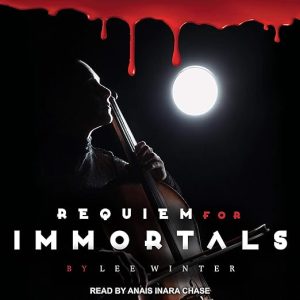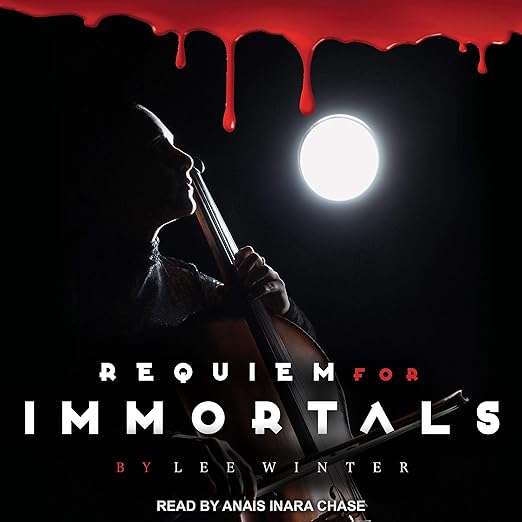
- Performance: Anais Inara Chase brings a cool precision to Natalya that is essential - the character is designed to unsettle, and a warmer vocal approach would drain the tension the plot depends on.
- What it covers: Cold moral complexity, reluctant attachment, F/F assassin romance in the Australian criminal underworld
- Feel: Taut and atmospheric, with the specific tension of someone dangerous choosing to feel something
- Our call: Lee Winter's Requiem for Immortals is F/F crime fiction that takes its assassin protagonist seriously enough to let her remain genuinely frightening.
Natalya Tsvetnenko fills concert halls with beauty and empties lives from the shadows of Australia's criminal underworld, and that duality is the precise engine of Lee Winter's Requiem for Immortals - narrated by Anais Inara Chase in this 12-hour-and-5-minute audiobook. The premise is built on a single destabilizing problem: a professional cellist who doubles as an assassin is hired to kill a woman who appears genuinely innocent, and for the first time in her career, she cannot determine why the contract was issued. Winter is an author whose readers describe physical responses to her opening paragraphs, and in this novel those opening pages earn that reaction: the juxtaposition of Natalya moving through Melbourne's elite social world while arranging deaths in its criminal one is handled with a tonal control that lesser F/F crime fiction rarely attempts.
What Winter does in this novel that separates it from standard assassin romance is refuse to make Natalya domesticable. She does not soften the character's lethality in proportion to her growing attachment to the target. Natalya remains cold, precise, and genuinely dangerous throughout a narrative that asks how far emotional investment can develop before it changes a person's fundamental commitments. One reviewer noted being uncertain, even at the end, whether they 'actually liked' Natalya - and that response is a mark of the novel's success rather than its failure. A character designed to unsettle should unsettle. The resolution Winter provides is not a redemption arc in the conventional sense; it is something more carefully calibrated and harder to fully trust.
The target, Alyson, is constructed as Natalya's opposite in almost every register: warm, open, and apparently innocent in ways that make her survival feel both rational and dangerous for Natalya to care about. One reviewer described Alyson as 'lovable' while finding Natalya 'cold and annoyingly distant by the end' - a reading that the novel itself seems to invite as one possible response. Winter does not ask you to find Natalya conventionally sympathetic; she asks you to find her comprehensible, which is a more demanding and more interesting request. The assassin's code name 'Requiem' is not accidental - the character is defined by endings, and the novel's central tension is whether Alyson's presence in Natalya's orbit represents the beginning of something genuinely different.
Highlights
Anais Inara Chase's narration is the right casting decision for material this tonally precise. Chase gives Natalya the quality of controlled distance - her voice rarely warms, and when it does, the departure is audible rather than assumed. That vocal restraint is load-bearing for the story's central tension: if Natalya sounds like she is already softening from the first chapter, the narrative loses its uncertainty. Chase keeps the character's danger present even in the passages where the story is building something else alongside it. For F/F audio fiction specifically, the quality of the narration matters considerably because the romantic and sexual tension is largely conveyed through what is held back rather than what is stated, and Chase's economy with emotional signaling is precisely what the material needs. At 12 hours and 5 minutes, the audiobook has room to develop both the crime-thriller plot and the reluctant attachment at its center without rushing either.
Weak Spots in Requiem for Immortals
The ending divides readers. One reviewer found it satisfying; another found Natalya's emotional position by the final chapter frustrating precisely because her coldness is so consistent that any emotional development feels insufficient. Listeners who need romantic closure in the conventional sense should approach with measured expectations. This is not a book that resolves its central tension cleanly - Winter is more interested in depicting a person at the beginning of possible change than in delivering a complete transformation. The Australian setting gives the novel a specific cultural texture that distinguishes it from the European or American settings that dominate assassin fiction; Melbourne's criminal world is rendered with enough specificity to feel like a genuine context rather than a generic backdrop. One reviewer described a distinctive physical reaction to the opening sentences of the prologue, a tingle of recognition that this was a writer operating at full capacity - a response that Winter's established readership consistently reports.
Is This One for You?
This audiobook is for F/F fiction readers who want their protagonists morally complex and their romance subordinated to genuine psychological tension. It works for crime and thriller listeners who are open to F/F central relationships, and for anyone who finds cold, highly competent protagonists more compelling than warm, relatable ones. Listeners who require likable protagonists or clean emotional resolution will find the book deliberately resistant to those expectations. Those who want F/F fiction that treats the assassin premise with full seriousness - without defanging the character to make her more palatable - will find this among the more accomplished examples of the form in audio. Lee Winter's fourth novel demonstrates that the cellist-assassin premise is not a gimmick but a genuine structural choice: the contrast between Natalya's public beauty and her private violence is not ironic but constitutive, and Winter uses it to ask what it means to produce one kind of feeling in the world while eliminating another. That question does not receive a tidy answer, which is exactly as it should be. Winter's confidence in the material is evident throughout - she does not explain Natalya to the reader or apologize for her, and the audiobook benefits from Chase's equally undefensive narration. This is a story about a dangerous woman told without the usual framing devices that would make her safe to be around, and for listeners willing to accept that discomfort, it is one of the more distinctive F/F listens currently available.
Good to Know
Is Requiem for Immortals a standalone audiobook or does it require prior Lee Winter titles?
It is a standalone novel. No prior familiarity with Lee Winter's other work is required, though existing fans of her writing will recognize the tonal precision and character construction that recurs across her catalog.
Is the Requiem for Immortals audiobook appropriate for listeners who want clear romantic resolution?
Readers are divided on this. Winter does not deliver conventional romantic closure - the ending has been described as both satisfying and frustrating depending on how much emotional resolution a listener needs. The novel is primarily a character study and a crime narrative, with the romantic element present but deliberately incomplete.
Does Anais Inara Chase's narration differentiate between Natalya and Alyson's perspectives in the audiobook?
Yes. Chase gives Natalya a controlled, distant quality and Alyson a warmer register, and the contrast is one of the narration's primary contributions to the story's tension. The two characters sound like who they are, which is not a given in single-narrator audiobooks.
Is the Requiem for Immortals audiobook appropriate for listeners new to F/F fiction?
Yes. The F/F content is central to the story but the book does not require or assume familiarity with F/F genre conventions. It works as crime fiction with a specific romantic undercurrent for readers approaching from either direction.