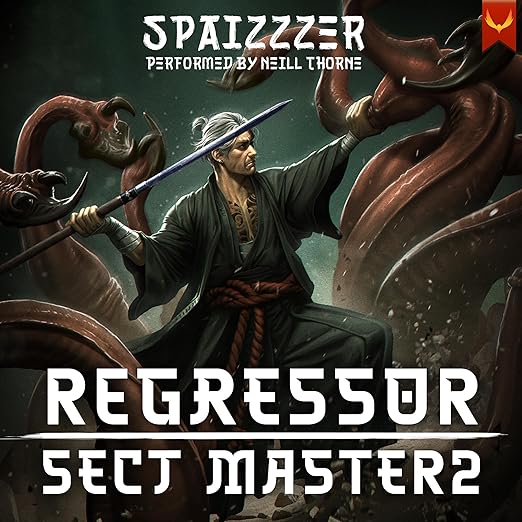
Quick Take
- Narration: Neill Thorne brings a steady energy to the cultivation sequences and handles the ensemble of supporting characters with enough distinction to keep the large cast readable.
- Themes: Regression and foreknowledge, family as the true path to power, the limits of solitary cultivation
- Mood: Propulsive and warmly constructed, with more emotional weight than the genre average
- Verdict: A strong second entry that develops its characters and deepens the series’ central conceit without losing the pacing that made the first book work.
I was on my third cup of coffee on a Sunday morning when I decided to check in with Regressor Sect Master 2. I had followed the first book without being a hardcore xianxia reader, partly out of curiosity about whether Spaizzzer could pull off the premise and partly because the Tree of Aeons series had already demonstrated that this author understood something about long-form progression fantasy that a lot of writers in the genre do not. The second volume rewards the investment. It does not just extend the story; it deepens it.
For those coming to this fresh, the premise requires a bit of setup. The protagonist is a regressor, someone who has already lived through a timeline and returned to the past with full knowledge of how things play out. The standard xianxia move at this point is to grind through cultivation as efficiently as possible, racing up power tiers with the benefit of foreknowledge. Spaizzzer does something more interesting. The protagonist has already done that. He has already been the all-powerful lone cultivator who maxed every system and saved the world through sheer strength. This time around, he has decided that the path worth taking is something entirely different: building a sect, raising students, investing in relationships, finding enlightenment not through alchemy and isolation but through the texture of family life.
What the Premise Actually Does in Practice
That setup sounds subversive for the genre, and in some ways it is, but Spaizzzer does not abandon the mechanics that make xianxia work as entertainment. The cultivation system is present and well-explained, the power levels matter, the villain tier is clearly defined without being telegraphed, and the fights are paced efficiently. One reviewer noted that the fights are not overly long and the story proceeds at a good pace, which is a common failure mode in the genre that this series avoids.
What changes is the emotional center. The protagonist’s choices are consistently oriented toward the people around him rather than toward his own advancement. When he makes a cultivation decision, the interesting question is not whether it will make him stronger but what it costs him in terms of the relationships he is trying to protect. That inversion gives the story a warmth that is unusual in a genre where power accumulation is usually the primary lens through which everything else is filtered.
Reviewers who were skeptical of this premise in the first book tend to describe themselves as converted by book two. One noted that instead of the super-power builds that start fun and then go stupid, the protagonist has already done that in a past life, and his story now builds around stemming off the end of the world by cultivating connection rather than power. That is a real departure from the template, and it mostly works.
Character Depth as a Distinguishing Feature
The most consistent praise across reviews is for the character development. Several listeners specifically contrasted this with the static supporting casts common in xianxia, where side characters exist to reflect the protagonist’s power or provide exposition. Here the side characters advance in their own right. One reviewer highlighted that the characters were fleshed out and did not remain static like other books in the genre. Another noted the supporting friends and family advance the story in a timely manner, which sounds like faint praise but is actually describing something the genre frequently fails to do.
The villain tier is another area where Spaizzzer shows restraint. The antagonists are mysterious and clearly defined without being over-explained. That balance is difficult to maintain in a story where the protagonist has foreknowledge of how previous timelines played out. The threat needs to feel real without being rendered trivial by the protagonist’s prior experience, and the book navigates that tension well in its second volume.
Neill Thorne’s Narration Across a Long Runtime
At thirteen hours and forty-two minutes, this is a substantial audiobook, and Neill Thorne sustains the energy across that runtime without the flattening that can happen in long progression fantasy entries. He handles the ensemble cast with enough differentiation that you can follow who is speaking without constant context, which matters in a book where family dynamics and sect relationships involve many named characters interacting across complex hierarchies.
Thorne’s pacing through the cultivation sequences is measured rather than rushed, which is the right call. These are the moments when the power system needs to be clear, and clarity requires not moving through them at the pace of action scenes. His performance in the quieter emotional beats between the protagonist and his closest relationships is where the narration earns its keep.
Who Should Listen and Who Should Skip
Xianxia and cultivation fantasy readers who found the first volume satisfying will want this immediately. It is also accessible to readers who enjoy LitRPG and progression fantasy more broadly, even if they are not specifically fans of the Chinese-inspired cultivation subgenre. The family-centered premise makes it more approachable than the more grind-focused entries in the space.
This is book two of a series, and while some context can be absorbed through listening, starting with the first volume will significantly deepen the stakes of what happens here. If the premise of cultivation fantasy as a genre does not appeal to you at all, this volume will not change your mind; the mechanics are present even if they are not the primary focus.
Frequently Asked Questions
Does Regressor Sect Master 2 work as a standalone, or do you need to have read the first book?
You should start with the first book. Spaizzzer provides enough context for the returning reader to follow developments, but the emotional weight of the protagonist’s relationships and the significance of his cultivation choices in this volume depend on understanding what he gave up in his previous timeline. Jumping in at book two will work mechanically but will flatten much of the resonance.
How does this series handle the xianxia power system compared to more grind-focused cultivation fantasy?
The power system is present and well-explained, but it is not the primary driver of the protagonist’s choices. Because he has already maximized cultivation in a previous timeline, his decisions in this one are oriented toward relationships and sect-building. The system exists as context for his choices rather than as the goal he is racing toward, which changes the flavor significantly.
Is the villain development in book two satisfying given that the protagonist already knows how the original timeline played out?
Yes. Reviewers specifically praise the villains as mysterious yet clearly defined. The challenge of writing compelling antagonists in a regression story is real, since a protagonist with foreknowledge can undercut threat, but Spaizzzer manages the tension by introducing elements that were not present or were differently configured in the prior timeline.
How does Neill Thorne’s narration handle the large cast of sect members and family characters?
Well enough that listeners following on audio can track who is speaking across complex ensemble scenes. The differentiation is functional rather than theatrical. Thorne does not go broad with character voices, which keeps the tone consistent with the book’s warmer emotional register.