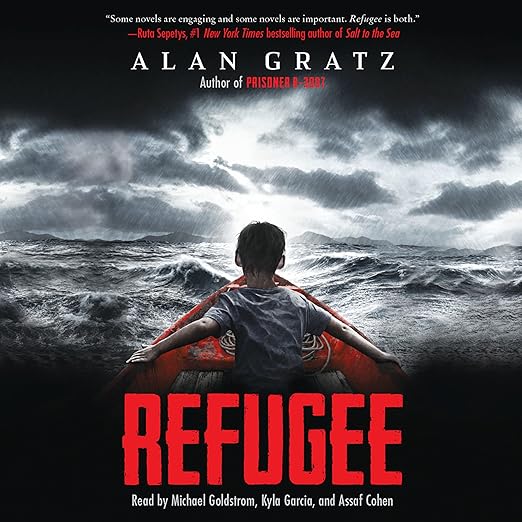
A reviewer named SURESH gave Refugee five stars for arriving in good condition. The quality of the product exceeds expectations, that review says, and even though it is labeled as used, it appears to be brand new, so books from this seller come confidently recommended. That is an assessment of a parcel. It sits on an audiobook listing for a 7 hour and 37 minute recording narrated by Michael Goldstrom, where nothing is labeled, shipped or secondhand. A second response, signed Shirley Ellison, reads in full: Gift, well liked. Two written responses out of five under this recording describe objects, not a story.
Alan Gratz built this novel out of three escapes running in parallel, and that structure is exactly why it survives the move to audio so well. Josef is a Jewish boy in 1930s Nazi Germany whose family boards a ship for the other side of the world with concentration camps closing in. Isabel is a Cuban girl in 1994 who leaves on a raft while riots tear through her country. Mahmoud is a Syrian boy in 2015 walking toward Europe after violence takes his homeland apart.
Josef, Isabel and Mahmoud never share a decade or a continent, and the book's promise is that their stories will turn out to be tied together anyway. Samantha McManus, writing four stars in March 2018, fills in the specifics the publisher's copy leaves vague: Josef boarding a luxury cruise ship in 1938 to outrun Hitler's army, Isabel pushing off in a homemade boat to flee Castro's Cuba, Mahmoud running from Syria after the wall of the family apartment is literally blown away. Gratz takes a political concept, McManus writes, and gives it a face, a story and a heart.
Becky Levine posted a five-star response while still only halfway through the book, and it stands as the most useful thing here for anyone weighing the recording. The craft observations are specific: the tight structure of the short chapters, the clarity with which Gratz switches between stories, the bits of power he hands the young characters, the slivers of hope woven in so subtly you do not notice them until later. Those are all qualities that translate directly into listening.
Short Rotating Chapters Built for Binge Listening
Seven hours and 37 minutes is short for a novel this ambitious, and the brevity is deliberate. Gratz writes in very short chapters that rotate between the three children, which in print reads as propulsive and in audio reads as almost impossible to stop. Each break lands right as a chapter ends, so a young listener who says one more and then bed will be lying, and a parent driving somewhere will discover the same thing about themselves. The rotation also solves a problem that sinks a lot of multi-strand novels in audio, where a listener loses track of which thread is running. Here the three eras are so far apart in setting and voice that reorientation takes about one sentence, no matter how long the gap between listening sessions.
Samantha McManus identifies the real reason this book gets assigned in classrooms. Refugee turns an abstraction that arrives through news headlines into three children with names, families, fears and terrible luck, and it does so without softening what happens to them. Drownings, bombings and betrayals are all promised in the publisher's own summary, and the book delivers on that promise. Heard aloud, those sections carry a weight the printed page can let a fast reader skim past.
Michael Goldstrom is the sole narrator named. That is one reader for a Jewish boy in 1930s Germany, a Cuban girl in the 1990s and a Syrian boy in the 2010s, plus the adults surrounding each of them. Reading across three continents and three eras asks a reader to build and hold nine or ten distinct presences without leaning on accent work as a crutch. It is a harder assignment than the runtime suggests.
Shelved as Adventure Despite Drownings and Bombings
Two things need flagging for the adult doing the buying. The first is the content: children die, families are separated, and the danger is never defused by a rescue that arrives in time. Happily Ever Elephants calls it a profound look at harrowing experiences so many children face on a regular basis, which is accurate and also a warning. The second is the shelving. This recording is filed under Action and Adventure, a tag that sits oddly on a Holocaust escape and a Mediterranean crossing.
Eleven people have graded it at 4.7, which fixes the total at 52 stars out of a possible 55, so the enthusiasm is real. The written column is thinner than the count implies, though. Three substantial responses landed between January and October 2018, all inside the first fifteen months after the August 2017 release. The other two arrived in January and March 2026, more than eight years later, and neither of them mentions the story at all.
Middle grade is where Happily Ever Elephants places it, and the phrase is worth taking seriously in both directions. The vocabulary and chapter length suit a confident nine or ten year old reader. The subject matter suits a listener old enough to ask follow-up questions afterward. Those two ages are not always the same child, and the recording gives you no way to preview the roughest passages except by listening ahead yourself.
A Book for Classrooms and Long Car Rides
Kids who already read history for pleasure will tear through this, and so will the adults who end up in the car with them. Classrooms and family listening sessions get the most out of it, because the three-strand structure practically demands conversation between chapters. Anyone who works with young people around displacement, or who wants a way into the subject that is neither a lecture nor a documentary, will find the seven and a half hours well spent. It also suits reluctant readers who have hit a wall with longer novels, since each chapter runs a few minutes and ends somewhere you want to keep going. Households already reading Gratz will recognize the approach from Prisoner B-3087 and Projekt 1065, both named on this listing as earlier work.
Not for you if you want a comfortable bedtime listen, because the last stretch of each strand is genuinely upsetting and does not resolve into safety for everyone. Not for you either if you came looking for the adventure the category tag advertises. Hand it to a young listener who can handle real stakes, then stay somewhere nearby for the final hour.
- Voice: Michael Goldstrom carries three children, three decades and three continents on a single credit.
- Big ideas: displacement and asylum, family under pressure, courage in children, historical parallels across eras.
- Atmosphere: urgent and clear-eyed, with real grief in the last hour.
- Worth it?: the rare middle grade novel that earns its subject, and short enough to finish in two sittings.
How graphic is Refugee for a middle grade listener?
Frank without being gratuitous. The publisher's summary promises drownings, bombings and betrayals, and the book keeps that promise for all three children. Nothing is described in gory detail, but people the story has made you care about do not survive. Most confident nine and ten year olds handle it; some will want an adult nearby.
Does the Refugee audiobook use different narrators for Josef, Isabel and Mahmoud?
No. No second performer is named beside Michael Goldstrom, so a single voice covers all three timelines and every supporting character in them. Nobody among the five writers here addresses how that single-voice approach works in practice, which leaves the sample clip as your best guide before buying.
Is the Refugee audiobook complete, or has anything been cut for the recording?
Nothing on the listing indicates an abridgment, and the 7 hour and 37 minute runtime is consistent with the full novel at ordinary narration speed. The word abridged appears nowhere on this page. Reviewers discuss chapters and story arcs as though working from the complete text throughout.