Quick Take
- Narration: Monica Levy delivers clear, steady narration appropriate to a science-adjacent wellness guide, professional and unobtrusive.
- Themes: Photobiomodulation science, cellular health, at-home wellness technology
- Mood: Informative and accessible, pitched at the curious non-expert
- Verdict: A solid introduction to red light therapy that covers the science without losing a general audience, though the PDF companion is genuinely necessary for anyone planning to act on the device recommendations.
I was halfway through a conversation with a friend who’d just spent four hundred dollars on a red light panel when I realized I had no idea what I was talking about. She kept mentioning mitochondria and nitric oxide and I kept nodding. A few days later I pulled up this audiobook on a long drive, hoping to close the gap. By the time I reached the cellular biology section, I understood what she’d meant, and also why she was using the thing at six in the morning before work.
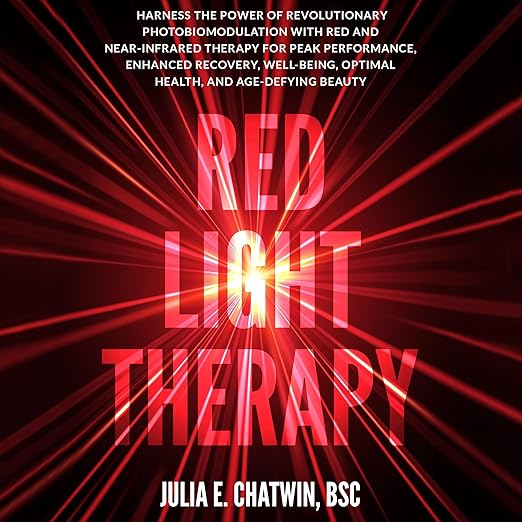
Red Light Therapy by Julia E. Chatwin BSC positions itself as a comprehensive guide for people new to photobiomodulation, the umbrella science that covers how light wavelengths interact with living tissue. Chatwin has a science background, and it shows in how she structures the material: history first, then mechanism, then application. It’s a thoughtful sequence that prevents the common wellness-book failure of leading with benefits and burying the reasoning.
The Science Explained Without Losing You
Chatwin traces red light therapy from early dermatological research through NASA’s experiments with plant growth and wound healing in low-gravity environments, reviewer Levia B. mentions encountering the NASA connection in the 1990s, which gives a sense of how long this technology has been percolating outside mainstream wellness. The explanation of how mitochondria absorb specific wavelengths and how that absorption affects cellular energy production is genuinely illuminating. It doesn’t require a biology degree to follow, but it does reward attention.
Monica Levy narrates with appropriate clarity. This is not the kind of audiobook where narration style carries the weight, the content is doing the work, and Levy’s job is to stay out of the way and read accurately. She does. For a science-dense text, that’s exactly what you want. The danger with this kind of material is a narrator who either over-performs or under-performs. Levy finds the right middle register.
Where the PDF Gap Becomes Real
The publisher notes that a PDF companion is included with purchase, and in this case that’s not a routine addendum, it’s load-bearing. When Chatwin describes how to assess a device’s irradiance or compare panel specifications, the listener without a visual reference is at a disadvantage. Reviewer Richard Thibault, who uses RLT professionally, calls it a practical tool, and for that practical application, the PDF helps considerably.
The book also addresses safety in ways that are more thorough than most competing titles. The sections on RLT during pregnancy, potential impacts on migraines, and contraindications for certain conditions are handled carefully. This is not a book that oversells the therapy, which is a notable contrast with the many influencer-adjacent wellness guides flooding the same subject. Chatwin maintains a measured tone: beneficial for many applications, more research needed for others, safety considerations are real not hypothetical.
For the Newly Curious and the Already Committed
Reviewer D. Luria, a yoga instructor drawn to the holistic applications, and reviewer Richard Thibault, who uses RLT in professional healthcare contexts, both gave this title strong marks, which tells you something about its range. The book functions as a genuine primer for someone who knows nothing about the subject, and as a structured reference for someone who’s already using devices and wants to deepen their understanding of why they work.
The runtime of just under four hours is appropriate. Where the book falls short is in the lack of comparative device reviews with current specifications, the field moves fast, and specific models mentioned may have been superseded. And the structure occasionally double-backs, covering some mechanisms twice in different chapters without quite integrating them.
Listen if: you’re considering purchasing a red light panel and want to understand what you’re buying into, or you’re already using RLT and want the science behind it. Skip if: you want clinical depth or a device-specific buying guide, those require resources more current than a fixed audiobook format can provide.
Frequently Asked Questions
Is the PDF companion actually necessary, or can you get full value from the audio alone?
For the historical and explanatory sections, audio alone works well. For the device selection and protocol sections, the PDF provides reference tables and specifications that genuinely help. If you’re planning to purchase equipment, download the PDF.
Does this book cover near-infrared light as well as red light, or only the visible red spectrum?
Both. Chatwin covers the distinction between red light (roughly 630-700nm) and near-infrared, explains why the wavelengths differ in tissue penetration depth, and addresses applications specific to each range. The title slightly undersells the scope of the content.
Is the science accurate, or does this read more like wellness marketing with biological vocabulary?
Chatwin’s background in science shows in how she handles mechanisms, she cites cellular respiration, mitochondrial function, and specific wavelength ranges rather than vague claims. It’s not a peer-reviewed text, but it’s more rigorous than most wellness guides on this topic. She also acknowledges areas where evidence is still emerging.
How does this compare to The Ultimate Handbook on Red Light Therapy by Jim Sanderson?
Chatwin’s book is generally more thorough on the science side, with more context about the history of photobiomodulation and cellular mechanisms. Sanderson’s handbook gives more attention to practical protocols and at-home device use. Both are useful introductions, they’re complementary rather than identical.