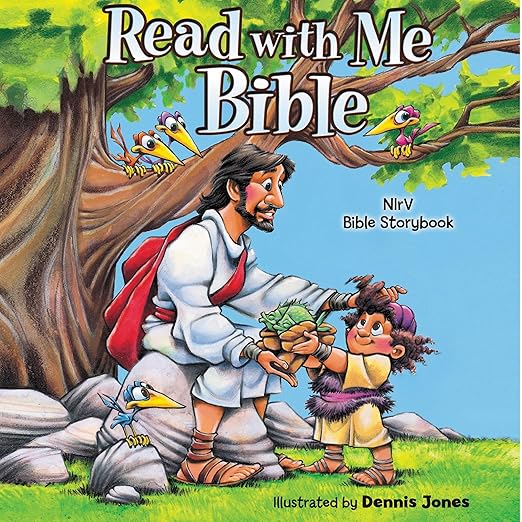
Zondervan's Read with Me Bible, NIrV arrives in audiobook form narrated by John Rubinstein, and the pairing of familiar scripture with a measured, fatherly voice gives this 2-hour-and-31-minute production a reliable warmth. The NIrV translation, designed specifically for early readers, uses simplified sentence structures and scaled-back vocabulary so children ages 4 to 8 can follow the material without adult translation. What the audiobook version adds is a read-along cadence that makes shared listening feel natural rather than instructional, and Rubinstein is the right narrator for that task.
106 Stories That Feel Purpose-Built
The 106 stories drawn from both the Old and New Testaments have been chosen with young attention spans in mind. You get the core narrative moments: Abraham and Isaac, Moses in the bulrushes, David and Goliath, the Nativity, the Sermon on the Mount, without the genealogical tangents that lose young listeners in full-length Bible recordings. The NIrV text prioritizes recognition over reverence, which is the right call for this age bracket. Rubinstein does not dramatize aggressively. His performance stays inside the lane of a careful storyteller rather than a theatrical performer, and that restraint serves the material well. Religious content for young children benefits from steadiness, and Rubinstein provides exactly that. The reviewer who described his narration as vivid and clear captures both qualities efficiently, though the production leans more toward clarity than vivid drama. The absence of music or sound effects keeps the experience simple and distraction-free, which parents of easily overstimulated young children will likely appreciate. Each story has been condensed from its full-text source while preserving the essential character and action, so the Passover narrative, the crossing of the Red Sea, and the Sermon on the Mount all arrive intact in shortened form rather than in truncated fragments. That editorial discipline is what makes this a usable rather than a decorative Bible resource for the target age group. What the NIrV format achieves that a full-text Bible recording cannot is the accessibility of the material to children who are not yet fluent enough to follow complex sentence structures, but who are old enough to understand narrative cause and effect. The 106-story collection does not feel like a simplified edition so much as a purpose-built one.
The Case for Audio Comes Down to Proximity
The primary argument for choosing the audio version over the print edition is proximity. A parent who wants to introduce Bible stories during car rides, at bedtime, or during a quiet afternoon at home can do so without needing to read aloud themselves. Rubinstein handles the pacing, which is consistent and measured across all 106 stories. The included Words You Should Know reference section exists in the print edition; in the audio version, Rubinstein handles vocabulary naturally within the text rather than pausing for definitions, which keeps the narrative flowing. At just over two and a half hours total, the full recording can be completed across several short sessions without losing thematic coherence. This is particularly useful for families who want to rotate stories rather than listening straight through. Each story functions as a self-contained unit, so a parent and child can select specific Old or New Testament passages based on whatever is relevant at the time, whether a holiday, a Sunday school lesson, or simple curiosity. The production's consistency across all 106 stories means there are no jarring tonal shifts between the weightier Old Testament material and the New Testament narratives. The second review note, that a listener purchased an additional copy for a family member who also enjoys the stories, suggests the material carries cross-generational warmth that functions beyond the immediate 4-to-8 target audience. For grandparents who want to read along with grandchildren but find sustained read-aloud sessions taxing, having an audio version that a child can initiate independently is a practical asset beyond its obvious educational function.
Closer to a Bedside Story Than a Drama
Families new to the NIrV translation should know it is a paraphrase-adjacent version rather than a strictly literal rendering of the Hebrew and Greek texts. It prioritizes readability at a second-grade level, which means some theological precision is traded for clarity. Adults familiar with the ESV or NKJV will notice the differences. For children ages 4 to 8, those differences are largely irrelevant, but for families who place doctrinal weight on a specific translation, it is worth knowing before purchasing. Rubinstein's narration is calm to the point of minimalism in certain stories. The more dramatic Old Testament moments, the binding of Isaac, Daniel in the lions' den, do not receive heightened performance energy. This is not a flaw, but it does mean children who respond to theatrical audiobook performances may find those moments less gripping than they might expect from a story they know. The overall production is quiet rather than dynamic. That is a deliberate creative choice, and it suits the intended use as a settling, companionable listen rather than an entertainment spectacle. With only two ratings currently available, extended reader response data is limited, though both reviews rate it at five stars and the satisfaction with the recording's clarity is consistent across both. Families who are comparing this to dramatized children's Bible productions with full voice casts and music scores should know those are quite different listening experiences from what this production offers. The Read with Me Bible in audio is closer to a bedside story than to a radio drama.
Skips the Need for Your Own Narration
Children ages 4 to 8 in households where faith is part of daily life will find this a natural fit. Parents looking for a low-effort way to introduce scripture during ordinary family moments, bedtime routines, weekend mornings, or car trips, get reliable material without requiring their own on-demand narration energy. The format is also appropriate for Sunday school supplementary use or for grandparents and caregivers who want to share Bible stories without referencing a physical book. Families who want a high-drama, fully cast audio production with music and sound effects will want to look elsewhere. This recording is for attentive, calm listening rather than immersive audio entertainment, and it serves that purpose with consistency and care.
Good to Know
Does this audiobook cover both the Old and New Testament?
Yes. The audiobook includes 106 stories drawn from both testaments, covering the major narrative moments from the Hebrew scriptures as well as the Gospels and key New Testament accounts.
Is this audiobook appropriate for children younger than 4?
The NIrV translation targets early readers ages 4 to 8. Younger children may enjoy listening alongside a parent, but the vocabulary and story structures are calibrated for that 4 to 8 range. Very young toddlers may not sustain attention across full stories.
How long is each individual story in the audiobook?
The total runtime is 2 hours and 31 minutes across 106 stories, which averages roughly 90 seconds per story. Some stories run slightly longer, but none are extended to the point of losing young listener attention.
Can you listen to individual stories out of order, or is this audiobook designed for linear listening?
Each of the 106 stories is self-contained, so listening out of order is entirely workable. Families can select Old or New Testament stories based on context, curriculum, or seasonal relevance without needing to follow the sequence from beginning to end.