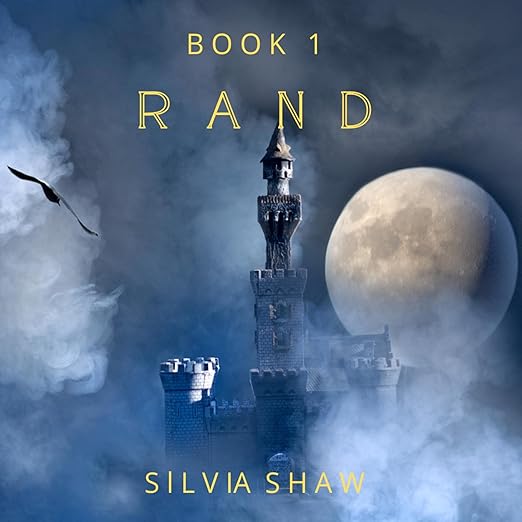
Quick Take
- Narration: Susan McGurl handles the portal fantasy’s dual-world structure with consistent clarity, differentiating the Earth-based Savannah from the warrior culture of Rand without overstating the contrast.
- Themes: The archaeologist chosen to bear ancient magic, a world ruled by an imperial line of queens, identity forged in an alien culture
- Mood: Epic and character-driven, building toward a larger series arc
- Verdict: An ambitious LGBTQ+ portal fantasy with a compelling central premise and strong world-building, best approached knowing that character depth is the main event even when the plot moves quickly.
I came to Rand: Book 1 looking for something that did what so many fantasy series promise and relatively few deliver: a fully realized world governed by different rules than our own, with a protagonist who is genuinely out of place there rather than conveniently already equipped for the adventure they are about to have. Silvia Shaw does this well. Dr. Savannah Cole is an archaeologist, not a warrior. She is intelligent, trained in specific skills that turn out to be partly relevant to her new situation, and completely unprepared for the rest of it. Her entry into Rand, a world ruled by an imperial line of queens for three hundred years, is not a triumphant arrival. It is a bewildering, frightening, and gradually clarifying process of having to become someone new.
The setup is portal fantasy in the classical mode: an artifact from another world, discovered during a dig in Algeria during a sandstorm, compels its finder to follow it back through a portal. The Circle of Sheda is a medallion and a talisman of significant power, and the fact that it has chosen someone from the other world, not a warrior, not a member of the warrior lineages that have traditionally borne it, is the novel’s central mystery and its central source of tension. Why Savannah? That question drives the book more than the external threats, which are also present in the form of demonic creatures and dark sorcery and which the book handles with appropriate urgency.
The Matriarchal World and What Shaw Got Right
The world-building in Rand is one of the novel’s genuine strengths. Shaw has built a society that has been ruled by queens for three centuries and has developed its own codes, hierarchies, and histories around that fact. The warrior women who serve the imperial line are not simply women doing what men did in a standard fantasy setting. They have their own culture, their own relationship to power and loyalty, and their own understanding of what the medallion means and who is worthy to bear it. A reviewer described the characters as so fully realized that each one could support a story of their own, and a specific character named Pela is cited as a particularly memorable creation. That depth is not accidental: Shaw clearly spent time thinking about this society as a coherent whole rather than as a backdrop for the protagonist’s adventure.
The LGBTQ+ dimension is woven into the world rather than grafted onto it. A reviewer who describes the book as a great lesbian read without virtue signaling is pointing at something structurally true: the same-sex relationships in the narrative exist within the world’s normal order rather than being marked as exceptional or in need of explanation. That integration is harder to achieve than it might appear, and it is one of the reasons the world feels genuinely different rather than simply a standard fantasy world with different surface features.
Savannah’s Archaeology as More Than a Credential
The protagonist’s professional background is used more cleverly than the genre usually manages with Earth-imported skills. Savannah is trained to observe, to gather context before drawing conclusions, to understand that objects carry histories that are not always visible at first contact. These habits of mind serve her in Rand in ways that combat training would not have, and Shaw uses them to pace the reader’s own discovery of the world through Savannah’s eyes. We learn what we need to learn when Savannah learns it, which keeps the exposition from front-loading and gives the world-building the quality of genuine discovery rather than orientation lecture.
One reviewer noted that while the main character’s development is strong, the supporting characters are understood somewhat at a surface level. This is a fair observation for book one of a series. The groundwork is laid for deeper development, and the characters that reviewers single out for particular praise, Pela especially, suggest that Shaw is capable of the depth that the reviewer wants. Series openings have the structural problem of having to introduce a world, a protagonist, and enough supporting cast to carry the story forward, and some of that cast necessarily gets less room in the first volume.
Susan McGurl and the Portal Fantasy Narration Challenge
Portal fantasy narration has a specific challenge: the narrator has to render both the familiar world the protagonist is leaving and the unfamiliar world they are entering, maintaining enough distinction between them that the audience can feel the transition. McGurl handles this well. Her Savannah in the Algeria sections has a different register from her Savannah in Rand, not dramatically different in the way that heavy-handed narrators manage the trick, but with the kind of subtle tonal shift that reflects genuine displacement. The warrior women of Rand have their own vocal presences, and McGurl gives Pela, who reviewers single out, a particular distinctiveness that serves the story across the full thirteen-hour runtime.
A Note on Editorial Roughness and the Series Ahead
One reviewer notes that the book has occasional word-form errors and misused phrases that suggest it could have benefited from more rigorous copy-editing. In audio, these register as moments where a phrasing lands slightly wrong rather than as significant disruptions. For listeners invested in the world and story, these are minor irritants. The underlying story, the world-building, and the mystery of Savannah’s selection are strong enough to carry the occasional rough edge. Shaw clearly has a large and detailed world in her head, and the ambition of the project is visible throughout even where the execution occasionally falters. Reviewers who pushed through the first volume are uniformly eager for what comes next, which is a meaningful signal about the series’ actual staying power.
Frequently Asked Questions
Is Rand: Book 1 primarily a romance, or does the fantasy world-building drive the story?
The world-building and the mystery of why Savannah was chosen to bear the medallion drive the primary narrative. Romance develops but is not the organizing structure of the book. It is closer to classic portal fantasy with LGBTQ+ characters than to a fantasy romance.
How integrated is the LGBTQ+ content into the world of Rand, or does it feel added on?
It is genuinely integrated. The same-sex relationships exist within Rand’s normal social order rather than being marked as exceptional, which is consistent with a world that has been ruled by queens for three centuries and has developed its own cultural norms around that history.
Does Susan McGurl’s narration handle the transition between Earth and the world of Rand convincingly?
Yes. McGurl gives Savannah subtly different registers in the two worlds, reflecting the displacement the character experiences, and differentiates the supporting cast well enough that the larger cast does not become confusing across thirteen hours.
Reviewers mention editorial roughness in the text. Does this affect the audiobook experience significantly?
Occasional word-form errors and misused phrases are present. In audio, these register as moments where a phrasing lands slightly wrong rather than as significant disruptions. Listeners invested in the world and story will find these minor irritants rather than obstacles.