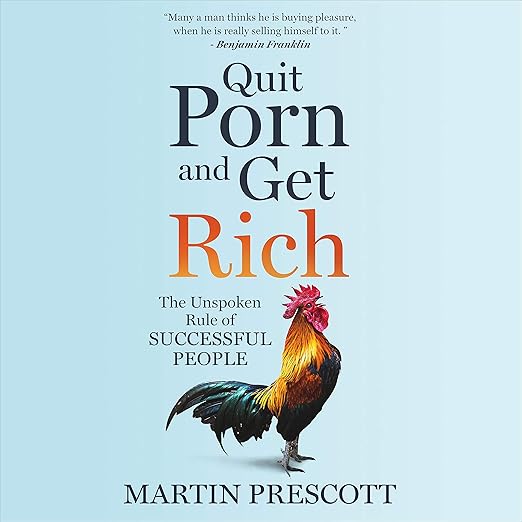
Quick Take
- Narration: Chad Loomis reads with the tone of a business documentary narrator, authoritative and clean, which suits the book’s framing of porn addiction as a productivity and motivation issue.
- Themes: Pornography’s impact on dopamine and motivation, professional performance, willpower and self-control
- Mood: Analytical and challenge-oriented, occasionally blunt
- Verdict: The productivity-focused framing of porn recovery is unusual enough to be genuinely differentiating, and the core neuroscience holds up reasonably well, though the title promises financial outcomes the content does not fully deliver.
There is a genre of men’s self-improvement audiobook that packages behavioral science inside an aggressive hook, and Quit Porn and Get Rich lives squarely in that space. The title is the pitch: there is a connection between pornography use and professional underperformance, and breaking one habit can unlock the other. Whether you find that framing reductive or usefully specific will probably determine whether you get anything out of the five and a half hours.
I listened to this one on a weekday morning with genuine curiosity about the argument. The neuroscience of dopamine dysregulation has been covered extensively in the addiction literature, but I had not encountered it applied specifically to the intersection of pornography use and professional motivation before encountering Martin Prescott’s framework. The question that interested me was whether the book actually earns its unusual thesis or whether the productivity framing is mostly marketing.
The Dopamine Desensitization Argument
The core scientific argument is that high-intensity artificial stimuli, specifically, internet pornography, elevate dopamine release to levels that ordinary daily activities cannot match. Over time, repeated exposure desensitizes dopamine receptors, making lower-intensity rewards like professional accomplishment, social connection, or sustained concentration feel progressively less compelling. The practical result, Prescott argues, is not just reduced sexual motivation but reduced motivation across domains: in negotiations, risk-taking, creative work, and the accumulation of wealth.
This argument has genuine grounding in neuroscience. The mechanisms Prescott describes are real: dopamine receptor downregulation has been documented in addiction research across multiple substance and behavioral categories. The extension of this mechanism to professional performance is more speculative but not implausible, and Prescott’s use of Dan Ariely on sexual arousal and decision-making, Napoleon Hill on sexual energy redirection, and Roy Baumeister on willpower depletion gives the argument several respectable anchors.
Where the Science Gets Stretched
The book is most reliable when it stays close to peer-reviewed research and most strained when it moves toward prescriptive applications. The claim that pornography use specifically undermines negotiation ability and risk handling draws on weaker inferential chains than the core dopamine argument. Reviewer P. Rudom captured the most robust version of the book’s thesis, that high doses of dopamine desensitize receptors and regular life becomes dim and depressing because we become insensitive to small releases of dopamine from the small beauties of everyday life, which is well supported. The specific claim that sobriety from pornography correlates with financial success is less rigorous than the title implies.
Reviewer Gonzalo, who is himself an author on pornography addiction recovery, called it a refreshing and stimulating reading that fills a gap in the available literature. That is probably the right framing: not a comprehensive clinical guide but a perspective on porn recovery that connects it to domains, professional confidence, motivation, social intelligence, that clinical approaches tend not to address.
Chad Loomis and the Narration
Loomis brings a businesslike competence to the narration that suits the material’s ambitions. This is not a warmth-and-healing book; it is a performance-optimization argument that happens to be about addiction. The clean, authoritative delivery matches that register. The academic citations and business anecdotes land with appropriate seriousness. Occasional passages where Prescott’s prose becomes more motivational are handled without tipping into the performative energy that men’s self-help narrators sometimes deploy to compensate for weak material.
Who Should Listen / Who Should Skip
Listen if: You are a man who suspects pornography use is affecting your professional motivation and confidence, you want a framework that connects sexual behavior to productivity rather than just moral framing, and the neuroscience angle appeals to you more than a shame-based or purely spiritual approach. Skip if: You are looking for clinical addiction treatment guidance, if the productivity framing feels reductive rather than useful, or if you need a narrator and author with clinical credentials rather than a self-help framework.
Frequently Asked Questions
Does Quit Porn and Get Rich actually explain how quitting porn leads to financial success?
It makes an argument connecting pornography’s dopamine effects to reduced motivation, self-control, and risk tolerance across professional domains. The connection to financial success specifically is more inferential than demonstrated, the book explains the mechanisms of dopamine desensitization clearly but is less rigorous about the specific career and wealth outcomes implied by the title.
Is the science in this book accurate?
The core dopamine desensitization argument has genuine grounding in addiction neuroscience. The applications to negotiation ability, risk-taking, and professional success are more speculative. Prescott draws on credible sources including Professor Dan Ariely and Professor Roy Baumeister but extends their research further than the original studies strictly support.
Is this book specifically for men, or is the content applicable more broadly?
The book is explicitly written for a male audience. The examples, framing, and the Napoleon Hill sexual transmutation concept are directed at men. Women dealing with pornography-related concerns would find the content less directly applicable.
How does Quit Porn and Get Rich differ from NoFap or similar online communities?
The book shares some of the NoFap movement’s core premises, particularly the idea that abstaining from pornography unlocks significant benefits, but Prescott frames the argument through formal neuroscience and business literature rather than online community experience. The tone is more analytical and less communal.