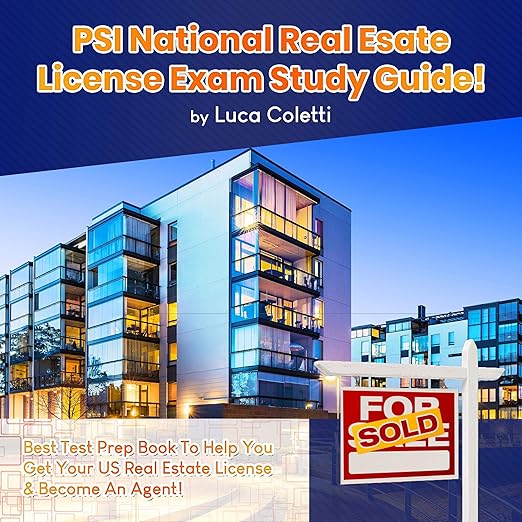
Luca Coletti's PSI National Real Estate License Exam Study Guide is one of a specific and crowded category of audiobooks: certification prep material designed for active learners who want to convert commute time into study hours. The pitch is clear. Hundreds of practice questions across eleven chapters, covering everything from Property Ownership and Land Use Controls through Financing, Contracts, Transfer of Title, and Real Estate Calculations. Appendices add test-taking tips, sample forms including a Purchase Agreement and a Disclosure of Property Condition form, and a Glossary of Real Estate Terms. As an audiobook designed to sit alongside your preparation for the PSI National exam, the material itself is organized and complete.
Eleven Chapters Mirror the Actual Exam Sequence
The structural logic of this audiobook is sound. Coletti, identified in the synopsis as a real estate professional himself, has organized the material in a sequence that mirrors how exam topics typically appear, moving from foundational concepts like property ownership and agency through to calculations and specialty areas. The decision to format this as a practice questions edition rather than a narrative overview means you are not receiving a survey of real estate principles in the abstract; you are working through the actual form that exam questions take. For adult learners who retain information better through active recall than passive reading, that approach has real advantages. Reviewer Tina called it an outright recommendation, noting that reading the entire book paid off.
The content coverage across the eleven chapters is comprehensive. Chapter Four on Financing, Chapter Seven on Contracts, and Chapter Eight on Transfer of Title are the areas where licensing candidates typically struggle most, and they receive dedicated treatment here. The appendix material adds practical value beyond pure exam prep: a Sample Offer to Purchase and Acceptance Contract, a Real Estate Purchase Agreement, and a Cancellation of Agreement form give you exposure to the actual documents you will use as a licensed agent. For a listener who is studying for the first time, that context is genuinely useful.
Designed as a Gym-and-Traffic Study Companion
The original design intention is important to understand: this was built as an audio companion. Coletti developed it specifically so that busy professionals could absorb exam material while at the gym, stuck in traffic, or doing other tasks. That context matters for how you approach it. An audiobook in the traditional literary sense rewards immersive listening and narrative attention. A certification prep audio guide rewards repetition, pausing, and revisiting specific sections. These are different cognitive modes, and listeners who approach this with literary expectations will find the format jarring. Those who use it as a mobile study session will find it functional.
At six hours and thirty-three minutes, the runtime is compressed for the volume of material covered. That compression means the pacing is brisk. Practice questions are delivered, answers and rationale are provided, and the next question follows. Reviewer Melissa Cleary noted that the format was not what she expected from the layout, and that observation is worth taking seriously when setting expectations. This is a structured practice-question sequence in audio form, not a warm narrative guide through the principles of real estate law.
Kasakova's Uneven Cadence Undercuts Comprehension
The narration by Lara Kasakova is the most contested element of this audiobook. One reviewer described her cadence as 'ridiculously up and down every few words,' calling it 'comically bad' and noting that they could not listen for comprehension because the delivery was so distracting. This is a substantive complaint, not a minor stylistic preference. For a certification prep guide, where accurate retention of specific terms and numerical formulas is the entire point, a narration that interrupts comprehension is a real functional problem. Listeners considering this audiobook should be aware that the delivery may require patience, and pausing frequently to replay passages may be necessary.
Certification prep material also has a shelf life. Real estate licensing requirements and specific statutes vary by state, and exam formats are periodically updated. The PSI exam structure covered here may not reflect the most current version of the national exam. Checking the publication date and verifying alignment with your specific state's current exam format before committing to this as your primary study resource is worth doing.
For listeners who have already sat through state-specific pre-license courses and need to reinforce the national content, this audiobook provides the most effective use of otherwise idle time. The commute application Coletti built it for is genuine: the practice question and answer format translates well to audio in ways that narrative content about legal concepts does not. You hear a question, you think through your answer, you hear the rationale. The repetition across eleven chapters builds the pattern recognition that multiple-choice exams actually test. That said, the narration remains the variable that will either make or break the experience for individual listeners, and some will find the text version more workable.
The appendix material extends the usefulness of the audiobook beyond the practice questions themselves. Test-taking tips, sample contracts including the Offer to Purchase and Acceptance Contract, the Real Estate Purchase Agreement, and the Cancellation of Agreement form, and a full glossary of real estate terms give listeners exposure to the vocabulary and document landscape of the profession. In audio form, the glossary is particularly effective as a revision tool: a clear definition of each term, delivered in sequence, reinforces the vocabulary that exam questions are built around.
Fine if You Can Tolerate Uneven Narration
Candidates preparing for the PSI National Real Estate License Exam who learn well through repeated question-and-answer exposure and who can tolerate an uneven narration performance will find value here. The content is comprehensive, the structure is logical, and the format is genuinely designed for on-the-go study. Listeners who need a warm, clear narration to retain information effectively, or who want a narrative overview of real estate principles rather than a practice-question sequence, will likely struggle with this format. If the narration proves too distracting, this title may work better in its print or digital text format than in audio.
How does the narrator's performance affect the usefulness of this study audiobook?
Multiple reviewers flagged Lara Kasakova's cadence as inconsistent and distracting, which is a real concern for retention of technical material. If you are sensitive to narration quality, this is worth considering carefully, and you may need to pause and replay sections more frequently than you would with a clearer delivery.
Does the audiobook include the sample forms mentioned in the appendices, or are those text-only?
The synopsis describes Sample Purchase Agreements, Disclosure of Property Condition forms, and a Real Estate Purchase Agreement as appendices, but in audio format these are narrated rather than visual. For actual reference to these documents, the print or digital edition will serve you better.