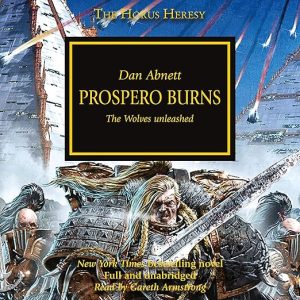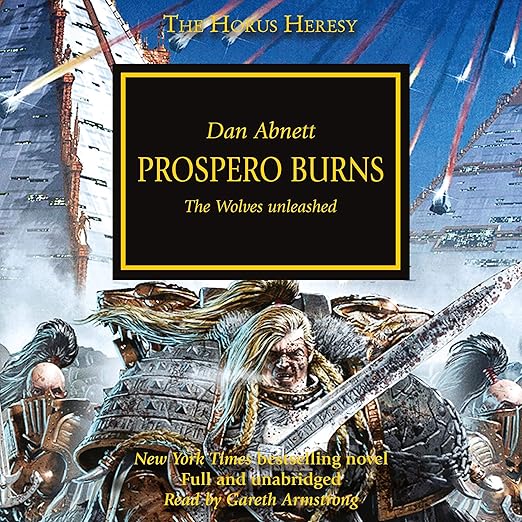
Dan Abnett's craft in the Horus Heresy series has always been defined by a willingness to approach familiar material from an angle that makes it strange again. Prospero Burns, the fifteenth entry in the series, does exactly that: it tells the story of the Space Wolves' assault on the sorcerer-world of Prospero from the inside of the Space Wolves themselves, through a human perspective that arrives at Leman Russ's Legion without the assumptions a Warhammer fan would typically bring. I came to this audiobook as someone who has read widely in the Black Library range, and Abnett's reputation for doing serious character work within the constraints of tie-in fiction is fully justified here. This is not a book about an assault. It is a book about what kind of society could produce the warriors who carry one out.
A Closer Look at Prospero Burns
The synopsis is accurate but slightly misleading: this is not primarily an action novel about the Emperor's rage or the apprehension of Magnus the Red. It is a character study of the Space Wolves as a Legion, told through an outsider's gradual acculturation to a culture that operates on principles very different from what the Imperium's more formal armies represent. Abnett's structural decision to embed the human narrator within the Space Wolves well before the assault on Prospero allows him to build the mythological and cultural logic of the Vlka Fenryka, to use their own term for themselves, across the narrative rather than using it as decoration. One reviewer described having 'never really liked the Space Wolves' before this novel lifted the veil and revealed 'a faction that has a lot more beneath the surface than initially meets the eye,' and that is an accurate description of what Abnett accomplishes.
Another reviewer called Abnett 'by far the finest author of the Black Library' and noted that his work is 'just good hands down,' not merely competent genre fiction but a genuine exploration of how human beings function under conditions of extreme conflict. That observation is important context. Prospero Burns rewards readers who are interested in that kind of inquiry, who want the worldbuilding to serve character rather than just geography. The RPG analogy offered by one reviewer, of the character who 'dumps Charisma' to maximize combat effectiveness, is a useful entry point from gaming culture but undersells what Abnett is actually doing with the Vlka Fenryka's internal logic.
What Makes Prospero Burns Worth Hearing
Gareth Armstrong's narration is one of the genuine assets of this audiobook. Armstrong has significant experience with varied literary registers, and he brings to Abnett's dense prose a vocal authority that suits the mythological register of the Space Wolves' self-presentation. The sagas and kennings that define their speech, Abnett's research into Norse linguistic and cultural traditions, are rendered by Armstrong with the cadence of someone who understands that this language is designed to feel ancient and earned. The battle sequences, which arrive in the novel's third act with sustained intensity, benefit from narration that keeps them spatially legible without sacrificing the chaos and weight that make them feel consequential.
The apparent social bluntness of the Space Wolves is not simply a character flaw as rendered here; it is a consequence of a specific philosophy about truth-telling and loyalty that the novel works to articulate over twelve-plus hours. Armstrong gives that philosophy enough weight to make it legible rather than merely quotable, and the listener comes away from the audiobook with a genuine sense of what the Vlka Fenryka believe they are and why they believe the Emperor sent them to Prospero. That understanding makes the assault, when it arrives, carry a weight it would not otherwise have.
Things to Know Before Starting Prospero Burns
This is the fifteenth book in a long series, and while Abnett constructs it with enough self-containment to be accessible as a standalone, listeners without prior familiarity with the Horus Heresy will be missing significant context for the political and theological stakes that drive the Emperor's decision to dispatch Leman Russ. The novel assumes knowledge of Magnus the Red and the Thousand Sons, and the emotional weight of the assault on Prospero depends partly on understanding what was lost and why it mattered. New listeners to the setting are not entirely without resources, but the investment will be proportional to the background they bring.
The slow build of the first half, focused on acculturation rather than action, will test the patience of readers who picked this up expecting a straightforward military science fiction novel. The payoff in the back half is significant, but getting there requires sustained attention to character and cultural texture rather than plot momentum. Listeners who find the early sections slow are advised to stay: the cultural groundwork Abnett lays in the first half is precisely what makes the third act devastating rather than merely spectacular.
Who Dan Abnett Is Writing For
Warhammer 40,000 and Horus Heresy fans who have avoided the Space Wolves or found them less interesting than other Legions will find this audiobook a substantial corrective. Readers of military science fiction with an appetite for character-driven worldbuilding will get a strong example of what the best Black Library work can accomplish. Those new to the Horus Heresy setting should start earlier in the series before arriving here, where the stakes will carry far more resonance. Listeners who appreciate Abnett's work in other contexts will find Prospero Burns fully consistent with the qualities that make him the finest author working in this space.
The Short Version
- Narrator: Gareth Armstrong brings vocal authority and mythological cadence to Abnett's Norse-inflected prose, handling the sagas with earned weight.
- Subjects: Legion identity and loyalty, outsider acculturation, the human cost of cosmic conflict
- Tone: Slow-burning and immersive, with mythological depth that rewards patience
- Bottom line: A standout entry in the Horus Heresy range that reframes the Space Wolves entirely, anchored by Abnett's character-first approach and strong narration.
Questions Listeners Ask
Is Prospero Burns primarily an action audiobook or a character study?
More character study than action, particularly in the first half. Abnett invests heavily in building the Vlka Fenryka's culture and logic through the outsider perspective before the battle sequences arrive in force. Readers expecting continuous military action throughout will need patience for the setup.
How does Gareth Armstrong handle the Norse-inflected language and naming conventions in this audiobook?
With real skill. Armstrong's vocal authority and experience with varied registers allow him to deliver the sagas, kennings, and Legion terminology with the cadence of something genuinely archaic rather than invented. It is a significant asset for material this dependent on cultural texture.
Is this audiobook a good entry point for the Horus Heresy series for someone new to Warhammer?
Not ideal. The series has considerable accumulated context, and Prospero Burns sits at book 15. Listeners new to the setting will benefit more from starting with Horus Rising or False Gods before arriving here, where the emotional stakes carry much more resonance.