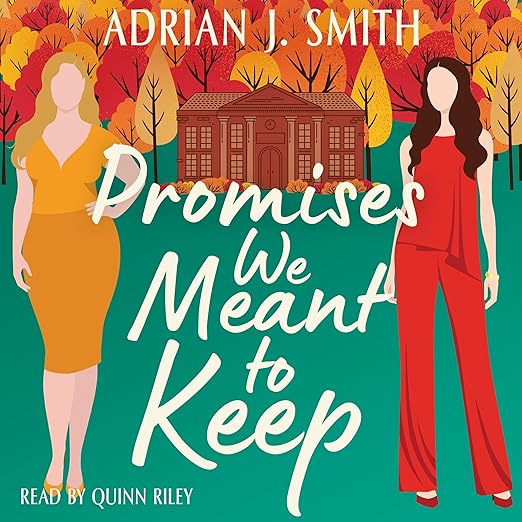
Adrian J. Smith's Promises We Meant to Keep, part of the Love in Massachusetts series and narrated by Quinn Riley across thirteen hours and forty-one minutes, arrives with a premise that sounds almost too familiar from the sapphic romance genre: fake dating, an age gap, a professional setting with high stakes for both parties. What lifts it above the premise is Smith's attention to the specific texture of vulnerability each woman carries, and that specificity is where the audiobook earns its runtime.
Kamryn Returns as the Boss Elia Wanted
Elia Sharpe is a middle-aged English teacher who spent eighteen years closing herself off after an accusation of impropriety that derailed her professional standing. She is not bitter so much as armored, someone who has learned to manage perception before it manages her. When her former student Kamryn returns to the school as a temporary Head of School, taking a position Elia felt entitled to, the dynamic is immediately charged with layered resentment: professional, personal, and historical.
Kamryn's situation is its own specific kind of messy. She is running from a recent breakup when a fall festival encounter with her ex forces a desperate move. She kisses Elia, the last person she would have chosen, and then compounds the impulsive act by asking her to fake-date for a best friend's wedding. The setup sounds comic on paper, but Smith plays it with enough emotional weight that it functions less as a meet-cute mechanism and more as an accelerant for two women who have been avoiding something they need to confront.
Reviewers have praised Smith's writing for packing "so much passion, anxiety, and love" into the characters, with one noting how they are "lovingly detailed." The private school setting gives the book a specific social ecosystem with its own rules and tensions, which Smith uses effectively to keep both protagonists under external pressure even as their internal resistance crumbles. One reader came to the series out of order and found the second book worked well enough to send them back for this one, a reasonable endorsement of the series' structural independence.
Riley Voices the Gap Between These Two Women
Quinn Riley's narration is a genuine asset to this particular story. The age-gap dynamic requires a narrator who can differentiate between two women at different life stages without making either sound like a caricature. Riley gives Elia a slightly more deliberate quality, careful and considered, carrying the weight of eighteen years of self-protection, while Kamryn reads as warmer and more impulsive. The contrast is not heavy-handed but it is consistent, and it means you rarely lose track of whose chapter you are in even during transitions.
The slow-burn structure rewards the full audiobook runtime. The fake-dating arrangement creates enough proximity and friction for feelings to develop gradually, and Smith resists the temptation to push the emotional resolution earlier than it earns. The investigation into who has been threatening Elia's reputation adds a plot-level urgency in the final act, giving the romance somewhere to land beyond its own emotional logic, and Riley handles the tonal shift from romantic tension to genuine stakes competently.
Fall Festivals and Faculty Halls Shape the Mood
One reviewer came to this book having read the second entry in the Love in Massachusetts series first and found it worked as a reading order regardless, which suggests the books have enough structural independence to be approachable out of sequence. That said, readers who come to this book after other series entries will likely find the detail richer, with character connections that resonate more fully when their histories are already established.
The book's central conflict, the threat to Elia's reputation and the eventual exposure of whoever has been working against her, is competently constructed but slightly mechanical in resolution. The romantic plot has more emotional texture than the investigation, and listeners who come primarily for the mystery dimension may find it functional rather than genuinely puzzling. This is primarily a character-driven romance that happens to have a plot-level resolution, not a romance-mystery hybrid with equal weight on both tracks.
The series title, Love in Massachusetts, signals something about the emotional temperature Richardson is aiming for: a particular kind of contained New England intensity, tied to institutional settings and seasonal rhythms. The private school backdrop contributes to this atmosphere more than a generic professional setting would. The fall festival where Kamryn's impulsive kiss happens, the corridors between staff office and classroom, the structured world of a boarding school with its own social codes, all of this gives the fake-dating premise specific texture that keeps it from feeling interchangeable with the dozens of other sapphic romances built on the same premise. Smith earns the setting, and Riley inhabits it.
Slow Emotional Development Suits Patient Sapphic Readers
Sapphic romance readers who appreciate slower emotional development, professional settings, and protagonists with complex histories will find this audiobook well-matched to their tastes. The age-gap dynamic is handled with nuance; Elia and Kamryn's history as teacher and student gives the initial dynamic an extra layer of complication that Smith resolves through the present-day professional framing rather than by ignoring it. Listeners new to the Love in Massachusetts series can start here without feeling lost.
This is less suited to readers who want their romantic resolutions fast or their protagonists uncomplicated. Elia especially is a character whose defensive patterns make early chapters occasionally frustrating, deliberately so, and the payoff requires patience with her process of opening up. Riley's narration helps, but the book does ask you to sit with discomfort for a while before the warmth arrives.
The Short Version
- Narration: Quinn Riley navigates the sapphic romance with clear differentiation between Elia and Kamryn's voices, handling the age-gap tension with restraint that keeps both protagonists sympathetic.
- Themes: age-gap romance, fake dating, reputation and professional vulnerability
- Mood: Warm and emotionally charged, with a slow-burn current beneath the tension
- Verdict: Adrian J. Smith's Love in Massachusetts series delivers a well-constructed fake-dating sapphic romance with genuine character depth, and Riley's narration makes the most of both leads.