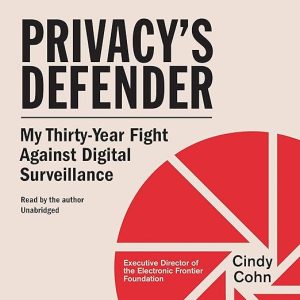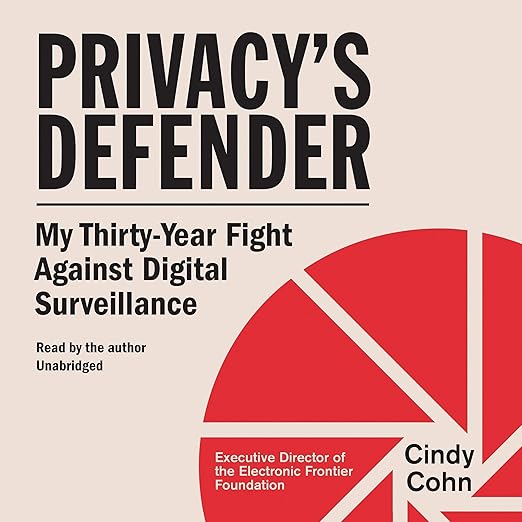
My interest in digital privacy law goes back to a long conversation I had with a cybersecurity attorney about surveillance legislation passed in the post-9/11 years, and the degree to which most people had no idea how much had already been ceded by then. Cindy Cohn's audiobook Privacy's Defender fills in the legal and personal history of how those cessions happened and who fought them, and it does so from the inside: Cohn has been at the Electronic Frontier Foundation for three decades, much of it as Executive Director. This is not outside analysis. This is a primary source, delivered by the person who was in the room for the cases that defined how digital privacy is understood today. The combination of legal memoir and personal chronicle makes this audiobook something that purely institutional histories of the same period cannot replicate.
Cohn structures the audiobook around three key legal battles that defined the digital age: the Crypto Wars of the 1990s, the FBI gag orders that followed, and the post-9/11 surveillance state that expanded government reach into private communications at a scale that has still not been fully reckoned with publicly. Each case is narrated with the kind of detail that comes from someone who was in the room, and the legal complexity is handled with genuine clarity without being simplified beyond the point of accuracy. Cohn's fundamental question, can we still have private conversations if we live our lives online, is not rhetorical. She has spent 30 years building the argument that the answer has to be yes, and she explains with precision exactly what it took to defend that position at each critical juncture.
The book also explicitly challenges what Cohn calls the 'hypermasculine myth' that the digital world was built by a handful of charismatic male founders. Her own story as a legal advocate in the early digital rights movement, and her account of growing the EFF from a 'ragtag group of lawyers and hackers' into one of the most powerful digital rights organizations in the world, is a direct counter-narrative to the origin story the tech industry has preferred to tell about itself. That counter-narrative is one of the book's most valuable contributions beyond the legal history.
Cohn Narrates Herself, Vouching for Her Story
Cohn narrates herself, and the self-narration is a genuine strength. Legal memoirs narrated by their subjects carry a specific kind of authority, the sense of someone vouching for their own account rather than delivering it through an intermediary. Cohn reads with the directness of someone who has spent decades in courtrooms and congressional hearings making complex arguments accessible to non-specialists. She is not performing drama; she is explaining, with the conviction of someone who believes the explanation matters enormously for the listener's understanding of their own digital life.
The personal dimension of the memoir is also genuinely surprising. Cohn weaves into the legal history her own discovery of her birth parents and her meeting of her life partner, both connected serendipitously to the work itself. These threads do not overwhelm the legal argument, but they humanize the cost of three decades of civil liberties work in a way that a purely institutional account would miss. A companion PDF is included with purchase, which provides useful reference material for the legal timeline and case names that feature throughout the narrative. For listeners who want to cross-reference the cases Cohn describes, the PDF makes a meaningful addition to the audio experience.
Personally Involved in Every Case She Covers
This is a book with a clear perspective: Cohn is an advocate, and the audiobook is written from the position of someone who believes digital privacy is a fundamental right rather than a policy preference. Listeners looking for a balanced account of government surveillance arguments will find the presentation weighted, intentionally, toward the civil liberties position. That is not a flaw so much as a feature of memoir-as-argument, but it is worth knowing in advance. Similarly, the legal history is detailed enough to be genuinely informative, but the cases chosen are the ones Cohn was personally involved in, which means some significant adjacent battles receive less attention than they might in a more comprehensive history of digital rights law.
The audiobook covers Cohn's 30-year career at the EFF, which means the timeline is long and the material necessarily selective. Some listeners may want more sustained analysis of specific legislative moments or court decisions, but the memoir format prioritizes the experiential account over comprehensive coverage. With only a single listener rating available, the external reception picture is limited, but the material itself is significant, and Cohn's standing in the field gives the account an authority that is hard to replicate.
One of the audiobook's most striking structural choices is the way Cohn links the personal and the professional without subordinating either. The discovery of her birth parents did not happen despite the work; it happened because of it, through connections made in the course of building the EFF's network of activists and allies. That integration of the personal and the professional is not a rhetorical device; it is a description of how Cohn's life actually unfolded, and it gives the memoir a coherence that books with more cleanly separated personal and professional chapters often lack. In audio, delivered in Cohn's own voice, that coherence feels genuine rather than constructed.
Stronger for Being an Advocate's Account
Anyone who uses the internet and has a stake in understanding how digital privacy rights were fought for and won should find this audiobook directly relevant. Civil liberties advocates, technologists, legal professionals, journalists, and policy listeners will find it essential. Listeners interested in the intersection of law, technology, and power will get one of the more personal and precise accounts of how that intersection was contested over 30 years. Those who want a neutral survey of surveillance policy debates should look elsewhere; this is an advocate's account, and it is stronger for being exactly that. Cohn does not pretend to neutrality she does not have, and the audiobook is more useful for that honesty.
In Brief
- Read by: Cindy Cohn narrates her own 30-year fight for digital privacy with the directness of someone who has spent decades making complex arguments accessible.
- At its heart: Digital privacy rights, civil liberties and surveillance, the EFF's legal battles against government overreach
- Vibe: Urgent and precise, with the authority of a primary source and unexpected personal warmth
- Short version: A first-person account of the legal battles that shaped your digital rights, essential for anyone who thinks privacy matters in the online world.
Good to Know
Is this audiobook accessible to listeners without a legal background?
Yes. Cohn has spent her career making complex digital rights law accessible to non-specialists, and the audiobook benefits from that skill. The legal cases are explained clearly enough that listeners without legal training will follow the argument without difficulty.
Does the audiobook cover recent developments in digital surveillance and privacy law?
The book covers Cohn's 30-year career at the EFF, including the Crypto Wars, post-9/11 surveillance legislation, and FBI gag orders. The timeline extends through her tenure, making it reasonably current, though the most recent legal developments will depend on the publication date.
Is Privacy's Defender an objective history of digital privacy debates or an advocate's audiobook?
Explicitly an advocate's account. Cohn is unambiguous about her position: digital privacy is a fundamental right, and the battles she describes were fights worth having. The account is detailed and legally precise but written from the perspective of someone who chose a side and built her life around defending it.
Does Cindy Cohn narrating this audiobook herself add to the experience?
Significantly. Her self-narration carries the authority of direct testimony, and the personal sections of the memoir, the discovery of her birth parents and the serendipitous meeting of her life partner through EFF work, come through with an authenticity that would be harder to achieve through a third-party narrator.