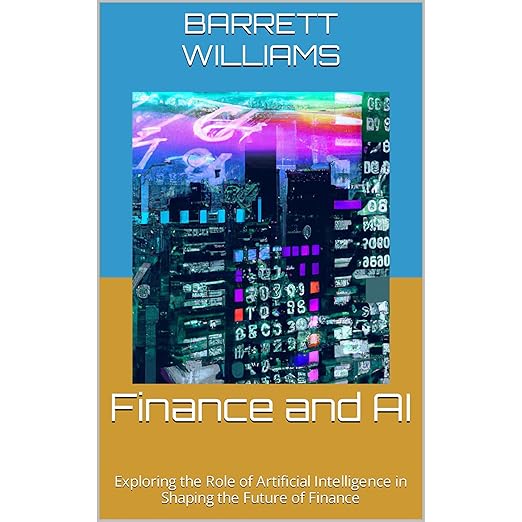
Imagine sitting in an airport lounge before a direct flight somewhere you have never been, and a stranger next to you starts explaining the landscape before you even land. That is approximately the experience of listening to Finance and AI, an audiobook from Barrett Williams that tries to cover a genuinely vast territory in under three hours. It belongs to a genre of brisk overview titles that are increasingly common in the technology and finance space, and its value depends entirely on what the listener brings to it and what they actually need from it. The convergence of artificial intelligence and financial services is one of the defining economic stories of the current decade, and a well-structured introduction to that territory has real value for a specific kind of listener.
Banking Gets the Deepest Coverage in This Survey
Finance and AI is structured as a survey, moving from foundational definitions of artificial intelligence through its applications in banking, investment, insurance, regulatory compliance, and data security, before gesturing toward future trajectories. The chapter organization is logical and the terrain is genuinely interesting: the convergence of algorithmic trading, machine learning in portfolio management, AI-driven fraud detection, and automated underwriting in insurance represents a real transformation that has accelerated faster than most commentary has caught up with. Williams walks through each of these domains accessibly, and for a listener who is new to either finance or artificial intelligence, the survey format delivers reasonable orientation. The book is part of the 'AI Unplugged: Navigating the World of Artificial Intelligence' series, and that context is useful to keep in mind. This is not a deep dive into any single application; it is a map of the broader territory, drawn at a scale appropriate for someone just beginning to navigate it.
The chapter on the intersection of AI and the banking sector is the most practically detailed, covering fraud detection, customer experience automation, and credit scoring models with enough specificity to be useful. The investment and insurance chapters are slightly thinner but cover the essential applications: algorithmic portfolio management, natural language processing of earnings calls, and predictive risk assessment models in underwriting. For a listener with no prior exposure to these applications, the level of detail is appropriate; for someone already working in either field, the treatment will feel abbreviated.
AI Narration Explains AI in Financial Services
The strongest sections of the audiobook are those dealing with the actual mechanisms of AI in financial decision-making: how machine learning models are trained on trading data, how natural language processing is being applied to earnings calls and regulatory filings, and how risk assessment in insurance is being reshaped by predictive modeling. These are areas where the material is genuinely novel enough to reward a listener who has some financial literacy but limited AI background, or vice versa. Williams keeps the explanations accessible without oversimplifying to the point of uselessness, and the short runtime of under three hours means the audiobook is easy to complete in a single commute or workout session.
The narration is handled by Virtual Voice, an AI-generated narrator, which is worth noting directly. The delivery is clean and serviceable for this kind of survey content, without the warmth or interpretive judgment that a skilled human narrator brings to denser material. For a broad-brush overview, the neutrality is largely adequate. The flatness of AI narration becomes more noticeable in passages that call for emphasis or momentum, but for a title of this scope and length, it functions well enough to carry the text through. It is also worth acknowledging a certain irony in having an AI narrator explain how artificial intelligence is reshaping financial decision-making; the medium comments on the subject in ways the author may or may not have intended.
Everything Compressed Into Under Three Hours
The book's ambition to cover everything in under three hours means that almost nothing receives sustained analysis. Practitioners in financial services or AI development will find the coverage too surface-level to be professionally useful. The chapter on regulatory measures, for example, moves so quickly through a genuinely complex landscape that it reads more like a table of contents for a longer discussion than a discussion itself. The concerns around AI and data security, flagged in the synopsis as a significant focus, are similarly compressed: a topic that could sustain an entire book receives a chapter that introduces the problems without resolving them.
At moments the language tilts toward the promotional register that characterizes some self-published business content, with descriptions of the material as 'groundbreaking' or 'exhilarating' in ways that the content itself does not always fully justify. A single listener rating of 3 out of 5 suggests the experience is functional but not particularly memorable. That is probably an accurate calibration: this audiobook does what it promises for its intended audience without exceeding those promises.
Business Students and Curious Generalists Get Value
Beginners in either finance or AI who want a short, structured orientation to the intersection of these two fields will find this audiobook useful. Business students, non-technical managers at financial institutions, and curious generalists who want a map before diving deeper will all get reasonable value from its compact runtime. Finance professionals and AI practitioners looking for analytical depth or current applied research will need to look elsewhere. This audiobook is an introduction, not an investigation, and the listener who gets the most from it will be the one who uses it as a starting point rather than a destination.