At a Glance
- At its heart: programming fundamentals, ethical hacking and network security, first-principles vocabulary for absolute beginners
- Vibe: even and instructional, a topic list read straight through
- Short version: Usable as orientation if you are starting from zero, but you are buying a synthetic reading of a contents page with no listener feedback behind it.
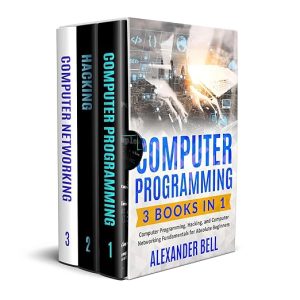
Three beginner manuals stacked into one purchase is a familiar offer on any store page, and this audiobook puts the whole arrangement in its title: programming, hacking, networking, absolute beginners, seven hours and twelve minutes covering all three. Divide the runtime evenly and each subject gets about two hours and twenty-four minutes, roughly one long evening per discipline. Whether that reads as a bargain or as a warning depends entirely on what you expect a fundamentals course to do, and this record gives you unusually little to go on before you commit.
Narrator Field Names No Human Reader
Start with what the description actually is, because it is a table of contents. Under the programming book you get program structure, variable declaration, looping structures, syntax, algorithms, data structures, a hierarchy of programming languages and web programming. Under hacking you get methodology, social engineering, physical security and password cracking. Under networking you get the seven layers of the OSI model, wireless and cellular networks, multimedia transport, network administration and infrastructure management. Every one of those is a topic heading. Not one of them tells you the depth, the language being taught, or whether a single line of code is ever spoken out loud.
Two further things sit on this record that a buyer should see before spending an evening on it. The copy closes by instructing you to click the BUY NOW button at the top of the page, a line lifted from a text listing that means nothing inside an audio file and suggests the description was never adapted for this format. And the narrator field does not name a person at all: it reads Virtual Voice, which is a synthetic reading rather than a hired performance. Add a reception column with nothing in it. One rating stands behind the visible 4.0 and no written verdict exists on this record at all.
Vocabulary and Orientation Before the Territory
A real case exists for it, though narrower than the title implies. A genuine beginner usually needs the map before the territory: what a variable is, why loops exist, what people mean when they say data structure, how a network is layered, what an attacker is actually doing when an attack happens. Hearing those ideas described in plain language, with no editor open and no pressure to type along, is a legitimate way to dissolve the anxiety that stops people starting. Seven hours of vocabulary and orientation can make a first written tutorial far less bewildering, and that is a job this format does well.
The bundling makes more sense here than bundling usually does, too. Programming, networking and security are taught separately and practiced together, and a beginner who learns only one of the three arrives at the others confused about why nothing connects. Whether the file honors that connection is not something the copy commits to anywhere. As for the reading, a synthetic voice has to pronounce acronyms, punctuation and list structure aloud, and this material is little else but acronyms and lists. Run the sample over a passage naming the OSI layers and judge whether seven of them survive as seven without a screen in front of you.
Ethical Hacking Blurs Into Attack Instructions
The hacking material deserves a flag of its own. The contents promise how to stage an attack, practical techniques to crack passwords and how to perform social-engineering attacks, all sitting in the same list as the phrase ethical hacking. Those two framings are not equivalent, and a beginners' bundle is exactly where the distinction gets lost. Audio compounds it: you cannot see a caveat, you cannot skim past a legal note, and nothing in the description mentions consent, scope or written authorization. Treat that middle third as vocabulary about how attacks work, never as instructions you are equipped to follow.
Format is the other structural problem, and it is not a small one. Syntax is visual. Indentation, brackets, semicolons and the shape of a nested loop are information a listener has to rebuild from a spoken description, and no companion document is mentioned anywhere on this listing. Anything the file spells out character by character will cost you rewinds. If you intend to write code rather than think about it, you need a screen, a keyboard and something to check your work against, none of which arrives with the file. The recording can tell you what a loop is. It cannot show you one.
Then the numbers, such as they are. A single rating produced the visible 4.0, which is at least internally coherent, since one vote can only land on a whole star. What it cannot do is inform you. No written verdict describes the level, the accuracy, or whether the three parts repeat each other where they overlap. The record is independently published, dated March 2025, carries no series information and no badges, and the entire public verdict on seven hours of teaching is one unexplained click.
Orientation for Beginners Who Cannot Code Yet
Buy it if you are at the very start and want vocabulary rather than skill: someone who keeps hearing these terms at work, or who has been told to learn a language and cannot yet tell one from another. Buy it if seven hours of plain orientation across three connected fields is worth more to you right now than depth in any single one. It also serves anyone who learns best by hearing a subject described before trying it, a real learning style that most technical publishing serves badly.
Leave it alone if you have written any code at all, if you want a structured course with exercises and feedback, or if you need the security chapters to be rigorous rather than introductory. Leave it alone as well if a synthetic voice grates on you, because seven hours is a long stretch to spend with one. If you do press play, keep a written tutorial open beside it and let the file do the explaining while the page does the showing.
Can this audiobook teach me to write code without a screen?
No, and nothing on the listing claims it can. Spoken syntax loses indentation, brackets and nesting, which is where most beginner errors live, and no companion document is offered. Use it to build vocabulary and intuition, then move to a written tutorial or an editor when you actually want to type something.
What does the Virtual Voice credit mean for this audiobook?
It means the reading is machine generated rather than performed by a hired narrator. Expect consistent pacing and correct words, but little emphasis where emphasis carries meaning, and unpredictable handling of acronyms and code-like fragments. Since nobody has left a written verdict on the file, the sample is your only evidence.
How is the seven hours split across programming, hacking and networking?
The record never says. An even three-way division would leave each subject a little under two and a half hours, but the description lists far more topics under networking than under hacking, so evenness is an assumption rather than anything you can verify before buying. Sample across a section boundary if that matters.