Quick Take
- Narration: Michael Ferraiuolo delivers the dual-POV narrative with distinct voices for Silas and Callisto that are immediately recognizable without resorting to caricature, and his comedic timing matches Winters’ prose closely.
- Themes: found family in a fae court, enemies-to-reluctant-allies-to-more, the weight of secrets between people falling for each other
- Mood: Warm and frequently funny with genuine emotional stakes underneath
- Verdict: Alice Winters at her best: snarky, sweet, and more emotionally resonant than the comedic surface suggests.
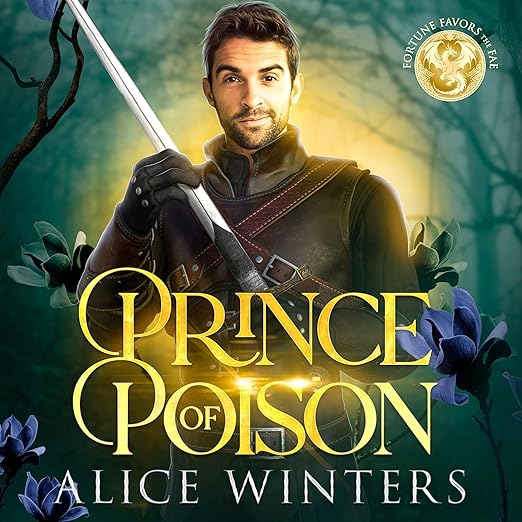
I had not read Alice Winters before picking up Prince of Poison, which means I came to it without the preexisting affection that colors a lot of the reviews here. What I found was something I genuinely did not expect from the fae fantasy subgenre: a book that is actually funny. Not witty-in-the-margins funny, but consistently, genuinely funny in a way that requires precise comic timing and a real understanding of how to let a joke land without undermining the emotional architecture that lives underneath it. Winters has that skill, and Michael Ferraiuolo’s narration captures it.
The setup involves two point-of-view characters: Silas, who catches sight of a fae prince being abducted and gets drawn in, and Callisto, the aforementioned prince, who has the somewhat inconvenient ability to poison anyone he kisses and is trying to figure out what is wrong with the king while also managing his very large, very devoted mount named Dandelion. That Dandelion becomes the book’s emotional anchor, a creature that everyone else finds threatening and that Callisto loves unconditionally, tells you something important about how Winters uses comedy: it is never purely decorative. The running gag about Dandelion is also the emotional throughline that reveals Callisto’s character more effectively than any amount of direct characterization could.
The Comedy That Carries the Weight
Alice Winters has a reputation in the MM romance and fantasy romance space for a writing style described by one reviewer as wonderfully witty, bordering on irreverent, producing exquisite characters with a healthy dose of snark. Prince of Poison delivers on that reputation while doing something slightly more interesting than pure comedy: it uses humor to set up emotional payoffs that a more earnest book could not achieve without strain. Callisto’s backstory, revealed in pieces as the narrative progresses, is genuinely affecting. The way Winters times these revelations, dropping them into comedic sequences where they land harder than they would in a straightforward dramatic scene, is a craft choice worth noticing.
Silas is the snarky, protective counterpart to Callisto’s sweetness, and the dual-POV format gives the book its central pleasure: watching both characters misread each other’s intentions in exactly the same direction. Silas believes Callisto should fear him and keeps his distance to protect Callisto from what he is. Callisto finds Silas inexplicably compelling and cannot understand the distance. The reader, seeing both sides, knows before either character does how this resolves, but Winters manages the dramatic irony without making the delay feel artificial.
Michael Ferraiuolo and Nine Hours in a Fae Court
At nearly ten hours, Prince of Poison is a substantial listen for what reviewers consistently describe as a feel-good book. The length works because Ferraiuolo is consistently engaging and because Winters builds enough plot, there is a deteriorating king, a destabilizing court, an attack on the royal family, and a coin of suspicious provenance, to give the romance something to develop against. Several reviewers note that the audio performance is specifically excellent, with one describing the narration as superb and singling it out as a reason to return to the series.
One reviewer noted that the first half is funnier and more engaging than the second, which stalls a little and tips toward the more ridiculous. This is a fair observation. The book’s back half, where the plot mechanics require more attention, does sacrifice some of the easy comedic energy of the opening. The ending lands well regardless, and the emotional payoff for both relationships justifies the slightly uneven pace in the middle.
The Standalone Commitment and What It Delivers
Prince of Poison is marketed as a standalone title in a series where books can be enjoyed in any order, which is a promise that Winters keeps. The world is established efficiently without the info-dump tendencies of many fantasy series openers, the romantic arc is complete, and the major questions are answered by the end of the nine hours. The supporting cast, particularly the animal-communicating companion Silas brings along, is well-drawn enough to want more of without the book requiring a sequel to feel finished.
The 4.6 rating across nearly a thousand listeners reflects a book that found its audience accurately. Readers who came for Alice Winters’ signature blend of humor and heart found it. The question for a potential new listener is whether that combination, warm fantasy, genuine comedy, and a romance between two characters carrying secrets that make their connection complicated, sounds like something they want from nine hours of audio. If the answer is yes, the execution here is reliable.
Who Should Listen and Who Should Skip
Listen to this if you enjoy MM romance or fantasy romance that is genuinely funny without sacrificing emotional depth, or if you want a standalone fantasy with a complete romantic arc and no cliffhangers. It is a strong entry point to Alice Winters’ work. Skip it if you want high-tension political fantasy where the stakes feel genuinely dangerous, or if the fae court setting combined with comedy-forward romance is not a combination that appeals to you.
Frequently Asked Questions
Is Prince of Poison the best entry point to Alice Winters’ work, or should new readers start elsewhere?
It works well as an entry point. It is a standalone, which removes the continuity commitment of series reading, and it demonstrates Winters’ comedic voice and emotional range clearly. Readers who respond well to it will have no trouble identifying which of her series to try next.
How prominent is the romance relative to the fantasy plot in Prince of Poison?
The romance is the primary arc, with the court intrigue and the mystery surrounding the king serving as the context in which the relationship develops rather than as equally weighted narratives. Listeners who want approximately equal weight given to fantasy world-building and romance may find the balance tilts somewhat toward the latter, especially in the second half.
Does Michael Ferraiuolo’s narration handle the comedic timing of Winters’ prose effectively?
Yes, and this is a genuine achievement. Winters’ humor depends on specific timing, particularly in Callisto’s POV sections where deadpan observation is doing most of the work. Ferraiuolo finds the right delivery consistently, which is why multiple reviewers single out the audio performance specifically as a reason to recommend the audiobook over the print edition.
Is Prince of Poison appropriate for readers who are new to the MM fantasy romance subgenre?
Yes. The romance is central but not explicit in ways that would be disorienting to readers new to the subgenre, and the fantasy world is accessible without requiring familiarity with genre conventions. The warmth and humor of the book make it a friendly entry point for readers exploring this corner of fantasy romance for the first time.