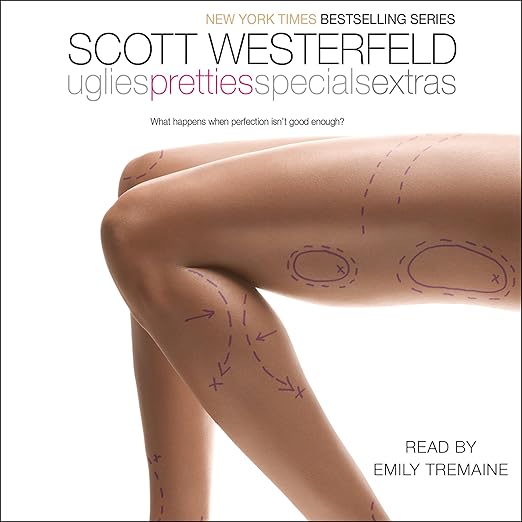
- Read by: Emily Tremaine's only other credit in this catalog sits in an unrelated genre, so carrying Tally through a real shift in memory and mindset here is best judged fresh, on this book's own terms.
- At its heart: enforced beauty conformity, memory and identity, rebellion against a surveillance state
- Vibe: Glossy and unsettling, party-bright on the surface with real dread underneath
- Short version: Sequel loyalty pays off for Uglies fans continuing the story; newcomers should start with book one instead.
Tally Youngblood got everything she wanted at the end of the first Uglies audiobook: perfect looks, a hot boyfriend, and full membership in the endless party that is being pretty. Pretties opens with her enjoying every bit of it, right up until a message from her own past arrives and ruins the fun.
Where This One Lands
Scott Westerfeld's Uglies series continues here as its second installment, and reviewers are direct that it picks up immediately where the first book left off: Tally and her friend Shay have both been transformed into pretties, living an outlandishly fun, nonstop-party lifestyle while nagging doubts about what they left behind keep surfacing. The dystopian premise, a society that surgically resolves social conflict by making everyone beautiful at a set age, gets a second book's worth of room to complicate itself here. The synopsis calls the original series a global phenomenon that started the dystopian trend and a New York Times bestseller, credentials worth knowing given how many imitators the genre has produced since. At nine hours and twenty-one minutes, the audiobook gives the sequel enough room to develop both the party-lifestyle world-building and the darker turn the plot eventually takes.
One detail sets this listing apart: a fifth review is written entirely in Italian, rating the book two stars and expressing disappointment that the story felt like reading another Hunger Games, adding that beyond the hoverboards, the reviewer did not see much inventiveness or imagination on display. That review is genuine evidence of the series reaching an international audience, even if the language barrier means most English-language shoppers cannot weigh it directly against the four English reviews sitting alongside it. A different reviewer adds texture the synopsis itself never spells out: Tally and Shay fall in with a clique called the Crims, pretties focused on staying "bubbly," meaning genuinely clear-thinking, who chase dangerous stunts for the thrill alone, giving the synopsis's vague nagging sense that something's wrong a much more specific, story-level shape.
Why Listen to Pretties
Emily Tremaine narrates, and this catalog holds exactly one other credit on file under that name, in a completely different genre with nothing in common with YA dystopian fiction. That means this performance is best assessed fresh rather than through an imported reputation: the specific technical demand here is carrying Tally through a genuinely altered mental state, since the synopsis describes her forgetting what mattered before she became pretty and only gradually remembering it once an old message arrives, a shift that has to register in performance without becoming a gimmick. Getting that balance right matters more here than in a book with a more conventional emotional arc, since the character a listener meets in the opening chapters is meant to feel subtly, unsettlingly different from the one who eventually resurfaces once the old message does its work.
Invented slang draws a divided reaction across the reviews: one reader specifically notes that terms like "bubbly" and "bogus" have visibly annoyed other readers, even while admitting to personally not minding the terms at all. That kind of divided reaction to invented vocabulary is worth knowing before starting, regardless of who is narrating it.
What to Watch For in Pretties
Children's audiobooks is the genre tag on this listing, though the content, forced beauty conformity, a surveillance state, and authorities willing to kill to protect their secrets, reads considerably older than that shelf placement suggests. Parents relying on the tag alone to gauge age-appropriateness should look closer at the actual synopsis first. The premise itself doubles as a pointed critique of appearance-based social conformity, a theme that reads as sharper and more relevant to teenagers navigating real social pressure than the shelf placement alone would suggest.
This listing's 4.4 rating rests on just three counted votes, a total no whole-star rounding scheme can turn into that exact figure, and it falls two short of the five reviews actually readable on the page. One of those five reviews is the Italian-language one discussed above, meaning only four are directly legible to an English-speaking shopper deciding whether to buy. That still leaves three enthusiastic five-star reviews and one four-star review among the English-language responses, a noticeably warmer reception than the disappointed international reader recorded above.
Who Should Listen to Pretties
Fans who finished Uglies and want to continue Tally's story immediately after are the obvious audience here; reviewers describe the second book picking up mere weeks after the first ends, with essentially no recap for anyone arriving without that context. Readers of dystopian YA more broadly, and anyone curious how a society built entirely around enforced beauty starts to crack from the inside, will find plenty to engage with too. One reviewer sums up that broader devotion plainly, describing being obsessed with the entire series after loving this specific installment's storyline, exactly the kind of momentum a strong middle volume needs to keep a long series alive.
Sequel skeptics who found Uglies merely fine should know that at least one reviewer here explicitly ranks this installment as a well-crafted improvement on the first book, for whatever that endorsement is worth against the counter-evidence of one disappointed international reader. Readers bothered by invented slang should expect that same friction to continue, since nothing about the audio format changes vocabulary choices already made on the page. Listeners choosing between a print and audio copy of this specific installment should weigh the slang question directly: hearing invented words like "bubbly" and "bogus" spoken aloud may land differently, better or worse, than encountering them silently on a page.