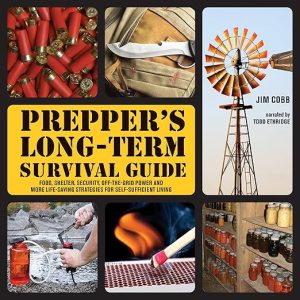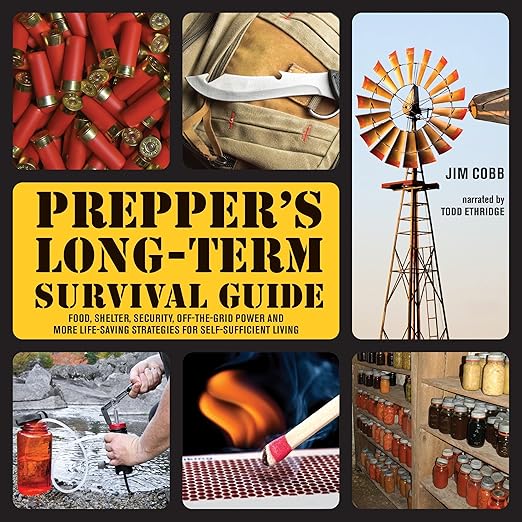
Jim Cobb's Prepper's Long-Term Survival Guide fills a specific gap in the preparedness genre that most mainstream emergency planning resources leave completely unaddressed: what happens when normalcy does not return? Government emergency pamphlets and standard disaster guides are built around the assumption that disruption is temporary, that the grid comes back, services resume, and social infrastructure holds. Cobb, narrated here by Todd Ethridge, writes from a different assumption entirely. This audiobook is for the scenario where nothing returns to normal for weeks, months, or even years.
That distinction shapes every chapter. The difference between a seventy-two-hour emergency kit and genuine long-term survival preparation is not a matter of scale. It is a matter of entirely different categories of knowledge and skill. Cobb addresses five core domains: water collection for drinking and hygiene, food through storage, growing, hunting, and foraging, first aid and medical care without professional resources, home fortification and defense, and community building as a survival strategy. Each of these deserves a separate book, and Cobb knows that. The guide's five-hour runtime makes it a framework and orientation rather than a comprehensive manual, which is both its practical limitation and its intentional design.
What distinguishes Cobb from the more sensationalist corners of prepper culture is his consistent non-preachy tone. He is not selling fear or ideology. He is a lifelong preparedness practitioner writing a practical guide that he explicitly designs to be accessible to readers who have never thought about these topics before. One reviewer described the approach as practical and non-preachy, covering a lot of ground in simple language, and that description is accurate. A separate reviewer came to the book as a complete newcomer to preparedness thinking, prompted by retirement planning rather than apocalyptic anxiety, and found it immediately applicable to their actual situation.
The community-building chapter is arguably the most important and least expected section of the guide. Individual household preparedness, Cobb argues, will not be sufficient in a genuinely prolonged crisis. The social infrastructure for collective support, mutual aid, skill sharing, and organized defense is not a soft addition to survival preparation but a core survival strategy. This insight, delivered matter-of-factly rather than as a political or ideological position, is the kind of grounded realism that elevates Cobb's work above the individualist survivalism that dominates much of the preparedness genre.
Ethridge's Serious Tone, Best for the Conceptual Chapters
Todd Ethridge's narration is well-matched to the material. He reads Cobb's direct, practical prose with appropriate seriousness but without the apocalyptic gravity that would make this feel like a thriller rather than a reference guide. The pacing supports the instructional nature of the content, giving listeners time to absorb specific recommendations before moving on to the next category. At just over five hours, this is not a long listen by audiobook standards, which has both advantages and limitations for a guide of this scope.
The audio format works particularly well for the conceptual and strategic sections: the discussion of crisis psychology, the community dynamics of resource scarcity, and the principles underlying home security assessment. These are analytical frameworks that benefit from narrative presentation rather than list format. The specific technical instructions, precise water filtration ratios, seed storage specifications, wound care protocols, are harder to retain from audio alone and would benefit from note-taking or referencing a written companion version. Listeners who take notes while listening will get considerably more practical utility from the guide than those who listen passively.
Assumes a Yard, and Demands Real Follow-Through
Cobb notes, and one reviewer echoed, that some recommendations assume a house or property context rather than an apartment or urban living situation. Listeners in dense urban environments will find several chapters significantly more applicable in principle than in direct practice. The water collection and food growing sections, in particular, presuppose access to outdoor space that urban residents may not have. Cobb addresses this honestly rather than pretending universality, which is admirable, and has written other books specifically addressing urban preparedness situations for listeners who need that framework instead.
This is also a guide that requires follow-through. Listening to five hours of preparation strategy without taking any action leaves you exactly where you started. Cobb structures the content to be immediately actionable, identifying first steps and priority sequencing throughout. The most effective use of this audiobook is as a planning session: listen to each section, pause, and identify what you would actually do given your specific housing situation, geographic location, household composition, and available resources. The guide gives you the framework; the implementation is yours to do.
Beyond the Seventy-Two-Hour Kit, for Homeowners Especially
This audiobook is for anyone who has thought seriously about household resilience and disaster preparedness but wants a practical, non-ideological framework rather than a political survival manifesto. It is particularly well-suited to homeowners or those with outdoor access who can implement the food production and water collection recommendations directly. The non-preachy approach makes it accessible to listeners who might be put off by the more zealous corners of prepper culture, and the straightforward writing style makes it equally readable for complete newcomers and people who already have basic emergency kits but want to think beyond the seventy-two-hour horizon.
Urban apartment dwellers and those with limited outdoor access should read this as a conceptual framework rather than a step-by-step practical guide, and should seek out urban-specific preparedness resources to supplement. At 4.5 stars across a limited but consistent set of reviews, the response from listeners reflects genuine appreciation for Cobb's grounded, practical approach to a subject that too easily tips into either complacency or catastrophism.