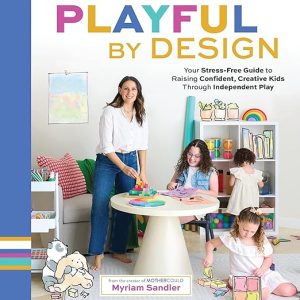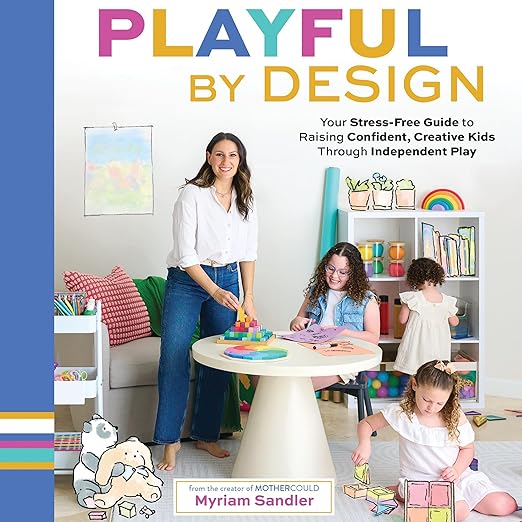
Playful by Design opens with a question that most parents answer by adding more toys: what if the problem with bored, clingy children is not a shortage of playthings but an overabundance of them, arranged in ways that prevent real engagement? Myriam Sandler, founder of the Mothercould platform, built her audience on exactly this insight, and this audiobook delivers her system in under three hours. Sandler narrates her own book, and the result is something like listening to a very organized friend explain what she actually did rather than what sounds theoretically correct. The self-narration is not incidental here. It makes the advice feel tested rather than aspirational.
Fewer Toys, Rotated and Organized by Type
The core argument is not complicated, but Sandler earns it through the specificity of implementation. Fewer toys, rotated thoughtfully and organized by type rather than by room or owner, create the conditions for deeper, more self-directed play. Children engage more fully with a curated selection than they do when surrounded by visual and physical noise. Sandler supports this with practical observation rather than academic citation, which keeps the audiobook accessible but means listeners looking for pediatric developmental research will need to supplement elsewhere.
What Sandler offers instead is the operational layer that most organizing books skip entirely. She covers how to plan play spaces room by room, how to declutter without battles, how to build a toy rotation system that does not require constant parental management, and how to maintain the whole structure without letting it collapse in six weeks. For anyone who has implemented an organizational system only to watch it deteriorate within a month, that maintenance chapter carries real value. The guidance is age-group specific, which matters when a household contains children at very different developmental stages. A toddler's play needs and an early-elementary child's needs require different organizational logic, and Sandler acknowledges both without conflating them.
Sandler Narrates a Compact Workshop, PDF Included
Self-narration is a gamble. Authors are not always performers, and the enthusiasm that makes someone qualified to write a parenting guide does not automatically translate into listenable pacing. Sandler is a natural exception. Her delivery is quick without feeling rushed, and she handles the practical lists and step-by-step instructions in a tone that feels conversational rather than clinical. At under three hours, this audiobook functions as a single-sitting listen, which is practical for parents who rarely find longer uninterrupted windows. The brevity is a feature rather than a limitation. Sandler is direct enough to cover her framework completely without repetition, and the result feels finished at its length rather than abbreviated.
Listeners should note that a companion PDF is available as a download alongside the audiobook. The PDF contains reference materials mentioned during the book, and while Sandler's verbal descriptions are clear enough that the audio works on its own, the visual aids in the PDF add a useful layer for anyone implementing the room-by-room setup sections. Think of the combination as a compact workshop: the audio teaches the principles and the reasoning, the PDF provides the reference material you return to during actual implementation. Together they function as a fairly complete course in intentional play-space design.
Specific Praise Signals an Operational Framework
The reviews for this book are almost uniformly enthusiastic, with parents describing it as something every family should have. What makes that enthusiasm credible rather than generic is how specific the praise is. Reviewers describe implementing particular elements, running activities with toddlers, and reporting that the system actually works in practice. That specificity of outcome is the best evidence that Sandler's framework is operational rather than aspirational.
Built for Preschool and Early-Elementary Households
The book is oriented primarily toward families with younger children. The toy rotation system and the play-space design principles work best for the preschool through early-elementary range. Sandler acknowledges that specifics shift with age, but parents of older children or households where screen-based play is dominant will find the framework requires meaningful adaptation. The assumption throughout is that physical play environments are the primary arena of childhood boredom and engagement, which is accurate for many families but not universal. Parents dealing primarily with older children navigating digital play will find the organizational principles transferable but the specific guidance less directly applicable.
This is an organizing and play-space design guide. It is not a book about child psychology, developmental science, or parenting philosophy in the broader sense. Within its defined and honest scope, it delivers. Readers who arrived expecting a comprehensive approach to independent play as a developmental philosophy rather than a home-organization framework may feel the scope is narrower than they hoped. Sandler is clear about what the book is, and matching expectation to that definition is the primary condition for satisfaction with the audiobook.
Relief for Parents Overwhelmed by Toy Clutter
Parents of young children who feel perpetually overwhelmed by toy clutter and the cycle of purchasing new things only to watch children ignore them within a week will find direct and practical help here. The audiobook works particularly well for parents who are already sold on the concept of minimizing and rotating but have not found a system with enough operational specificity to implement successfully. Families in small spaces where every object in the environment needs to earn its presence will find the space-planning guidance immediately applicable. Listeners who prefer parenting books grounded in formal developmental psychology, or those whose children are primarily older, may want to supplement with additional resources to address what falls outside this book's focused scope.
The Short Version
- Read by: Myriam Sandler reads her own book with the warm, practical energy of someone who has actually lived this system, giving the advice a natural and trustworthy quality rather than the detached tone of a hired narrator.
- At its heart: Intentional toy curation, independent play environments, reducing parental overwhelm through design
- Vibe: Practical and encouraging, organized for implementation
- Short version: Parents drowning in toy clutter who want a structured, room-by-room approach to reclaiming their space will find this short audiobook genuinely actionable rather than theoretically inspiring.