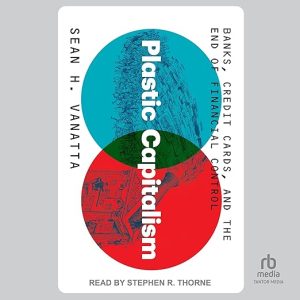
I started listening to Plastic Capitalism on a Sunday afternoon after checking my credit card statement, which was probably the most appropriate possible way to encounter this book. Sean H. Vanatta's history of the credit card industry is the kind of work that reframes something so familiar it had stopped registering, the fact of American consumer debt, as something that was designed rather than inevitable, chosen rather than discovered.
The book comes with no reader reviews at the time of this writing, which makes it genuinely difficult to triangulate against an established response. What the synopsis offers is an argument, and it is a serious one: that the indebted American household is not a product of consumer irresponsibility or cultural attitudes toward credit, but of specific decisions made by specific bankers at specific moments, aided by regulatory environments they actively worked to shape.
Citibank's 1980 Move Becomes the Book's Hinge
Vanatta's argument traces from the postwar period, when state and federal regulations kept banking relatively conservative and credit relatively affordable, through the 1960s, when banks began experimenting with mass credit card mailings to build a debt industry from scratch, through the consumer protection movements of the 1970s, and finally to the pivotal moment in 1980 when Citibank relocated its credit card operations to South Dakota and Delaware, states with the weakest consumer protection laws. This last move is the book's hinge: once banks could offer credit under the weakest state's rules regardless of where the borrower lived, the regulatory protections that consumers had fought for in the 1970s became effectively unenforceable.
The detail that a single institution's decision, Citibank's relocation, reshaped the consumer credit landscape for all American households is the kind of specific historical leverage point that makes this genre of institutional history so effective. You are not reading about abstract forces but about bankers sitting in rooms making decisions that would affect the financial lives of hundreds of millions of people for generations.
Thorne's Measured Delivery Suits Complex Regulatory History
Stephen R. Thorne is a reliable narrator for demanding nonfiction, and the sixteen-hour-and-thirty-six-minute runtime suggests Vanatta has not cut corners on the research. Tantor Audio consistently delivers clean production, and Thorne's measured delivery suits the material. This is not a book that benefits from dramatic narration. It benefits from clear, precise presentation of a complex regulatory and financial history, and that is what Thorne provides.
The absence of reader reviews creates an uncertainty that is worth naming. The book was published in May 2024, which means a relatively small audience has had the chance to engage with it. The academic pedigree appears strong and the argument, as presented in the synopsis, is coherent and specific rather than tendentious. This looks like serious history writing rather than popular polemic.
Protection Won, Then Undermined by a Loophole
The book's most important contribution may be its documentation of the 1970s consumer protection period, when Americans did successfully fight back against exploitative credit terms and achieved real regulatory wins, before those wins were circumvented by the South Dakota and Delaware loophole. This arc, protection won and then undermined through regulatory arbitrage, is a story that applies far beyond credit cards and should be useful for anyone thinking about how financial regulation works and fails.
Listeners should be prepared for a genuinely technical book. The regulatory detail is the point, not the backdrop. This is not a narrative-driven investigation in the Michael Lewis mode but an academic history written for a serious general audience that is comfortable with policy and institutional analysis.
Glass House and Crashed Readers Find Common Ground
This is the right audiobook for listeners who want to understand the structural origins of American consumer debt, for anyone interested in how banking regulation works and how it fails, and for readers who enjoyed books like Glass House by Brian Alexander or Crashed by Adam Tooze. It is not light listening and it is not designed to be. If you carry credit card debt and have ever wondered how the system came to be designed exactly this way, this book has a specific and well-researched answer. Strongly recommended for economically and politically engaged listeners.
At a Glance
- Voice: Stephen R. Thorne narrates with the methodical clarity this academic history requires, making the regulatory and banking detail accessible without oversimplifying.
- Big ideas: Credit card industry origins, regulatory capture, consumer debt as systemic design
- Atmosphere: Dense and illuminating, with the quiet anger of well-documented structural critique
- Worth it?: An authoritative and properly enraging history of how American consumer debt was deliberately manufactured and why no one stopped it.