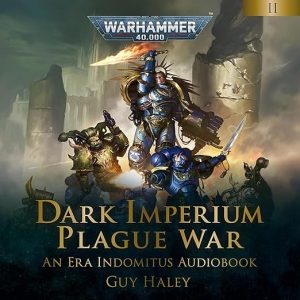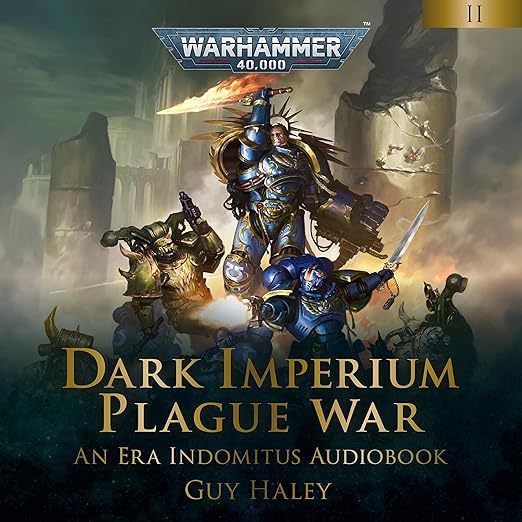
I have been reading in the Warhammer 40,000 fiction space long enough to know that most novels in the line function as extended combat sequences with world-building gloss. Plague War is something different. I picked it up because the first Dark Imperium volume had surprised me, and this second entry in the trilogy manages the difficult trick of being both a satisfying battlefield narrative and a serious meditation on the ideological tension that has sat at the heart of the 40K setting since Rogue Trader. I listened through the last third on a late night after everyone else in the house had gone to sleep, and I was not checking the time.
The plot summary is relatively simple on its surface. The primarch Roboute Guilliman, regent of a reconstituted Imperium, continues his war to drive Mortarion and his Death Guard Traitor Legion from Greater Ultramar. The two brothers eventually meet on the diseased plains of Parmenio in a confrontation that serves as the book's climax. But the actual story Haley is telling is not about territory. It is about what happens to a committed rationalist when miracles start occurring on his behalf.
Guilliman is, within the 40K canon, the primarch most deeply associated with the Emperor's original rationalist vision, what the lore calls the Imperial Truth. He built Ultramar as a model of secular governance and military competence. He wrote the Codex Astartes. He is, by disposition and by design, the champion of reason over superstition.
The problem, which Haley explores with more care than most authors in this space attempt, is that Guilliman has returned to a galaxy where the Emperor's project of exterminating religion has not only failed but has been catastrophically reversed. The Imperium is now governed by a fanatical church in the Emperor's name. And worse, miraculous interventions keep happening around Guilliman in ways he cannot explain within his framework. One of the reviewers captures the precise appeal of this thread: it revisits one of the Horus Heresy's most resonant unresolved tensions, whether the Emperor lost, and the religious fanatics won, or whether the truth of the setting was always more complicated than the Imperial Truth acknowledged. Haley does not resolve this. But he makes Guilliman's discomfort with it vivid and specific.
Why Plague War Works as an Audiobook
What gives the primarch confrontation its weight is that Mortarion is not simply the villain. He is Guilliman's ideological inverse, a being who once shared something of the Emperor's skepticism and was corrupted into becoming the champion of Nurgle, the Chaos god of decay and entropy. The conversation between these two brothers, when it finally comes, works because both figures are carrying the weight of what the galaxy has become and both know that neither the old Imperial Truth nor the worship of Chaos offers a satisfying account of what they are living through.
A reviewer notes that Guilliman was most interesting in this novel, particularly his struggle with faith and forces that exist outside his knowledge of science. That is precisely right. Haley keeps a healthy tension between these two positions rather than resolving it into a simple answer, which is what most 40K fiction does not bother to do.
Weak Spots in Plague War
The Warhammer audiobook line has an established stable of narrators, and Banks is one of the most reliable of them. His voice carries the appropriate weight for primarch-scale events without tipping into parody, which is a real danger in a setting that runs on baroque excess. The differentiation between Guilliman's measured authority, Mortarion's corroded contempt, and the various Space Marine and human supporting characters is handled cleanly. At twelve hours, the pacing is appropriately dense for the material.
The one criticism in the reviews, that some sections over-explain in ways that slow the momentum, is fair. Haley is working with a fan base that ranges from deep lore veterans to relative newcomers, and the explanatory passages sometimes serve the latter at the expense of the former. Banks handles even these passages with competent pacing, but they are the moments where the novel feels most like a licensed property doing maintenance work rather than a story moving under its own momentum.
Should You Listen to Plague War?
This is not a starting point. Dark Imperium, the first volume of the trilogy, is required reading. Listeners who arrive without that context will be immediately lost in the political geography of the Plague Wars, the relationships between characters, and the significance of specific theological and historical references. For those who have done the work, Plague War offers one of the more intellectually serious entries in recent Warhammer 40,000 fiction, one that uses the setting's mythology as a genuine frame for questions about rationalism, faith, and what it costs to maintain an ideology in a universe that refuses to cooperate with it.
Does Plague War work as a standalone audiobook or do you need to have listened to Dark Imperium first?
You need Dark Imperium first. Plague War picks up directly from the events of the first volume and assumes familiarity with its characters, conflicts, and the political situation in Greater Ultramar. New listeners will be lost almost immediately without that foundation.
How does John Banks handle the primarch characters compared to the human characters in his narration?
Banks gives the primarchs a deliberate weight and cadence that distinguishes them from the human cast without making them sound cartoonishly different. Guilliman in particular benefits from this approach; his rational precision comes through in Banks's measured delivery in a way that makes his ideological disorientation throughout the novel feel genuinely unsettling.